中文简体
 русский
 Français
 Español
 Deutsch
 عربى

Holiday communication has become faster, more convenient, and more crowded than ever. A seasonal message can be sent in seconds through a social platform, email service, or mobile application. Digital greetings are useful, but their speed can also make them feel temporary. A notification appears, is opened, and quickly disappears beneath the next message. A handwritten greeting card creates a different kind of experience. It asks the sender to pause, choose words, hold a pen, and make a physical gesture toward another person.
The New Christmas Handwritten Greeting Card is designed around that meaningful difference. It is not a card filled with machine-printed sentiment that leaves little space for personal expression. It is a blank card supplied with a matching envelope, allowing the sender to write a memory, wish, thank-you message, or simple note of affection by hand. The finished result is personal because the message comes directly from the sender rather than from a template or automated system.
For retailers, gift brands, stationery stores, seasonal shops, and organizations seeking a more thoughtful paper product, this greeting card offers a combination of emotional value, material quality, and responsible production. Its smooth, thick cardstock provides a substantial writing surface, while its natural finish avoids the highly reflective appearance associated with many glossy cards. The matching envelope includes recycled content, and vegetable-based inks support a more considered approach to paper goods.
Behind the product is Yiwu Magic Tree Gift Bag Co., Ltd., a paper packaging manufacturer with experience across greeting cards, gift bags, gift boxes, and patterned wrapping paper. The company’s wider production capabilities include design and prepress, printing, laminating, hot stamping, creasing, bag making, and manual finishing. That combination allows a greeting card to be developed within an integrated paper-production system rather than through a disconnected chain of suppliers.
This article examines the product’s purpose, physical characteristics, competitive advantages, manufacturing process, sustainability considerations, and commercial potential. It also explains why a simple blank card can be a strong product for a market that increasingly values authenticity, tactile quality, and more responsible materials.

New Christmas Handwritten Greeting Card
The Product at a Glance
The New Christmas Handwritten Greeting Card is a seasonal greeting card intended for handwritten communication. Its interior is blank, giving the purchaser complete control over the message. It comes with one matching envelope, creating a ready-to-use set for personal correspondence, gifting, customer appreciation, or holiday retail display.
The card is made from smooth, thick cardstock with a natural finish. This construction gives the product a firmer feel than lightweight promotional paper and provides an even surface for handwriting. The natural finish also avoids an overly shiny appearance. This is important because handwriting is easiest to appreciate when the paper feels calm, tactile, and visually restrained.
The envelope uses recycled content, adding an environmental consideration without changing the traditional character of the product. Vegetable-based inks are used for printing, supporting the product’s positioning as a paper item that minimizes unnecessary plastic-like visual and material effects. The card does not rely on a plastic coating to create its appeal. Instead, it uses paper weight, texture, print quality, and the human message as its main sources of value.
The card is intentionally simple. It does not try to replace the sender’s voice with a long printed greeting. Its purpose is to provide a well-made foundation for a personal note. That simplicity broadens its use. The same card can carry a formal holiday greeting, a warm family message, a short expression of gratitude, or a private memory between close friends.
For wholesale buyers, this flexible use can make the product suitable for different channels. It may be sold as an individual card, included with a seasonal gift, offered as part of a stationery collection, or used by a business communicating with customers and partners. The product can function as both a retail item and a supporting component in a broader packaging or gifting program.
Why Handwritten Communication Has Lasting Value
Handwriting creates visible evidence of effort. The reader can see that the sender did more than select a digital icon or click a standard message. The words may be brief, but the act of writing gives them a physical presence. Differences in pressure, spacing, letter shape, and ink flow make each card distinct. These characteristics cannot be reproduced exactly by a mass-generated digital greeting.
A handwritten note also has a slower rhythm. The recipient usually reads it at a different pace from a digital notification. The card can be placed on a desk, shelf, mantel, or refrigerator. It may remain visible for days or weeks, turning a seasonal message into a small part of the recipient’s surroundings. In some cases, it may be stored in a box and revisited years later.
The blank interior is central to this value. A fully printed card tells the sender what the card is supposed to say. A blank card leaves room for the relationship between sender and recipient. A message can refer to a shared event, a family tradition, a difficult year, a new beginning, or an ordinary moment that deserves recognition. The product does not impose one emotional tone.
This flexibility gives the card an advantage over highly standardized greeting products. A printed message may be attractive but unsuitable for a particular relationship. By contrast, a blank interior allows the purchaser to make the card appropriate for a parent, customer, colleague, friend, teacher, neighbor, or business partner. The emotional meaning comes from the written content.
The card can also support more intentional gifting. A gift bag or gift box presents the outside of a present, while a handwritten card explains the feeling behind it. When combined with wrapping paper and a carefully selected gift, the card becomes part of a complete presentation. Its physical presence reinforces the idea that the gift was considered rather than simply ordered and delivered.
Material Quality and the Writing Experience
Thick Cardstock for a Substantial Feel
Paper weight influences a recipient’s first impression. A thin sheet can feel disposable, particularly when it is used as a greeting card intended to be kept. Smooth, thick cardstock gives the New Christmas Handwritten Greeting Card greater structure and a more substantial hand feel. It resists the limpness associated with ordinary office paper and helps the card remain presentable after handling.
Firm cardstock also supports the card during writing. The sender can write without the material collapsing easily beneath the hand. This is useful when a person writes at a desk, on a table, or while preparing several cards at the same time. The stable surface makes the task feel more deliberate and helps the finished message appear neat and considered.
A Natural Finish Rather Than Excessive Shine
The product uses a natural finish instead of a glossy plastic-like coating. This choice affects both appearance and touch. A non-shiny surface reduces glare under indoor lighting and allows the printed artwork to retain a quieter, more refined character. It also preserves the paper’s tactile identity.
Glossy cards can be visually bright, but their reflective surfaces are not always ideal for handwriting. Depending on the pen, ink may dry differently or remain more noticeable on the surface. A natural finish is better aligned with the purpose of this product because it emphasizes the written message and the physical quality of the stock.
The restrained finish can also appeal to buyers who prefer sustainable-looking paper products. A card does not need a heavy coating, metallic appearance, or complex surface treatment to feel special. In this design, quality is communicated through thickness, smoothness, print control, and the space reserved for the sender’s own words.
A Matching Envelope for a Complete Set
The included envelope makes the product immediately usable. The buyer does not need to search for a separate envelope with a suitable size, color, or appearance. A coordinated card-and-envelope set also produces a more polished result when presented in a shop or included with a gift.
The envelope protects the card during storage and delivery. It also creates a small moment of anticipation for the recipient. Opening an envelope is different from receiving a message in an application. The action involves touch, movement, and a physical reveal. These details contribute to the emotional character of the product.
Because the envelope uses recycled content, the complete set reflects a more responsible material approach. The recycled component does not remove the traditional function of the envelope; it simply introduces a different material choice into a familiar format.

Advantages Over Standard Mass-Printed Greeting Cards
Many greeting cards depend heavily on prewritten messages, decorative effects, or complex finishing. Those features can be attractive, but they may also make the product feel interchangeable. The New Christmas Handwritten Greeting Card takes a different position by making personal writing the principal feature.
Personalization Without Complex Customization
Some personalized paper products require a customer to submit names, dates, or messages before production. That model can be useful, but it may involve longer lead times, minimum quantities, and additional approval steps. A blank handwritten card offers personalization at the moment of use. The retailer can stock a versatile product, and the final message is created by the purchaser.
This approach reduces the risk that a printed sentiment will fail to suit the buyer’s needs. One card can be used for many relationships and circumstances. The flexibility is built into the blank interior rather than added through a complex ordering process.
A More Authentic Alternative to Automated Messages
Digital communication tools make it easy to send large numbers of seasonal greetings. However, automation can weaken the impression of sincerity when recipients recognize that the same message has been sent to many people. A handwritten card communicates individual attention. Even a short message can feel more meaningful because it requires direct participation.
The product is therefore positioned not only as stationery but also as an alternative to impersonal communication. It gives brands and consumers a tangible way to express appreciation. For a business, a handwritten card can make a customer thank-you or holiday greeting feel less like a routine marketing action. For an individual, it can restore warmth to a seasonal tradition.
Material Restraint Compared with Over-Processed Cards
Some greeting cards use multiple coatings, plastic films, glitter effects, or elaborate attachments. These elements may create immediate visual impact, but they can also increase material complexity and make the card feel less aligned with responsible consumption. The New Christmas Handwritten Greeting Card relies on thick paper, a natural finish, recycled-content envelope material, and vegetable-based inks.
This restrained construction can be an advantage for retailers whose customers are looking for paper products with a simpler material profile. It also fits minimalist, natural, craft, Scandinavian, heritage, and eco-conscious visual merchandising themes. Rather than competing through excess decoration, the product competes through purpose and quality.
A Keepsake-Oriented Product
A card with a personal message can become a keepsake. The recipient may store it because the words connect to a particular year, person, or memory. A generic printed card is less likely to receive the same treatment if its message can be found in many other products.
The blank interior increases the possibility of preservation because the message is unique. The card becomes a record of a relationship and a moment in time. That long-term emotional value is an important distinction from disposable seasonal communications.
Responsible Material Choices
Paper products are often evaluated by their source materials, coatings, inks, manufacturing processes, and end-of-life characteristics. No single feature answers every environmental question, but each design decision contributes to the product’s overall material profile.
The New Christmas Handwritten Greeting Card avoids a plastic coating and uses a natural paper finish. This reduces reliance on a surface treatment whose primary purpose would be shine or additional resistance. The product instead depends on the quality of its cardstock and printing process.
The envelope uses recycled content. This choice supports the use of recovered fiber in part of the product set and communicates a clear environmental direction to buyers. Recycled content can be especially relevant to stores that curate sustainable stationery, responsible gifts, or low-plastic seasonal collections.
Vegetable-based inks are another part of the product’s material story. Ink selection affects how printed decoration is produced and can support a more environmentally considered approach than conventional petroleum-heavy alternatives. The use of vegetable-based inks does not eliminate the need for responsible sourcing, efficient production, and appropriate disposal, but it demonstrates attention to the details of printed paper manufacturing.
The product’s responsible positioning should be communicated accurately. Buyers should understand the specific features provided: a natural finish, no plastic coating as described for the product, recycled content in the matching envelope, and vegetable-based inks. Clear communication is more valuable than broad environmental language that cannot be supported.
For wholesale customers, this clarity can simplify product descriptions, shelf signage, catalog copy, and online listings. Retailers can explain the card’s material choices without suggesting that one greeting card solves every sustainability challenge. The result is a credible product story built on identifiable features.
Manufacturing Strengths Behind the Product
The quality of a greeting card depends on more than the paper selected at the beginning of production. Design preparation, color management, printing, cutting, creasing, folding, assembly, inspection, and packaging all influence the final result. A weakness in any stage can affect the card’s appearance or usability.
Yiwu Magic Tree Gift Bag Co., Ltd. manages multiple paper-converting and finishing capabilities in-house. Its capabilities include professional design and prepress, laminating, hot stamping, creasing, printing, bag making, and manual finishing. Although the featured card uses a natural finish and does not depend on every available treatment, access to these processes indicates that the manufacturer understands the broader technical requirements of paper packaging and printed stationery.
Design and Prepress
Design and prepress preparation form the foundation of consistent print production. Artwork must be checked for dimensions, color settings, typography, image resolution, bleed, trim areas, and folding or assembly requirements. For greeting cards, alignment matters because the front design, fold, interior writing area, and envelope must work together as one set.
Professional prepress helps reduce avoidable errors before printing begins. It also supports repeatability when an item is reordered or adapted for a related seasonal collection. Correct file preparation can improve color consistency, prevent unwanted borders, protect important artwork from trimming, and ensure that the blank interior remains genuinely available for handwriting.
Printing Control
Printing determines how the seasonal artwork appears on the card. Vegetable-based inks must be applied with suitable control to produce clean details and consistent coverage. The print result should complement the natural finish rather than overwhelm it with excessive gloss or visual noise.
As a manufacturer of paper bags, gift boxes, cards, and wrapping paper, Magic Tree works with different paper grades and formats. This experience is valuable because each substrate responds differently to ink, pressure, drying, folding, and finishing. A company familiar with white cardboard, coated paper, and kraft paper can select production methods according to the intended tactile and visual result.
Creasing and Folding
Creasing is important for folded cards because it helps create a defined opening line and reduces the chance of uneven folding. Proper creasing contributes to a cleaner appearance and helps the card sit naturally when displayed. It also protects the fold from unnecessary stress during handling.
For wholesale buyers, consistency in folding is particularly important. When a large quantity is placed on a retail shelf, variations in fold position or edge alignment can make the collection look uneven. Controlled converting and inspection help maintain a professional presentation across the batch.
Manual Finishing and Assembly
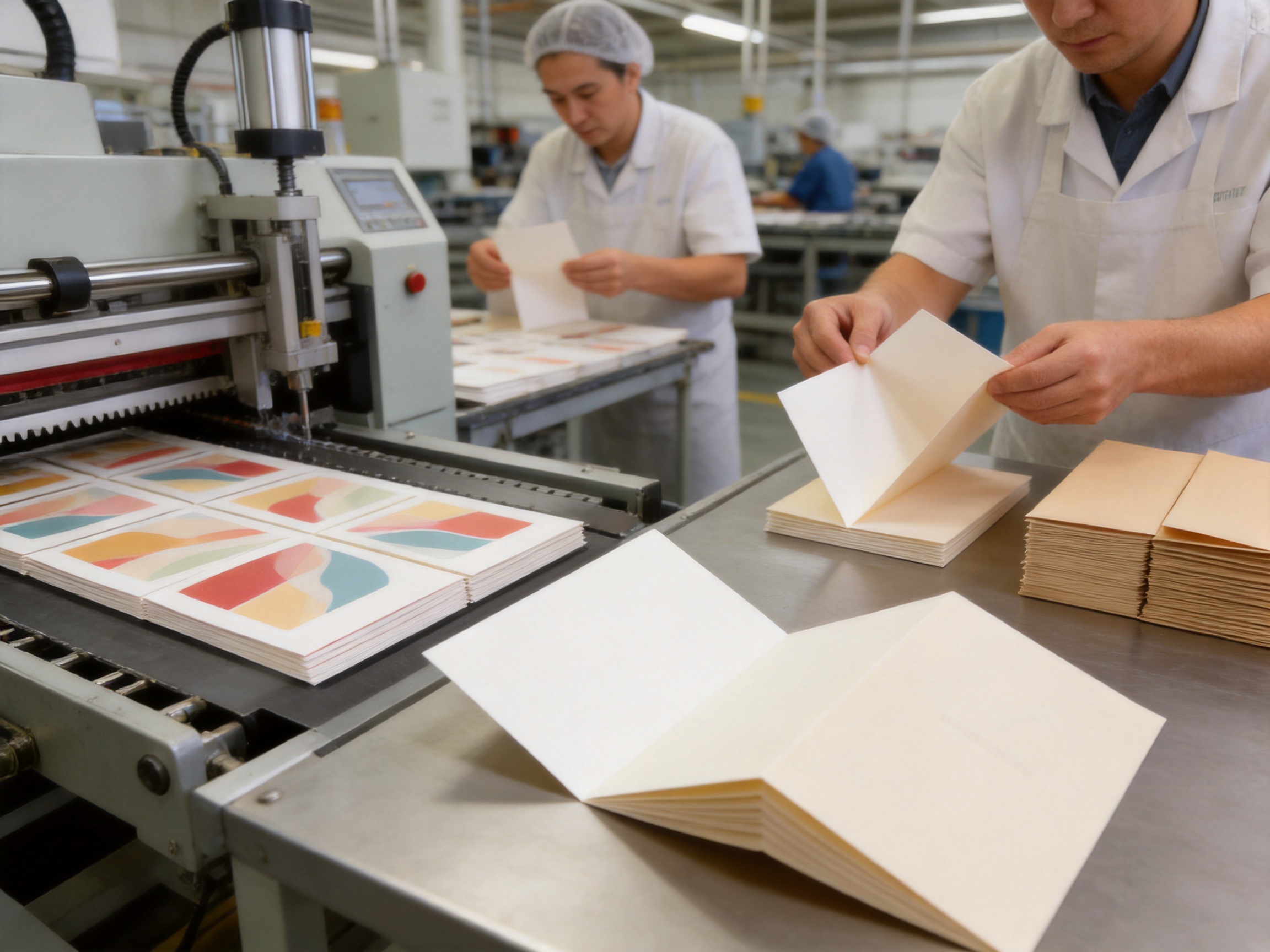
Some paper products require manual finishing or assembly even when much of the process is automated. Greeting cards may need careful folding, pairing with envelopes, checking for print defects, and organizing into retail or shipping quantities. Manual finishing provides an additional opportunity to identify problems before products leave the factory.
The human element is especially relevant to a product centered on handwritten communication. While the message is written by the final purchaser, the card itself must arrive clean, correctly folded, and ready to use. Manual handling helps support that final experience.
Integrated Production and Supply Chain Advantages
Magic Tree’s manufacturing model covers the process from raw materials to finished paper products. This integrated approach can provide several advantages for buyers. When key processes are managed within one company, communication between design, production, finishing, and quality teams can be more direct.
Integrated production may also reduce the coordination burden for a wholesale customer. Instead of working separately with a printer, a finishing supplier, an assembly provider, and a packaging company, the buyer can discuss the product with a manufacturer whose capabilities cover multiple stages. This is valuable when a customer is developing a greeting card together with gift bags, boxes, or wrapping paper.
Consistent production oversight can support more predictable quality. Paper stock, printing requirements, folding specifications, and packing instructions can be recorded and communicated across the internal workflow. The result is a better foundation for repeat orders, seasonal planning, and coordinated product collections.
Magic Tree reports annual output value exceeding 50 million yuan. This scale suggests an established manufacturing operation capable of serving professional buyers rather than only small one-off orders. The company also serves clients in the United States, Canada, Mexico, the United Kingdom, Japan, and China. Experience across these markets can help support communication with buyers who have different packaging expectations, retail formats, and seasonal calendars.
The company was founded in 1996 as Fushida Plastic Factory and rebranded in 2019 as Magic Tree Paper Products Co., Ltd. Its development reflects a long manufacturing history and a stronger focus on paper packaging solutions. Nearly three decades of experience can be valuable in areas such as material selection, production scheduling, print coordination, finishing, and export preparation.
How the Card Fits into a Complete Gift Presentation
A greeting card rarely exists in isolation during the holiday season. It may accompany a wrapped present, sit inside a gift bag, or be included in an order shipped directly to a recipient. The card’s scale, neutral usability, and matching envelope allow it to work naturally with other paper packaging products.
Gift bags provide convenience and visibility, while gift boxes provide structure and protection. Patterned wrapping paper creates the outer decorative layer. The handwritten greeting card adds the personal explanation. Together, these items can form a consistent holiday presentation with multiple tactile points.
For brands, coordinated paper products can improve collection building. A retailer might display the greeting card beside kraft gift bags, printed gift boxes, and seasonal wrapping paper. A corporate buyer might use the card as part of a customer appreciation package. A subscription or e-commerce business might place the card inside a shipment so that the recipient receives a human message along with the purchased product.
Because the interior is blank, the card can serve different industries. A bookstore can use it for literary holiday gifting. A florist can pair it with seasonal arrangements. A bakery or specialty food brand can add a handwritten thank-you. A hotel or hospitality business can use it for guest recognition. A nonprofit organization can use it for donor communication. The product’s value comes from its adaptability rather than a narrow printed message.
Wholesale and Retail Potential
For Stationery and Gift Stores
Stationery and gift stores can position the card as a premium, thoughtful alternative to ordinary holiday cards. The product’s thick cardstock and natural finish support a higher-quality shelf impression, while the blank interior gives customers a reason to choose it for a specific recipient.
Retailers can merchandise it near pens, writing sets, gift wrap, ribbons, candles, ornaments, or small gifts. The writing experience can be emphasized through simple point-of-sale language that invites customers to “write a memory” or “send a personal holiday wish.” Such messaging explains the product’s purpose without requiring complex technical education.
For Corporate and Organizational Buyers
Businesses increasingly seek ways to make customer and partner communication feel more personal. A blank greeting card allows team members to write individualized notes rather than placing every recipient into a single automated campaign. It can be used for holiday thanks, milestone recognition, appreciation messages, or relationship-building initiatives.
Organizations should establish internal writing guidelines if cards are used at scale. A short, specific reference to the recipient’s relationship with the company is usually more effective than a generic paragraph. The card provides the physical platform, while the organization’s words create the final value.
For E-Commerce and Direct Shipping
Online retailers can include the card as an optional gift message format. A buyer may select the card when sending an item to another household, allowing the recipient to receive a physical message with the order. The blank interior can be written by the purchaser, the retailer, or a fulfillment team according to the service model.
The matching envelope helps the card arrive in an organized and presentable form. Retailers should select protective outer packaging that prevents bending and moisture exposure during transportation. Proper packing preserves the quality of the cardstock and maintains the card’s premium feel when it reaches the recipient.
For Seasonal Collections
The product can anchor a broader Christmas or winter stationery range. It may be displayed with several patterned wrapping papers or packaged with complementary gift bags. A unified collection can use related colors, motifs, paper textures, and print techniques while retaining the card’s blank interior as its defining feature.
Magic Tree’s broader capabilities in gift boxes, bags, cards, and wrapping paper can be useful for buyers seeking coordinated products from one manufacturing partner. A single supplier may help simplify artwork management, color coordination, packaging instructions, and order planning across the collection.
Quality Considerations for Buyers
Wholesale buyers should evaluate greeting cards through both emotional and technical criteria. The product must look attractive, but it must also be consistent, functional, and suitable for the intended sales channel.
| Evaluation Area | What Buyers Should Review | Why It Matters |
|---|---|---|
| Cardstock | Thickness, smoothness, rigidity, and writing suitability | Determines hand feel, durability, and the quality of the writing experience |
| Surface finish | Natural appearance and absence of unwanted shine | Supports readability, tactile appeal, and a restrained premium presentation |
| Interior | Clean blank space without unintended marks or excessive print bleed | Preserves room for the sender’s personal message |
| Envelope | Size coordination, construction, closure, and recycled content | Ensures the set is practical, cohesive, and aligned with the product story |
| Printing | Color consistency, image sharpness, edge control, and ink coverage | Creates a professional appearance across the production batch |
| Folding | Accurate crease placement and clean edges | Improves opening, display, and overall presentation |
| Packaging | Protection against bending, moisture, dust, and transit damage | Helps the finished cards reach retailers in saleable condition |
A buyer should also confirm order specifications, sample approval procedures, production timing, carton quantities, labeling requirements, and export documentation. Seasonal paper products are often planned months before the holiday period, so early coordination is essential.
Design Guidance for a Handwritten Card
Because the interior is blank, the exterior should create an invitation rather than compete with the writing. Seasonal artwork can establish the mood through color, line, typography, and imagery, but it should leave the recipient curious about the personal message inside.
Balanced front-cover design is particularly important. Too much decoration may make the card feel crowded or difficult to combine with other gift packaging. Too little visual structure may make it appear unfinished. The most effective direction depends on the target market, but the product’s natural finish and thick cardstock support designs that are elegant, warm, and tactile.
Typography should remain legible at retail distance. If the card includes a short printed phrase, it should not limit the types of personal messages that can be written inside. A neutral seasonal greeting is generally more versatile than a highly specific statement.
Color selection should also reflect the intended channel. Traditional red, green, gold, and cream can support a familiar Christmas presentation. Muted greens, warm neutrals, off-white, and understated metallic-inspired tones can support a more contemporary or eco-conscious collection. Since the product uses vegetable-based inks and a natural finish, colors should be selected with the paper surface in mind.
Designers should protect the blank writing area from unnecessary interior decoration. A small printed detail may add character, but the primary function of the interior is to provide room for the sender’s own words. The blank area is not unused space; it is the core functional feature of the card.
Using the Card to Build Emotional Connection
The strongest benefit of a handwritten greeting card is not a technical specification. It is the emotional transition that takes place when a mass-produced paper item becomes personal. Once a sender writes inside, the card carries evidence of a relationship. The recipient no longer sees only a seasonal product; they see a message from a particular person.
This transformation is especially valuable during holidays, when people may be physically separated from family, friends, colleagues, or customers. A card cannot replace direct presence, but it can provide a tangible reminder of connection. It travels through ordinary logistics and arrives as something intentionally prepared.
The card can also encourage reflection by giving the sender a reason to identify what they appreciate. A written message may mention a shared experience, acknowledge support received during the year, or express hope for the coming season. These statements may never be made in a fast digital exchange.
For brands, the same principle applies. A handwritten message can humanize a company without turning the communication into an advertisement. The most effective business cards often focus on gratitude rather than promotion. The physical format gives the company an opportunity to show care in a way that supports, rather than interrupts, the customer relationship.

Frequently Asked Questions
What is the New Christmas Handwritten Greeting Card?
It is a Christmas-themed greeting card with a blank interior, designed for a personal handwritten message. Each card comes with a matching envelope.
Why is the interior blank?
The blank interior allows the sender to write a message that matches the recipient and the relationship. It can contain a memory, holiday wish, thank-you note, or short personal greeting instead of a standardized printed statement.
What type of paper is used?
The card uses smooth, thick cardstock with a natural finish. This gives it a firm hand feel and a writing-friendly surface without a glossy appearance.
Does the card have a plastic coating?
The product is described as having a natural finish without a plastic coating. Its appearance and durability come from the cardstock, printing, and manufacturing quality rather than a shiny plastic-like surface treatment.
What is notable about the envelope?
The matching envelope uses recycled content. It is supplied with the card so the buyer receives a coordinated and ready-to-use set.
What inks are used?
Vegetable-based inks are used for the printed design. This supports the product’s more considered approach to paper materials and printing.
Is the card suitable for business use?
Yes. Businesses can use it for customer appreciation, partner communication, employee recognition, holiday gifts, and other relationship-focused messages. The blank interior allows each message to be adapted to the recipient.
Can it be combined with other gift packaging?
Yes. The card can accompany gift bags, gift boxes, and patterned wrapping paper. It can be sold as part of a coordinated holiday collection or included with a packaged gift.
What manufacturing capabilities support the product?
The manufacturer’s capabilities include professional design and prepress, printing, laminating, hot stamping, creasing, bag making, and manual finishing. These processes support artwork preparation, print production, folding, assembly, and quality control across paper products.
Why might a buyer choose this card instead of a heavily decorated card?
This product emphasizes personal writing, thick cardstock, a natural finish, and a simpler material profile. It may appeal to buyers who prefer authenticity, tactile quality, and responsible paper choices over excessive decoration or standardized messages.
What should wholesale buyers confirm before ordering?
Buyers should confirm artwork specifications, paper details, sample approval, order quantities, production timing, packaging requirements, shipping arrangements, and any market-specific labeling or documentation needs.
Conclusion
The New Christmas Handwritten Greeting Card is built around a straightforward idea: a personal message deserves a physical form. In a season filled with rapid digital communication, a card written by hand can feel deliberate, sincere, and memorable. Its blank interior gives the sender freedom, while its thick cardstock, smooth natural finish, coordinated envelope, recycled-content component, and vegetable-based inks provide a carefully considered material foundation.
Its competitive strength comes from combining emotional usefulness with practical manufacturing quality. The card does not depend on a generic printed message, excessive surface treatment, or unnecessary complexity. It creates value through the writing experience and the possibility that the finished card will be kept as a memento.
For wholesale buyers, the product is versatile enough for stationery retail, gift shops, corporate communication, e-commerce fulfillment, hospitality, and coordinated seasonal collections. Its compatibility with gift bags, gift boxes, and patterned wrapping paper makes it suitable for a broader paper packaging program.
Magic Tree’s long manufacturing history and integrated capabilities add further value. Experience in design and prepress, printing, creasing, finishing, and paper packaging allows the company to manage the practical details behind a polished finished product. Its international customer base and established factory operation support the needs of professional buyers seeking consistent supply and coordinated paper solutions.
Ultimately, the card succeeds because it leaves room for something that cannot be mass-produced: the sender’s own words. The paper provides the structure, the envelope provides the presentation, and the handwriting provides the meaning. That combination gives a simple seasonal product a lasting role in modern gifting and communication.
References
1. Product information supplied for the New Christmas Handwritten Greeting Card, including material, format, and usage details.
2. Company information supplied for Yiwu Magic Tree Gift Bag Co., Ltd., including company history, product categories, manufacturing capabilities, markets, and production scope.
3. General principles of paper product design, including cardstock selection, folding, printing, finishing, and packaging presentation.
4. General principles of sustainable packaging communication, including recycled content, responsible material descriptions, and the importance of accurate environmental claims.