中文简体
 русский
 Français
 Español
 Deutsch
 عربى


Packaging is often the first physical interaction a customer has with a retail brand. Before a product is opened, used, or displayed at home, its bag can communicate color, quality, convenience, and attention to detail. Candy Color Kraft Paper Shopping Bags with Twisted Paper Handles are designed to make that first interaction attractive and practical. Their bright solid colors, sturdy paper construction, comfortable handles, and customizable surface create a versatile packaging solution for retail stores, gift shops, bakeries, cosmetic companies, event organizers, and distributors.
Unlike plain commodity bags that may provide only basic carrying functionality, these colorful kraft paper shopping bags combine presentation value with everyday usability. They can be coordinated with seasonal campaigns, retail interiors, product collections, corporate events, and branded merchandise programs. At the same time, their flat-bottom structure helps them stand upright during filling, storage, and display, making them more efficient for both staff and customers.
Manufactured by Yiwu Magic Tree Gift Bag Co., Ltd., the bags are supported by nearly three decades of paper product manufacturing experience. The company’s production capabilities include printing, laminating, hot stamping, creasing, bag making, and manual finishing. These integrated processes help buyers source multiple packaging requirements from one experienced supplier instead of coordinating with several independent factories.
This article examines the structure, applications, customization opportunities, manufacturing advantages, quality considerations, and procurement value of candy color kraft paper shopping bags with twisted paper handles. It also explains how wholesalers, retailers, packaging distributors, and OEM customers can evaluate the product for different commercial purposes.
1. The Role of Shopping Bags in Modern Retail Packaging
Retail packaging performs several functions at once. It protects products during short-distance transportation, gives customers a convenient way to carry purchases, supports brand recognition, and contributes to the overall shopping experience. A well-designed bag can also extend the visibility of a brand after the customer leaves a store. When a shopper carries a colorful paper bag through a shopping district, event venue, office, or public transport system, the packaging may create additional exposure without requiring a separate advertising campaign.
For this reason, many businesses no longer treat shopping bags as disposable afterthoughts. They evaluate handle comfort, paper strength, appearance, print quality, size availability, storage efficiency, and environmental positioning. The right bag must be attractive enough for presentation while durable enough for practical use.
Candy color kraft paper shopping bags address these needs through a balanced combination of visual appeal and structural performance. The solid pastel color range creates a cheerful, approachable appearance, while the kraft paper body provides a natural paper-based look. The design can suit a broad range of product categories, from small gifts and cosmetics to apparel, bakery items, accessories, and takeaway goods.
These bags are particularly useful for businesses that need a consistent packaging family in different colors or sizes. A retailer may use one color for a seasonal promotion, another for premium products, and a third for everyday purchases. A distributor may offer several colors and dimensions to different customer groups. An event organizer may choose colors that correspond to a campaign theme, school identity, wedding palette, or corporate program.
2. Product Overview and Core Construction
The product is a paper shopping bag made from quality kraft paper and fitted with twisted paper handles. Its construction is intended to support repeated handling throughout the normal retail process. The bag can be filled at a counter, carried by the customer, placed in a vehicle, and stored temporarily without losing its basic shape when the selected size and paper weight are matched properly to the contents.
The flat-bottom format is an important part of the design. A flat base allows the bag to stand upright on a counter or shelf, which simplifies loading and helps staff arrange products neatly. It can also improve the visual presentation of packaged goods when several bags are prepared for pickup or displayed at a retail point.
The twisted paper handles provide a practical alternative to simple die-cut openings. Their rounded form is generally more comfortable to hold, especially when the bag contains several lightweight items. The handle style also contributes to the product’s handmade and paper-oriented appearance. Handle length, paper color, thickness, attachment method, and other details can be discussed during customization.
The surface of the bag is suitable for branding and decorative treatment. Depending on the project requirements, buyers may request custom logo printing, product information, labels, hot stamping, or other finishing options. A smooth paper surface can help create a cleaner visual result, especially when the artwork includes typography, simple graphics, or a recognizable logo.
Key Product Features
The main features of the bags include a solid candy color appearance, kraft paper construction, twisted paper handles, flat-bottom stability, multiple size options, and a surface suitable for customization. These features are not independent. Together, they create a packaging format that can function as both a carrying container and a brand presentation tool.
| Feature | Packaging Value | Typical Commercial Benefit |
|---|---|---|
| Candy color selection | Creates a bright and coordinated appearance | Supports seasonal displays, product grouping, and themed campaigns |
| Kraft paper body | Provides a paper-based structure with a natural visual character | Supports practical retail packaging and eco-conscious brand positioning |
| Twisted paper handles | Offers a comfortable carrying format | Improves user convenience and contributes to a finished retail look |
| Flat-bottom construction | Allows the bag to stand upright | Makes loading, temporary storage, and counter presentation easier |
| Customizable surface | Accepts logos, labels, and selected finishing treatments | Helps businesses turn standard packaging into branded packaging |
| Multiple sizes | Accommodates different product dimensions | Reduces the need to use one oversized bag for every order |
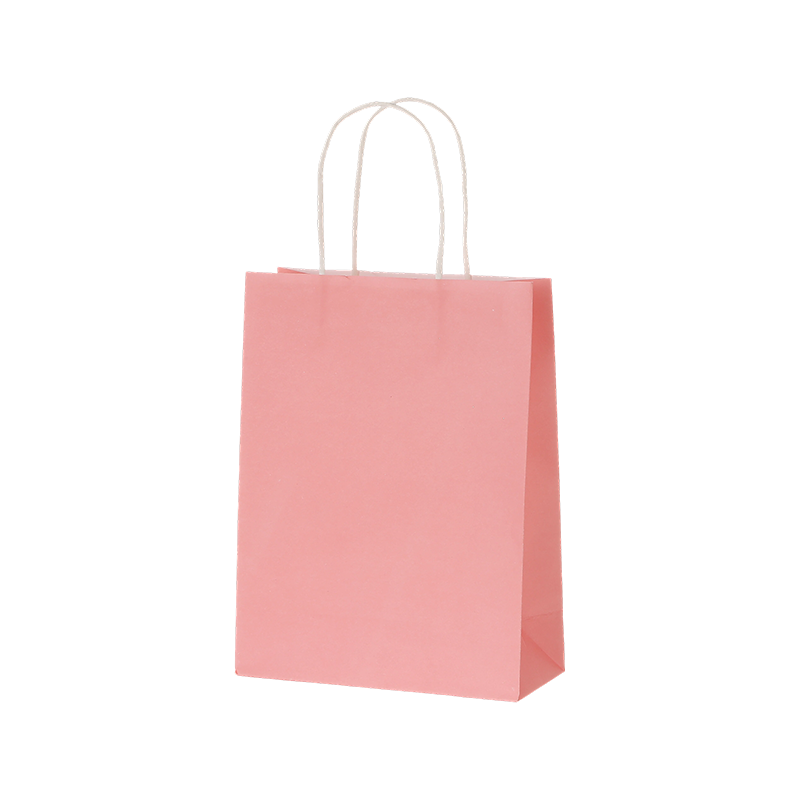
Candy Color Kraft Paper Shopping Bags with Twisted Paper Handles
3. Advantages Compared with Basic Commodity Shopping Bags
Many low-cost shopping bags are designed only to contain a purchase. They may have limited color choices, generic dimensions, simple handles, or weak branding potential. While these bags can be suitable for short-term utility, they may not deliver the visual consistency or customer experience required by growing brands.
Candy color kraft paper shopping bags offer several advantages over basic unprinted or poorly coordinated alternatives. First, the color range gives businesses more control over their packaging identity. A store can select colors that correspond to its logo, product categories, holidays, or interior design. Even without complex printing, a carefully selected solid color can make packaging look more intentional.
Second, twisted paper handles provide a more finished appearance than basic cutout handles. They can make the bag feel more like a gift or boutique shopping package, which is valuable for cosmetics, accessories, fashion items, stationery, and small lifestyle products. The handle also gives the customer a familiar carrying format that is easy to grasp.
Third, the flat-bottom construction supports better handling during filling. Staff members can place the bag upright, add products in an organized sequence, and prepare orders more efficiently. A bag that collapses easily may require additional support or manual adjustment, increasing handling time at busy retail counters.
Fourth, the bags provide a better platform for brand communication. A logo, slogan, contact detail, product message, or seasonal graphic can be applied to a broad visible surface. A generic bag may complete the transaction, but a customized bag can help reinforce brand recognition after the transaction is finished.
Fifth, the paper format can support companies that want to reduce reliance on plastic-based retail packaging. Material selection should always be evaluated according to the intended use, printing method, coatings, local regulations, and disposal infrastructure. However, for many everyday retail applications, paper shopping bags offer a familiar and easily recognizable alternative for businesses seeking paper-based packaging.
Visual Differentiation
Color is one of the fastest ways to differentiate packaging. Candy colors are associated with friendliness, celebration, creativity, and accessibility. They can be especially effective for products aimed at gift buyers, young consumers, lifestyle shoppers, beauty customers, and event participants. A coordinated group of pastel bags can also create a visually attractive store counter or product pickup area.
Compared with plain brown kraft bags, solid candy colors can make the packaging feel more expressive. Compared with heavily printed bags, a solid color can provide a cleaner and more flexible background for a small logo or minimalist design. The choice depends on the brand’s visual strategy, but the availability of both color and print customization gives buyers more options than a standard off-the-shelf bag.
Practical Carrying Performance
Packaging performance depends on paper weight, dimensions, construction, handle attachment, product weight, and handling conditions. The twisted paper handle design is intended to provide a comfortable grip for ordinary retail carrying. Buyers should communicate the expected load and product type to the manufacturer so that the paper specification and construction can be matched to the application.
For light and medium-weight products, the bags can be used for cosmetics, clothing accessories, gifts, bakery products, stationery, and takeaway items. For heavier products, the buyer may need a heavier paper grade, reinforced attachment points, a wider base, or a different structural configuration. Responsible procurement means selecting a bag based on actual use rather than judging performance from appearance alone.
4. Applications Across Different Business Sectors
Retail Stores and Boutiques
Fashion boutiques, accessory shops, gift retailers, and lifestyle stores can use the bags as part of a consistent customer service package. The color can be selected to reflect the store’s identity, while the size can be matched to garments, scarves, jewelry boxes, shoes, or small home products.
For boutique retail, presentation is often as important as basic protection. Customers may reuse an attractive bag, store products in it, or carry it to another destination. A well-designed bag can therefore remain visible beyond the original purchase. The combination of pastel color and twisted handles creates a welcoming appearance suitable for both everyday sales and special shopping occasions.
Cosmetics and Personal Care
Cosmetic packaging frequently relies on color, texture, and clean visual presentation. Candy color kraft paper bags can coordinate with beauty product collections, seasonal gift sets, skincare promotions, salon events, and makeup launches. A small printed logo or foil detail can be placed on the front panel to create a recognizable takeout package.
Different sizes can be used for individual products, multiple-product orders, gift sets, and promotional bundles. When the bag is intended for glass bottles or heavier containers, the paper weight and handle attachment should be specified accordingly.
Gift Shops and Seasonal Promotions
Gift shops require packaging that can serve a variety of product shapes and purchase occasions. A customer buying a birthday present, holiday item, souvenir, or small home accessory may appreciate a bag that already looks presentable. Candy colors naturally support celebration-oriented merchandising and can be combined with custom labels, stickers, tissue paper, or matching greeting cards.
Seasonal promotions may use different colors for spring, summer, holidays, anniversaries, or limited-edition product launches. Because the bag can be customized, businesses can create a packaging series without changing the overall construction.
Bakeries and Food Takeaway Businesses
Bakeries, dessert shops, cafés, and takeaway businesses can use paper bags for boxed pastries, cookies, packaged snacks, and other suitable items. The flat base can help the bag remain upright when the contents are packed in boxes or trays. A printed logo can turn each order into a branded customer touchpoint.
Food-related buyers should confirm the intended food-contact requirements, paper specifications, coatings, and local compliance obligations before placing an order. These bags are suitable for many takeaway packaging concepts, but the exact material configuration must be selected according to the product and regulatory environment.
Corporate Events and Promotional Merchandise
Companies, schools, associations, exhibition organizers, and event agencies can use customized bags for welcome kits, conference materials, promotional products, and employee gifts. The bag provides a convenient way to collect brochures, samples, notebooks, apparel, and small merchandise.
For events, color can help distinguish attendee groups or reinforce a campaign theme. Printing can add the event name, date, sponsor information, or organizational logo. Since the bags are lightweight and stackable, they can be prepared in advance and distributed efficiently at registration desks or product counters.
Packaging Distributors and OEM Buyers
Distributors often need products that can be offered in more than one color, dimension, or printing configuration. The candy color bag format is suitable for building a product line with different options while keeping a recognizable construction. OEM customers can also request custom sizes, paper weights, handle styles, surface finishes, and full-brand printing.
A supplier capable of handling design, printing, bag making, and finishing under one production organization can simplify project management. This is particularly important when buyers need consistent results across a long-term supply program.
5. Customization Options for Wholesale and OEM Projects
Customization allows the basic bag format to be adapted to a brand’s commercial and logistical requirements. The most common customization variable is size. A small bag may be used for jewelry, cosmetics, or accessories, while a medium or large bag may be required for clothing, gift boxes, bakery cartons, or promotional kits.
Paper weight is another important variable. Lightweight paper can help reduce material use and shipping weight for suitable applications. Heavier paper may provide increased stiffness and support for products requiring a stronger structure. The correct choice should consider the bag dimensions, contents, carrying distance, storage conditions, and expected handling.
Color can be selected from standard options or developed according to a project requirement, subject to production feasibility and minimum order considerations. Buyers should approve color samples because paper surface, ink, lighting, and production conditions can influence the final appearance.
Handle customization may include paper color, twisted cord thickness, length, and attachment details. A short handle can create a compact hand-carry format, while a longer handle may offer greater flexibility. The handle should be selected together with the bag size and expected load rather than as an isolated decorative element.
Printing can include logos, brand names, patterns, slogans, product information, campaign messages, and simple illustrations. Depending on the artwork and budget, buyers may select one-color printing, multicolor printing, or more specialized treatments. Clear artwork files, accurate dimensions, and approved color references help reduce production misunderstandings.
Finishing options may include laminating, hot stamping, labels, and other surface treatments. Hot stamping can introduce a metallic or premium accent, while laminating may alter the surface appearance and provide a different tactile effect. Not every finish is suitable for every paper type or environmental objective, so the final configuration should be reviewed with the supplier.
Customization Checklist
Before requesting a quotation, buyers should prepare the intended bag dimensions, product weight, quantity, color preferences, logo files, printing requirements, handle specifications, finishing requirements, delivery destination, and expected order schedule. It is also useful to provide product photographs or physical samples when the bag must accommodate an unusual shape.
A clear specification makes it easier to compare quotations fairly. A lower unit price may reflect thinner paper, fewer colors, simpler handles, or different packaging quantities. Buyers should compare the complete specification and not only the headline price.

6. Manufacturing Capabilities and Integrated Production
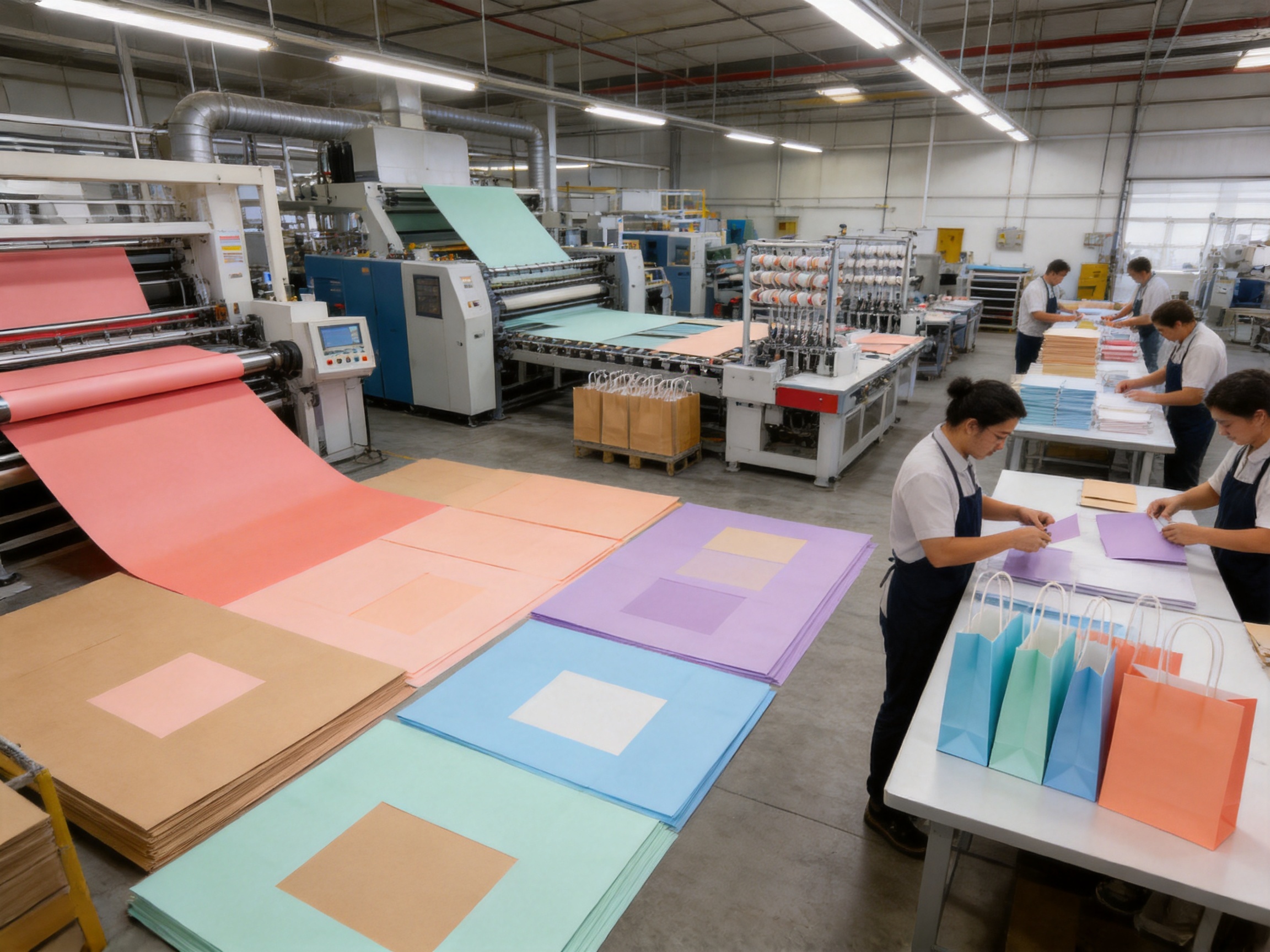
The strength of a paper packaging supplier is determined not only by the finished appearance of one sample but also by its ability to repeat that result at commercial volume. Yiwu Magic Tree Gift Bag Co., Ltd. has developed its business around paper packaging products and maintains in-house capabilities across several production stages.
The company began in 1996 as Fushida Plastic Factory and was rebranded in 2019 as Magic Tree Paper Products Co., Ltd. Its current business focus includes paper bags, gift bags, gift boxes, greeting cards, and patterned wrapping paper. This product scope gives the company experience across different paper structures, printing requirements, and finishing methods.
Integrated production can reduce communication gaps between separate suppliers. When design preparation, printing, converting, bag making, and manual finishing are managed within one organization, production teams can coordinate changes more directly. This can be valuable for custom projects involving specific dimensions, color matching, handle attachment, or multi-item packaging programs.
Design and Prepress
Professional design and prepress are important because many packaging problems begin before printing. Artwork must be checked for dimensions, bleed, resolution, color separation, text placement, and safe margins. The design team can also help determine how artwork will appear on a folded bag, where the front panel will sit, and how the handle area may affect the visual layout.
Prepress review can identify potential issues before materials enter production. It can help prevent clipped logos, uneven positioning, unsuitable fine details, or color expectations that do not match the chosen paper. For OEM customers, this stage is an opportunity to confirm the relationship between the brand’s digital artwork and the physical packaging.
Printing
Printing gives the bags their branded identity. The production approach depends on the artwork, paper, quantity, color requirements, and desired appearance. A reliable printing process requires controlled setup, suitable ink application, accurate registration, and inspection during the production run.
For solid candy color bags, the base color itself is part of the visual specification. If the color is created through dyed or colored paper, consistency between batches becomes important. If color is applied through printing or coating, coverage and surface uniformity require attention. In either case, sample approval and production references help establish an agreed appearance.
Laminating and Surface Treatment
Laminating can change the tactile and visual quality of a paper bag. Depending on the selected film or treatment, the surface may appear more matte, glossy, smooth, or protective. The choice should be considered carefully when the buyer wants to maintain a natural paper feeling or emphasize a premium appearance.
Surface treatments also influence recyclability and environmental positioning. A buyer seeking an eco-oriented packaging program should discuss the material combination and end-of-life expectations with the supplier. The most appropriate finish is the one that supports the required performance without adding unnecessary complexity.
Hot Stamping
Hot stamping can add a premium accent to logos, lettering, borders, or decorative elements. Metallic gold, silver, and other visual effects are commonly associated with gift packaging, cosmetics, boutique retail, and seasonal collections. The stamping area should be planned so that it remains clear and visually balanced on the colored paper surface.
Because hot stamping requires tooling and controlled pressure and temperature, the buyer should review the artwork size, fine details, and target appearance during sampling. A well-executed small foil logo can make a simple bag look more distinctive without covering the entire surface with complicated graphics.
Creasing and Bag Making
Creasing creates the fold lines required to form the bag body and base. Accurate creasing helps the panels fold in the intended locations and supports a more orderly finished shape. Bag making then brings the printed and creased material into its final three-dimensional form.
The flat-bottom structure depends on accurate folding, adhesive application, and assembly. Production control is important because small variations can affect whether the bag stands evenly, whether the panels align, and whether the base supports the intended load. These details may not be obvious in a flat sheet, but they have a direct effect on the finished product.
Manual Finishing and Handle Attachment
Manual finishing remains valuable for paper bags because certain assembly steps require careful visual inspection and flexible handling. Workers may inspect folding, reinforce selected areas, attach twisted paper handles, remove minor defects, and prepare the finished bags for packing.
Handle attachment deserves special attention because it combines appearance and performance. The handles should be positioned consistently, attached securely, and checked for visible defects. Manual finishing provides an additional opportunity to identify problems before the goods are packed for shipment.
7. Quality Control Considerations
Quality control for paper shopping bags should cover raw materials, color, dimensions, printing, structure, handles, finishing, packing, and shipment preparation. A professional buyer may establish an inspection checklist before production begins so that the factory and purchaser share the same acceptance standards.
Material inspection can verify paper type, paper weight, surface quality, and color. Dimensional inspection can confirm bag width, height, gusset, base size, and handle length. Printing inspection can review artwork position, clarity, registration, color appearance, and surface marks.
Structural inspection can include checking whether the bag opens properly, stands on its base, folds correctly, and remains intact during normal handling. Handle inspection can focus on attachment position, visible adhesive, twisting consistency, and resistance to ordinary carrying conditions.
Packaging inspection is also important for international orders. Finished bags should be protected from moisture, crushing, dirt, and unnecessary deformation during storage and transportation. Carton marks, quantities, pallet requirements, and loading instructions should be confirmed before dispatch.
Sampling Before Mass Production
Sampling is a practical way to confirm the design before committing to a large quantity. A pre-production sample can reveal how the selected color looks on the actual paper, how the logo fits on the front panel, whether the handle length is suitable, and whether the bag dimensions accommodate the intended product.
For complex projects, buyers may request more than one sample revision. This can add time at the beginning but may reduce the risk of costly changes after mass production. The approved sample should be retained as a reference for future repeat orders, especially when the project will be produced in multiple batches.
8. Environmental and Material Considerations
Paper packaging is often selected as part of a broader environmental strategy, but environmental claims should be specific and supported by the actual material configuration. A paper bag may have advantages in certain disposal systems, while coatings, laminates, inks, adhesives, and mixed materials can affect recycling or composting considerations.
Kraft paper is widely associated with a natural appearance and paper-based packaging. Businesses choosing these bags should still ask about paper sourcing, recycled content, available grades, coatings, printing systems, and relevant documentation. A responsible supplier should help buyers understand what can and cannot be claimed about the finished product.
Material efficiency is another consideration. Using the correct bag size can reduce unnecessary paper consumption and shipping volume. A bag that is too large for a small product may look inefficient and require extra filling material. A bag that is too small may be difficult to load or place stress on the handles. Proper sizing supports both operational efficiency and responsible material use.
Durability can also contribute to packaging efficiency. If a bag performs reliably during the intended use, the business is less likely to experience product loss, repacking, or customer dissatisfaction. The goal is not simply to use the least material possible, but to select a suitable structure that balances resource use, functionality, and product protection.
9. Storage, Logistics, and Order Planning
Paper shopping bags should be stored in a clean, dry environment away from excessive humidity, direct water exposure, and extreme temperature changes. Moisture can affect paper stiffness, adhesive performance, printing appearance, and dimensional stability. Proper carton storage helps preserve the finished bags until they are needed.
Because the bags can be supplied flat or in compact packed units, they are generally suitable for efficient warehouse organization. Buyers should confirm the packing method and carton dimensions before placing a large order. This helps estimate warehouse space, freight cost, and handling requirements.
Order planning should take into account artwork approval, sampling, raw material preparation, printing, converting, finishing, inspection, packing, and transportation. Custom colors, special finishes, and nonstandard sizes may require additional preparation time. Buyers with seasonal promotions should provide forecasts early enough to protect the launch schedule.
For long-term supply programs, it is helpful to define reorder quantities, expected annual demand, color references, packaging instructions, and quality standards in advance. A stable specification supports repeatability and can reduce the time needed for each new order.
Wholesale Procurement Questions
Wholesale buyers should ask whether the requested size is standard or custom, which paper grades are available, what printing processes are suitable, whether the handles can be changed, how samples are approved, what packing quantities are used, and how quality is inspected. They should also confirm the minimum order quantity, production lead time, shipping terms, and available documentation.
These questions help buyers compare suppliers on total value rather than unit cost alone. A supplier with stronger production coordination may reduce the hidden costs associated with revisions, inconsistent batches, delayed communication, and rejected goods.
10. Why an Experienced Factory Matters
Experience becomes particularly important when a product appears simple but contains many production variables. A paper shopping bag consists of paper, printing, folding, adhesive, handles, and finishing, yet each stage can influence the final result. An experienced factory understands how these stages interact and can recommend a practical configuration for the intended use.
Magic Tree has nearly 30 years of experience in paper product manufacturing. Its product range extends beyond shopping bags to include gift boxes, greeting cards, and patterned wrapping paper. This broader experience can be useful for customers seeking coordinated packaging collections rather than a single standalone item.
The company operates its own factory and manages processes from raw materials to finished products. This in-house model supports closer control over production scheduling, technical communication, and quality management. It also gives OEM and ODM buyers a direct channel for discussing design changes, new dimensions, and finishing requirements.
Its production capabilities include professional design and prepress, laminating, hot stamping, creasing, printing, bag making, and manual finishing. Together, these capabilities form a practical manufacturing chain for customized paper packaging. Buyers can request a simple colored bag, a printed retail bag, or a more elaborate gift packaging program based on the needs of the project.
The company serves customers in the United States, Canada, Mexico, the United Kingdom, Japan, and China. Experience with international buyers can support communication around specifications, packing, inspection, export preparation, and delivery coordination. Its reported annual output value exceeding 50 million yuan also indicates an established operating scale for serving commercial orders.
11. Designing a Strong Packaging Program
A successful packaging program begins with the product inside the bag. Buyers should identify the product dimensions, weight, fragility, shape, and required presentation. From there, the bag size, paper grade, base construction, handle specification, and printing area can be selected logically.
The second step is to define the visual system. This includes the primary color, supporting colors, logo placement, typography, imagery, and finishing details. For a minimalist brand, a solid candy color with a small centered logo may be sufficient. For a promotional event, the design may include larger graphics, dates, slogans, and sponsor information.
The third step is to consider customer handling. Will the customer carry the bag for several minutes or several hours? Will the product be placed in a vehicle? Will the bag be reused? Will store staff fill the bag quickly during busy periods? These questions help determine the appropriate structure and handle configuration.
The fourth step is to plan inventory. A business should estimate how many bags are required for normal sales, peak seasons, promotional events, and replacement stock. Ordering too little may lead to rushed production or inconsistent emergency purchases. Ordering too much may tie up warehouse space and working capital, particularly when the bags carry a date-specific campaign.
Finally, the packaging should be tested in the real operating environment. Staff should fill sample bags, carry them, place them on counters, and evaluate how they look with the actual products. This practical review often reveals details that are difficult to judge from artwork alone.
12. Cost and Value Analysis
Price is an important part of procurement, but the lowest unit price does not always create the lowest total cost. A bag that is too weak may result in product damage or repacking. A bag with poor printing may weaken the brand presentation. A bag with incorrect dimensions may use excess material or require staff to spend more time arranging products.
The total value of a shopping bag includes material cost, printing, finishing, labor efficiency, storage, freight, customer experience, and marketing exposure. A colorful branded bag may support repeat recognition each time it is carried outside the store. A flat-bottom structure may help reduce counter handling time. A suitable paper weight may prevent avoidable failures during normal use.
Customization should also be evaluated against order volume. For high-volume programs, custom printing and special colors may provide strong brand value. For small test orders, standard colors and simpler finishes may be more economical. An experienced supplier can help identify a configuration that fits the intended budget without removing the features most important to the brand.
13. Recommended Buyer Evaluation Framework
When comparing potential suppliers, buyers can use five broad categories: product suitability, manufacturing capability, quality management, customization support, and commercial service. Product suitability asks whether the bag can carry and present the intended goods. Manufacturing capability asks whether the supplier can produce the required dimensions, colors, printing, handles, and finishes.
Quality management covers sample approval, material consistency, structural inspection, handle inspection, and packing. Customization support includes artwork review, color development, prototyping, and repeat-order management. Commercial service includes communication, quotation clarity, lead-time planning, shipping support, and after-sales response.
This framework is useful because a supplier may be strong in one area but limited in another. A trading company may offer many products but have less direct control over production. A small workshop may provide flexibility but have limited capacity for large repeat orders. A factory with integrated capabilities may offer a better balance for buyers who need customized paper packaging at commercial scale.
14. Frequently Asked Questions
Q1: What products can be packed in these candy color kraft paper shopping bags?
The bags can be used for cosmetics, clothing, accessories, gifts, bakery products, stationery, takeaway items, promotional merchandise, and many other lightweight or medium-weight retail goods. The correct size and paper specification should be selected according to the actual product dimensions and load.
Q2: Are the twisted paper handles comfortable for customers?
Twisted paper handles are designed to provide a familiar and comfortable hand-carry format. Comfort depends on handle length, handle thickness, bag size, paper weight, and product load. Buyers should discuss the expected use with the manufacturer and evaluate these details during sampling.
Q3: Can the bags be printed with a company logo?
Yes. The surface can be customized with logos, labels, slogans, artwork, and other branding elements. Printing options depend on the paper, artwork, quantity, and desired appearance. Buyers should submit accurate artwork and approve a sample before mass production.
Q4: Are custom colors available?
Multiple candy and pastel colors are available, and custom color requirements can be discussed for OEM and ODM projects. Final color appearance may depend on the paper surface, printing or coloring method, lighting, and production conditions. A physical color sample is recommended for important brand colors.
Q5: Can the bag size be changed?
Yes. Custom dimensions are available for suitable projects. Buyers should provide the product length, width, height, weight, and any internal packaging details. The manufacturer can then recommend a practical bag size and base configuration.
Q6: Are these bags suitable for heavy products?
They are suitable for many light and medium-weight retail products, but the exact load capacity depends on the bag dimensions, paper weight, handle construction, attachment method, and product distribution. Heavy products may require reinforced specifications or a different packaging structure.
Q7: Can hot stamping or other surface finishes be added?
Hot stamping, laminating, labels, and other finishing methods can be considered depending on the project. The selected treatment should match the paper type, artwork, budget, appearance requirements, and environmental objectives.
Q8: What makes a flat-bottom bag useful?
A flat bottom allows the bag to stand upright, making it easier for staff to load products and prepare orders. It also helps the bag remain organized on counters, shelves, and temporary storage surfaces.
Q9: How should buyers evaluate the environmental claims of paper bags?
Buyers should review the actual paper grade, recycled content, coatings, laminates, inks, adhesives, and disposal conditions. Paper-based construction may support an eco-conscious packaging strategy, but specific environmental claims should be based on verifiable material information and applicable local standards.
Q10: Why should a buyer request a sample before ordering?
A sample allows the buyer to check color, size, logo placement, handle length, structure, surface finish, and overall presentation with the actual product. It is one of the most effective ways to reduce misunderstandings before mass production.
Q11: Can one supplier produce bags and other paper packaging products?
Magic Tree manufactures paper bags, gift bags, gift boxes, greeting cards, and patterned wrapping paper. This makes it possible for buyers to explore coordinated packaging programs with related paper products from the same manufacturing organization.
Q12: Which information should be included in a quotation request?
A quotation request should include the bag size, quantity, paper specification if known, color, printing artwork, handle requirements, surface finishing, packing preferences, delivery destination, and desired schedule. Product photographs or samples can also help the supplier recommend an accurate configuration.
15. Conclusion
Candy Color Kraft Paper Shopping Bags with Twisted Paper Handles provide a versatile combination of attractive presentation, practical carrying performance, and customization potential. Their solid pastel colors help businesses create cheerful and coordinated packaging, while the kraft paper body supports a familiar paper-based retail format. Twisted handles improve the finished appearance and carrying experience, and the flat-bottom construction assists with filling, storage, and display.
The bags can serve boutiques, gift shops, cosmetics retailers, bakeries, cafés, promotional agencies, event organizers, wholesalers, and OEM customers. Custom dimensions, paper weights, colors, handle styles, printing, labels, hot stamping, and other finishing options allow the product to adapt to different commercial programs.
The manufacturing strength behind the product is equally important. Yiwu Magic Tree Gift Bag Co., Ltd. brings nearly 30 years of paper product experience, in-house production capabilities, and a broad portfolio that includes gift boxes, greeting cards, and patterned wrapping paper. Its integrated services cover design and prepress, printing, laminating, hot stamping, creasing, bag making, and manual finishing.
For buyers, the best results come from treating the bag as part of a complete packaging system. Clear product information, accurate artwork, realistic load expectations, sample approval, suitable material selection, and careful order planning can help ensure that the finished bags perform effectively in daily retail use. When these factors are managed together, the product becomes more than a simple carrier: it becomes a practical extension of the brand and an efficient tool for customer presentation.
References
1. Company product information for candy color kraft paper shopping bags with twisted paper handles, supplied by Yiwu Magic Tree Gift Bag Co., Ltd.
2. Company background and manufacturing capability information for Magic Tree paper packaging products.
3. General packaging design principles concerning paper bag structure, handle construction, printing, folding, and retail presentation.
4. General procurement considerations for custom paper packaging, including material selection, sampling, inspection, storage, and logistics planning.
5. General environmental packaging considerations relating to paper materials, coatings, laminates, inks, adhesives, and end-of-life evaluation.