中文简体
 русский
 Français
 Español
 Deutsch
 عربى


Packaging is often the first physical point of contact between a customer and a product. Before a shopper opens a box, uses a gift, or experiences the item inside, the bag carrying it has already communicated something about the retailer, brand, event, or occasion. A well-designed shopping bag can make a purchase feel more valuable, improve the presentation of merchandise, and reinforce a company’s visual identity. Candy Color Kraft Paper Shopping Bags with Twisted Paper Handles offer a practical way to achieve these objectives while maintaining a bright, approachable, and professional appearance.
These bags combine the familiar strength and versatility of kraft paper with a selection of attractive solid pastel colors. Their colorful exterior creates a cheerful impression, while the flat-bottom construction, reinforced twisted paper handles, and smooth printable surface support reliable commercial use. They are suitable for retail stores, gift shops, boutiques, cosmetics suppliers, bakeries, promotional campaigns, corporate events, takeaway businesses, and many other applications that require practical paper packaging.
For wholesalers, importers, packaging distributors, retailers, and OEM buyers, the product offers more than an attractive appearance. It provides a flexible packaging platform that can be adapted to different product sizes, paper weights, colors, handle styles, printing requirements, and finishing methods. This flexibility is especially valuable for businesses that serve multiple market segments or need packaging for seasonal campaigns and changing product collections.
The Role of Paper Shopping Bags in Contemporary Retail
Retail packaging must perform several functions at the same time. It must protect products during handling, provide a convenient way to carry purchases, support efficient storage, and represent the seller in a visually consistent manner. It should also be cost-effective enough for regular commercial use. Candy Color Kraft Paper Shopping Bags are designed around this combination of practical and promotional requirements.
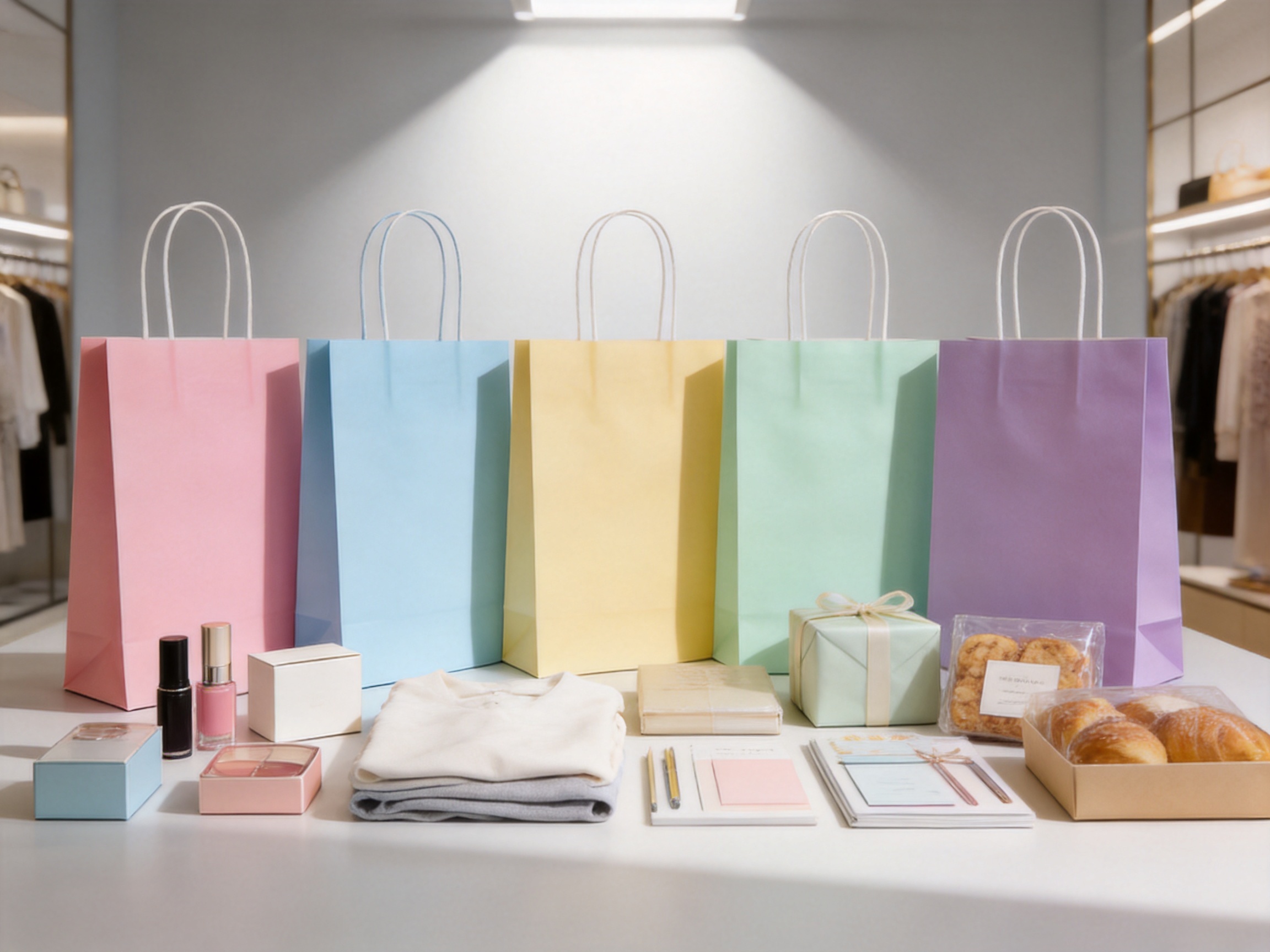
Unlike plain disposable carriers that may look generic, these bags use color as an immediate visual feature. Soft pink, blue, yellow, green, purple, and other pastel shades can create a friendly and coordinated appearance. A retailer can select one color for its general packaging, assign different colors to product categories, or use seasonal colors for holidays and promotional periods. The color itself can become part of a store’s presentation strategy.
Paper bags also offer a tactile experience that differs from plastic packaging. The natural paper surface gives the package a more substantial and gift-friendly character. When the bag includes a printed logo, a label, a hot-stamped mark, or a carefully selected finish, it can function as a mobile brand presentation tool. Customers may carry it through shopping areas, offices, public transportation, and social events, giving the business additional exposure beyond the point of sale.
For B2B buyers, the importance of a shopping bag extends beyond individual customer experience. Packaging must be easy to order in volume, consistent from one production batch to another, and adaptable to logistical requirements. A manufacturer with integrated design, printing, bag-making, and finishing capabilities can make the procurement process more efficient and help reduce coordination between multiple suppliers.
Key Features of Candy Color Kraft Paper Shopping Bags
Vibrant Solid Pastel Colors
The most recognizable characteristic of this product is its candy-inspired color range. Solid pastel colors provide a lively appearance without creating a visually complicated package. The result is suitable for businesses that want packaging to feel modern, warm, and accessible. Pastel colors are particularly effective for fashion accessories, cosmetics, children’s products, stationery, confectionery, small gifts, and lifestyle merchandise.
Color selection can also support product organization. A retailer may use one shade for beauty products, another for apparel, and another for special orders. Event organizers can select colors that match a campaign, celebration, trade show, wedding, or corporate identity. With custom production, buyers may also request specific colors that correspond to a brand palette or seasonal marketing plan.
Twisted Paper Handles
The twisted paper handles provide a comfortable grip and contribute to the bag’s overall appearance. Their paper construction creates a coordinated look with the body of the bag, while the twisted structure provides useful strength for normal retail carrying conditions. The handles are suitable for customers carrying clothing, accessories, boxed gifts, cosmetics, bakery items, and other lightweight to medium-weight products, subject to the selected bag size and paper specification.
Handle attachment is an important area of paper bag manufacturing. A handle must be positioned accurately and secured to the bag body so that weight is distributed properly during use. Professional production methods help maintain consistent handle placement, attachment quality, and visual alignment across large quantities. This consistency is particularly important for retailers that distribute hundreds or thousands of bags under the same identity.
Flat-Bottom Construction
The flat bottom allows the bag to stand upright when it is opened and filled. This feature makes loading faster at the checkout counter or packing station because employees can place products into the bag without holding the bag open continuously. It also improves the presentation of goods inside the package and helps prevent the bag from collapsing immediately after it is placed on a counter or shelf.
For customers, a stable bottom can make the bag easier to set down while shopping or traveling. For retailers, the construction supports better organization during packing and temporary storage. A flat-bottom bag can also make more effective use of cartons and warehouse space compared with irregularly shaped carriers.
Smooth Surface for Branding
The smooth paper surface is suitable for different branding methods, including custom logo printing, product information, labels, promotional graphics, and selected decorative finishes. A business can keep the design minimal by applying a small logo or create a more expressive package using full-surface artwork. The available approach depends on the desired visual effect, order quantity, paper color, ink requirements, and finishing specifications.
Printing on a solid-color bag requires attention to contrast and color control. Artwork should be prepared with the selected background in mind so that the logo remains readable and the final result matches the intended visual identity. A professional prepress team can help evaluate artwork, adjust color separation, prepare proofs, and identify potential production problems before mass manufacturing begins.
Multiple Size Options
Different retail products require different packaging dimensions. A small bag may be suitable for jewelry, cosmetics, cards, or accessories, while a wider or taller format may be needed for clothing, footwear, bakery boxes, or larger gifts. Offering multiple sizes allows buyers to select packaging that fits the product more appropriately instead of relying on one oversized bag for every order.
Correct sizing can improve both customer experience and cost control. A bag that is too large may consume unnecessary paper and require more storage space. A bag that is too small may force employees to overfill it, creating stress on the handles and seams. Custom dimensions allow buyers to balance appearance, carrying performance, product protection, and material consumption.
Candy Color Kraft Paper Shopping Bags with Twisted Paper Handles
Advantages Over Generic Shopping Bags
Improved Presentation
Generic bags often fulfill only the basic function of carrying a purchase. Candy Color Kraft Paper Shopping Bags add a more deliberate presentation layer. Their pastel shades can make even a simple purchase feel more carefully prepared. This is particularly valuable for businesses that sell gifts or products where visual experience influences perceived value.
A coordinated bag can also improve the appearance of a retail counter, packing table, or event booth. When multiple bags use the same color family and construction, they create a consistent visual system. This effect is difficult to achieve with unrelated stock bags purchased from different sources.
Stronger Brand Visibility
Printed paper bags act as a form of practical advertising. A logo, slogan, website name, product category, or campaign message can remain visible while the customer carries the bag. Unlike a printed receipt or an online advertisement that may be seen only briefly, a shopping bag may be visible for a longer period and in several locations.
Custom printing also helps small and medium-sized businesses appear more established. A professionally produced bag communicates that the seller pays attention to detail. For wholesalers and distributors, the ability to offer branded bags can create an additional service category and strengthen relationships with retail customers.
More Comfortable Carrying
Handles influence how customers perceive packaging quality. Thin, poorly secured, or uncomfortable handles can create frustration, especially when the bag is carried for more than a few minutes. Twisted paper handles provide a more substantial grip and are visually consistent with the paper bag body. When correctly matched to bag dimensions and paper weight, they support comfortable everyday carrying.
Better Storage and Loading Efficiency
Flat-bottom paper bags can be arranged, counted, and loaded efficiently. At a retail location, they can be stacked in organized bundles near the checkout area. During shipping, they can be packed into cartons according to size and quantity. Their foldable structure helps conserve space before use, which is helpful for stores with limited backroom capacity.
Customization Without Changing the Basic Format
One of the strongest advantages of this product is that buyers can create different packaging programs while retaining a proven bag structure. Customization may include dimensions, paper weight, colors, handle styles, printing coverage, labels, hot stamping, laminating, and other surface treatments. This gives businesses room to adapt the package to different products without redesigning the entire packaging concept.
Applications Across Different Business Sectors
Fashion and Apparel Retail
Clothing stores, accessory boutiques, shoe shops, and fashion distributors can use these bags for garments, scarves, hats, belts, jewelry boxes, and other merchandise. A larger bag can accommodate folded apparel, while smaller sizes are suitable for accessories. A printed logo in a clean, centered position can complement a minimalist fashion identity, while a colorful full-coverage design may suit a youthful or seasonal collection.
Cosmetics and Beauty Products
Cosmetic packaging often depends on color coordination and gift-like presentation. Pastel paper bags are suitable for skincare products, fragrance boxes, makeup sets, hair accessories, and salon purchases. Retailers can match bag colors with product families or use one signature shade to build a recognizable store identity. The smooth exterior also provides room for care instructions, promotional messages, or decorative artwork when required.
Gift Shops and Specialty Stores
Gift retailers need bags that work across multiple occasions. A candy-color paper bag can be used for birthdays, baby celebrations, seasonal purchases, souvenirs, and everyday gifts. The bag’s appearance can reduce the need for additional wrapping in some situations, especially when the customer wants an attractive carrier rather than a fully wrapped package.
Bakery and Takeaway Businesses
Small bakeries, dessert shops, cafés, and takeaway businesses can use appropriately sized bags for boxed pastries, packaged snacks, gift assortments, and takeaway goods. The exact paper grade and internal packaging should be selected according to the product, weight, moisture, heat, and handling conditions. For dry or separately packaged products, the shopping bag can provide a colorful and convenient outer carrier.
Corporate Events and Promotional Campaigns
Companies often require packaging for trade shows, product launches, conferences, employee gifts, and promotional kits. Printed paper bags can hold brochures, samples, apparel, stationery, or gift items while presenting a unified campaign image. Different colors may be used to distinguish event activities, customer groups, or product lines.
Wholesale and Distribution Programs
Wholesalers and packaging distributors can purchase multiple sizes and colors for resale to stores, event agencies, brands, and local businesses. A manufacturer able to provide custom production and consistent quality can support recurring supply programs. This helps distributors offer more than standard stock packaging and may allow them to serve customers that require private-label or OEM solutions.
Manufacturing Process and Quality Control
The quality of a paper shopping bag depends on more than the visible color or printed logo. Paper selection, printing accuracy, folding, bottom formation, handle attachment, adhesive application, drying, inspection, and packing all influence the final result. An integrated manufacturer can coordinate these stages more effectively than a supplier that outsources every operation to unrelated factories.
Material Selection
Production begins with selecting a paper material appropriate for the intended size, carrying load, surface appearance, and printing method. Kraft paper is widely valued for its balance of flexibility, strength, and natural paper character. Different paper weights can be considered according to the product application. Lighter grades may support economical high-volume packaging, while heavier grades can provide a more substantial feel for premium retail or gift use.
Paper selection also affects folding behavior and handle performance. The material must be able to form clean creases without excessive cracking or distortion. It should work well with the selected adhesive and remain stable during printing and bag making. For custom projects, the manufacturer can review the intended product weight and recommend a suitable paper specification.
Design and Prepress Preparation
Professional design and prepress work helps convert a concept into production-ready artwork. The process may include checking dimensions, confirming bleed areas, adjusting color separation, positioning logos, reviewing text, and preparing files for the selected printing method. These steps are important because errors detected after mass printing may be costly to correct.
Prepress specialists can also help ensure that graphics remain legible on pastel backgrounds. Fine lines, small text, gradients, and low-contrast artwork may require adjustment. A proof or sample review gives the buyer an opportunity to confirm the color, artwork placement, and overall appearance before full production.
Printing and Color Management
Printing gives the bag its branding and visual character. Consistent color management is essential when a buyer orders several sizes or repeats an order over time. The production team must control ink application, registration, drying, and alignment so that the printed design appears clean and professional.
For bags using solid pastel colors, the background itself may be produced through colored paper, surface printing, or a combination of material and printing choices. The best method depends on the required shade, order quantity, paper type, artwork, and finishing plan. Technical evaluation helps balance color accuracy with production efficiency.
Laminating and Surface Finishing
Some projects may require additional finishing to improve appearance or provide a particular surface effect. Laminating can create a different tactile and visual result, while hot stamping can add a metallic or decorative mark. Creasing supports accurate folding and helps define the bag’s panels, gussets, and bottom structure.
Finishing should be selected according to the intended use. A simple uncoated kraft appearance may be ideal for a natural retail concept, while a coated or decorated surface may be preferred for a premium campaign. The manufacturer can help determine whether a selected finish is compatible with the paper, printing process, and target price.
Bag Making and Structural Assembly
After printing and preparation, the paper is converted into the bag format. This stage includes folding panels, forming side gussets, creating the flat bottom, applying adhesive, and attaching handles. Accurate mechanical adjustment is necessary to maintain consistent dimensions and clean edges.
The bag-making process must also account for the relationship between bag size, paper weight, handle length, handle position, and expected carrying load. A well-coordinated structure reduces the risk of uneven loading or uncomfortable carrying. Production staff inspect samples and finished quantities to identify issues such as incomplete bonding, misaligned handles, weak creases, or incorrect dimensions.
Manual Finishing and Inspection
Some orders require manual finishing after automated production. Workers may inspect printed surfaces, remove minor paper debris, adjust handles, organize color combinations, count quantities, or complete special decorative details. Manual inspection is especially useful for customized projects with multiple specifications.
Quality checks can cover paper appearance, color consistency, printing clarity, handle attachment, bottom formation, folding accuracy, cleanliness, and packing condition. Consistent inspection helps protect the buyer from receiving mixed sizes, incorrect colors, or bags that do not meet the approved sample.
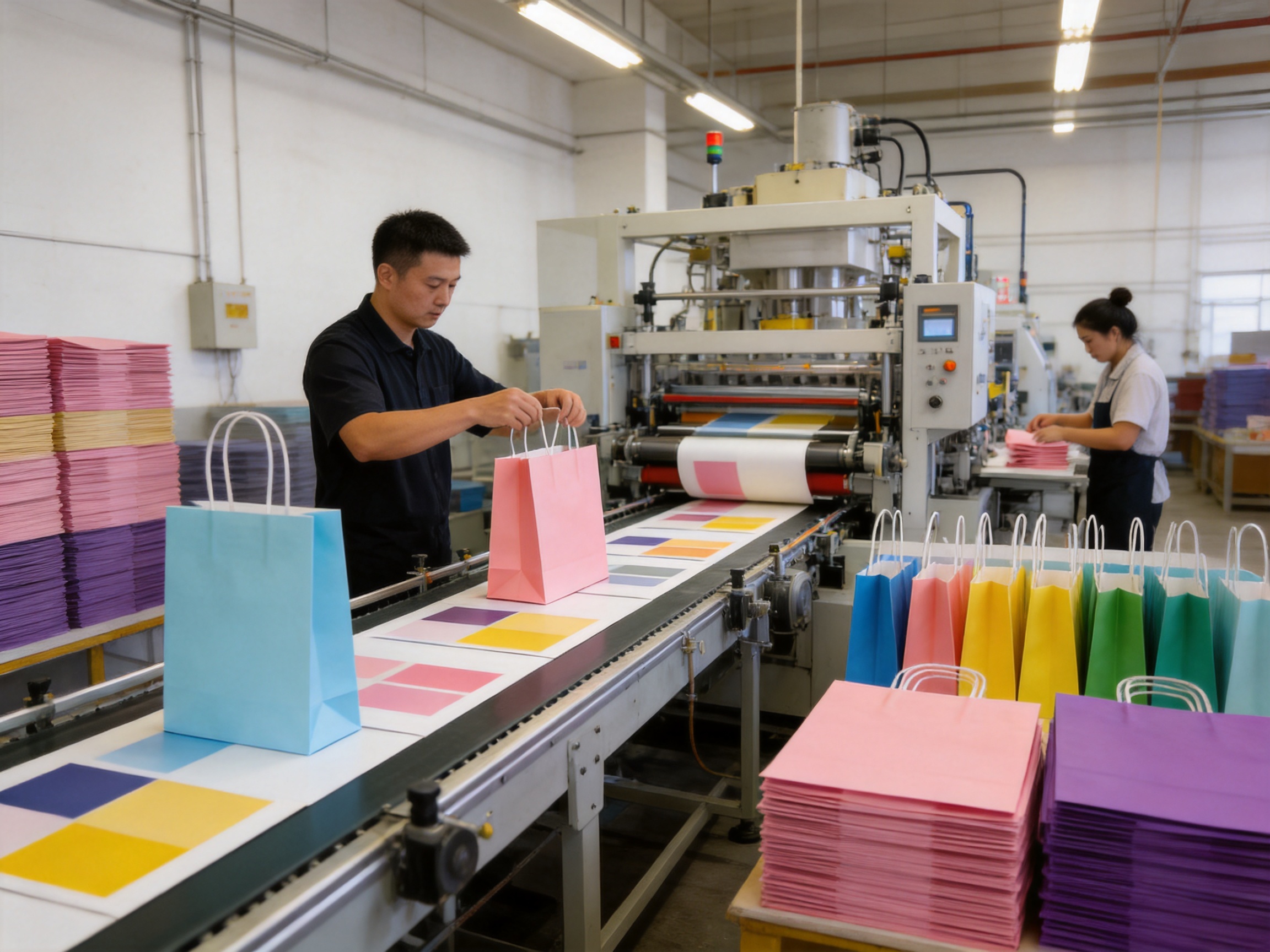
Integrated Production Strengths
The manufacturer behind this product has developed experience in paper packaging production over several decades. The business began in 1996 as Fushida Plastic Factory and was rebranded in 2019 as Magic Tree Paper Products Co., Ltd. Its product scope includes paper bags, gift bags, gift boxes, greeting cards, and patterned wrapping paper made from materials such as white cardboard, coated paper, and kraft paper.
This product range provides a useful foundation for customers that require coordinated packaging. A retailer may need shopping bags together with gift boxes, greeting cards, or wrapping paper. Working with a supplier experienced in several related product categories can make it easier to maintain consistent colors, themes, finishing methods, and delivery schedules across a complete packaging collection.
The company operates its own factory and manages multiple stages internally, including design and prepress, laminating, hot stamping, creasing, printing, bag making, and manual finishing. This integrated structure can provide several advantages over a trading company that simply forwards specifications between separate subcontractors.
Centralized Communication
When design, printing, assembly, and finishing are coordinated under one production system, technical communication is more direct. Buyers can discuss paper, color, dimensions, printing, handle details, and finishing with one manufacturing team. This reduces the possibility that important specifications will be lost when an order moves between unrelated suppliers.
Better Process Coordination
Paper packaging involves sequential operations. Printing must match the bag layout, creasing must support the folding design, and handle attachment must suit the completed structure. An integrated factory can schedule and coordinate these operations more efficiently. This may help reduce avoidable delays and improve consistency between production stages.
Support for OEM and ODM Projects
OEM customers may provide their own artwork, dimensions, brand standards, and packaging instructions. ODM customers may request assistance developing a complete packaging concept. The manufacturer’s capabilities in design, prepress, printing, finishing, and bag making support both types of cooperation.
Customization can include bag dimensions, paper weight, color, handle style, printing coverage, surface treatment, and packaging method. Buyers can therefore develop a product that reflects their market positioning rather than selecting only from a fixed catalog of standard bags.
Production Capacity for Wholesale Buyers
Annual output value exceeding 50 million yuan reflects a substantial commercial operation capable of serving volume-oriented customers. Capacity is important for wholesalers and distributors because packaging demand may increase during holidays, promotional campaigns, or retail expansion. A factory with established production systems can be better positioned to manage recurring orders and larger purchasing programs.
International Market Experience
The company serves customers in the United States, Canada, Mexico, the United Kingdom, Japan, and China. Experience with buyers from different markets can support clearer communication regarding packaging specifications, artwork preparation, product quality, and shipment planning. International experience may also help the factory understand that customers in different regions have different expectations for style, labeling, carton packing, and delivery coordination.
Comparison of Packaging Options
The following table presents a general comparison of common packaging choices. Actual performance depends on material grade, construction, product weight, printing requirements, and intended use.
| Packaging Option | Visual Character | Branding Potential | Carrying Convenience | Typical Applications |
| Candy Color Kraft Paper Shopping Bag | Colorful, friendly, gift-ready, and professional | Logo printing, labels, hot stamping, and custom graphics | Twisted paper handles and flat bottom | Retail, gifts, cosmetics, apparel, events, and specialty products |
| Plain Stock Paper Bag | Simple and functional | Limited unless separately labeled or printed | Depends on handle and construction | Basic retail and short-term carrying |
| Plastic Carrier Bag | Generally utilitarian | Can be printed, but may offer a different brand impression | Lightweight, depending on design | General retail and high-volume carrying |
| Rigid Gift Box | Premium and structured | High potential for decorative presentation | Usually requires a separate carrier for convenient transport | Luxury gifts, presentation sets, and premium products |
| Fabric Tote Bag | Reusable and lifestyle-oriented | Strong printing and embroidery potential | Reusable, but usually higher cost and storage volume | Promotional programs, events, and long-term reuse |
The paper shopping bag occupies a practical position between basic carrying packaging and premium presentation packaging. It generally costs less and requires less storage space than a rigid box, while offering a more polished appearance and stronger branding potential than an unprinted carrier. Compared with a reusable fabric bag, it can be more suitable for routine high-volume retail transactions where low unit cost and efficient distribution are important.
Customization Strategy for B2B Buyers
A successful custom packaging project begins with a clear specification. Buyers should identify the products that will be placed inside the bag, the expected carrying weight, the preferred dimensions, the required quantity, the artwork, the desired colors, and the target delivery schedule. Sharing product samples or accurate measurements can help the manufacturer recommend a better size and paper grade.
Choosing the Correct Dimensions
Dimensions should allow the product to fit comfortably without excessive empty space. Buyers should consider product height, width, depth, protective wrapping, and any additional inserts. If the bag will hold a box, the box dimensions should be measured rather than estimated. The flat-bottom construction should also be considered because the base area affects how products sit inside the bag.
Selecting Paper Weight
Paper weight influences stiffness, strength, folding behavior, appearance, and cost. A lightweight option may be appropriate for small accessories or low-weight products. A heavier grade may be preferred for larger bags, premium merchandise, or applications where customers expect a more substantial package. The selected grade should be tested with the intended product load before mass production.
Planning the Color System
Color choices should reflect the target customer and product category. Soft pastel shades can create a gentle and cheerful impression, while stronger colors may provide more energy and visibility. Buyers should decide whether all sizes will use one color, whether different colors will represent different product lines, or whether seasonal colors will be introduced for specific campaigns.
Preparing Artwork
Artwork should be supplied in a clear, high-resolution format with correct dimensions and colors. Important text and logos should be positioned away from folds, gussets, bottom creases, and handle attachment areas. The buyer should review spelling, contact details, legal marks, and brand colors before approving the production file.
Selecting Finishing Details
Printing alone may be sufficient for a simple retail bag. Other projects may benefit from hot stamping, special labels, laminating, or decorative paper choices. Finishing should support the product’s intended image without adding unnecessary cost or complexity. A manufacturer can help compare visual effects and production implications before the order is finalized.
Storage, Handling, and Use Recommendations
Paper bags should be stored in a clean, dry environment away from direct water exposure, excessive humidity, and sources of heat. Cartons should not be overloaded or placed where they may be crushed. Proper storage helps maintain the shape, surface appearance, and handle condition of the bags before use.
Retail employees should select the bag size according to the product load rather than forcing large or heavy items into a small format. Products should be placed evenly on the flat bottom, and sharp edges should be protected when necessary. Careful loading reduces stress on the side seams, bottom, and handles.
Although kraft paper bags are designed for everyday retail carrying, they are not intended to replace specialized moisture-resistant or heavy-duty industrial packaging in every application. Buyers should communicate the product type and carrying requirements to the manufacturer so that paper grade and construction can be selected appropriately.
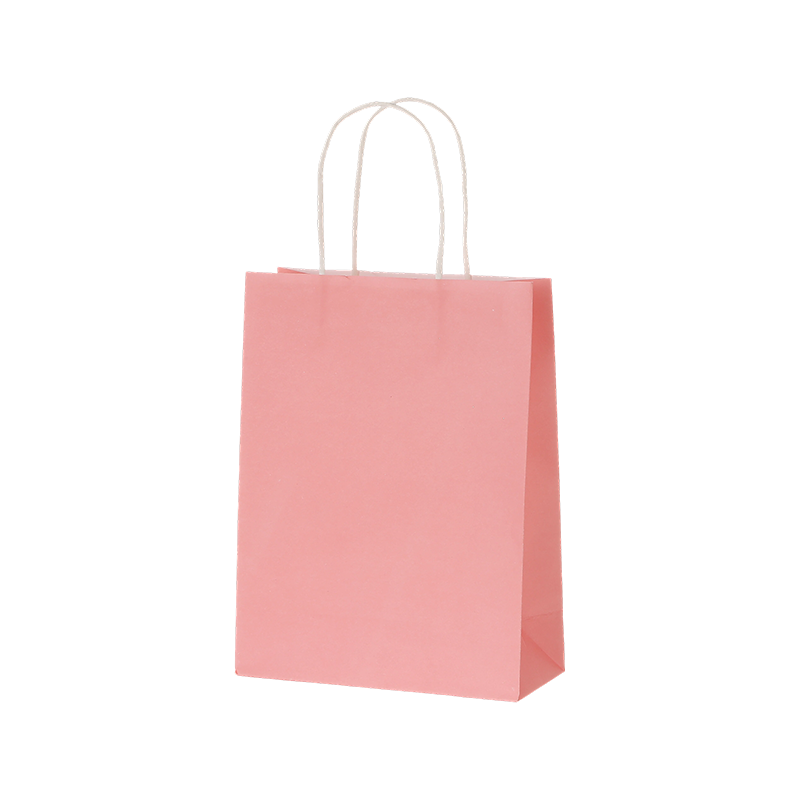
Why Color and Packaging Psychology Matter
Color influences how customers interpret a package. Pastel colors are often associated with softness, friendliness, creativity, celebration, and approachability. These associations make candy-color bags suitable for gift-oriented businesses and brands that want to create a light, welcoming experience.
Color can also support recognition. When a business repeatedly uses a distinctive shade or color family, customers may begin to associate that appearance with the store or product line. Consistency is important: the same color should be managed carefully across different bag sizes and reorders so that the packaging system remains visually unified.
However, color should not be considered separately from structure and print quality. A bright bag with poorly attached handles or uneven folding may weaken the overall impression. The strongest packaging result combines appropriate color with clean construction, accurate printing, suitable materials, and dependable manufacturing control.
Environmental Considerations
Paper packaging is often selected by businesses seeking alternatives to conventional plastic carriers. Kraft paper has a natural appearance and can support packaging strategies that emphasize paper-based materials. The environmental performance of a finished package depends on many factors, including the paper source, coatings, inks, adhesives, production energy, transportation, reuse, collection, and local recycling systems.
For buyers seeking more environmentally responsible packaging, it is important to discuss material grades and finishing methods with the manufacturer. Excessive coatings or mixed materials may affect recycling options in some regions. A simple paper construction may be preferable when the product application does not require additional surface protection.
Responsible packaging also means selecting the correct size and avoiding unnecessary material use. A bag that fits the product efficiently can reduce wasted paper and shipping volume. Durable construction may help prevent premature failure and reduce the need for replacement bags during normal use.
Quality, Reliability, and Long-Term Procurement
For B2B purchasing, quality is not limited to the appearance of one sample. Buyers need confidence that repeated orders will maintain similar paper feel, dimensions, printing position, color, handle attachment, and packing standards. This is why manufacturing experience, process control, and in-house capabilities are important when evaluating a supplier.
A reliable supplier should be able to discuss material options, provide production samples when appropriate, confirm artwork, explain lead times, and communicate packing details. Clear approval procedures help reduce misunderstandings. For recurring orders, keeping a reference sample or approved color standard can help maintain continuity.
Magic Tree’s experience in paper packaging, combined with its own factory and broad process capabilities, provides a foundation for long-term procurement. The company’s product range and international customer base also make it suitable for buyers seeking a partner that can support both individual bag projects and broader packaging programs.
Frequently Asked Questions
What products can be carried in these paper shopping bags?
The bags can be used for cosmetics, apparel, accessories, gifts, bakery products, stationery, promotional items, and many other lightweight to medium-weight retail products. The appropriate bag size and paper weight should be selected according to the product dimensions and carrying load.
Are the twisted paper handles comfortable to use?
Twisted paper handles are designed to provide a practical grip for everyday retail carrying. Their comfort and performance depend on handle length, paper specification, bag size, attachment method, and the weight of the contents.
Can the bags be customized with a company logo?
Yes. The smooth surface can be prepared for custom logo printing, labels, hot stamping, and other branding methods. Buyers should provide artwork and confirm the desired print position, colors, and coverage before production.
Can buyers request custom colors?
Custom colors may be available depending on the order quantity, paper material, printing method, and production requirements. Buyers can discuss brand colors, seasonal shades, or a coordinated color system with the manufacturer.
Are different sizes available?
Yes. Multiple sizes can be produced for different products and retail applications. Custom dimensions are also available for OEM and ODM projects, subject to production specifications and order requirements.
Can the bags be ordered with other paper packaging products?
The manufacturer also produces gift bags, gift boxes, greeting cards, and patterned wrapping paper. This may allow buyers to coordinate several packaging items through one supplier.
How should artwork be prepared?
Artwork should be supplied in a clear, high-resolution production format. Important graphics and text should be kept away from folds, gussets, bottom creases, and handle areas. A prepress review is recommended before mass production.
Can the bags stand upright?
The flat-bottom construction allows the bags to stand upright when opened and loaded. This supports faster packing and can improve product presentation on counters or temporary display areas.
Are these bags suitable for direct contact with food?
Food applications should be evaluated according to the specific product, internal packaging, paper grade, ink, adhesive, and regulatory requirements. Buyers should communicate the intended use before ordering. For many bakery and takeaway applications, the paper bag serves as an outer carrier for separately packaged products.
What finishing options are available?
Depending on the project, options may include standard printing, laminating, hot stamping, labels, special paper colors, and other surface treatments. The suitable combination depends on the desired appearance, budget, and use conditions.
Why is an integrated factory useful for custom packaging?
An integrated factory can coordinate design, prepress, printing, creasing, bag making, finishing, and inspection within one production system. This can simplify communication, improve process coordination, and support more consistent results across large orders.
How can buyers begin a custom project?
Buyers should provide the intended product application, approximate dimensions, product weight, quantity, artwork, preferred color, handle requirements, finishing preferences, and delivery destination. The manufacturer can then review the project and recommend suitable specifications.
Conclusion
Candy Color Kraft Paper Shopping Bags with Twisted Paper Handles combine attractive presentation, practical carrying performance, and flexible customization. Their pastel colors create a cheerful retail identity, while the flat-bottom design supports efficient loading and upright presentation. The twisted paper handles provide a coordinated and comfortable carrying solution, and the smooth surface gives businesses space for logos, labels, promotional graphics, and decorative finishes.
Compared with generic carriers, these bags offer stronger visual differentiation and greater potential for brand communication. Compared with rigid gift packaging, they are lighter, easier to store, and more suitable for regular retail distribution. Their range of sizes, colors, paper weights, handle styles, and printing options makes them appropriate for retailers, wholesalers, event organizers, distributors, and OEM customers.
The manufacturing strength behind the product is equally important. Experience dating back to 1996, in-house production, design and prepress support, printing, laminating, hot stamping, creasing, bag making, and manual finishing provide a strong foundation for consistent packaging production. With international market experience and a broad paper product range, the manufacturer can support both individual shopping bag orders and complete coordinated packaging programs.
For businesses seeking a colorful, customizable, and commercially practical paper packaging solution, this product provides a balanced combination of appearance, usability, manufacturing flexibility, and long-term procurement value.
References
1. General principles of paper packaging design and structural development.
2. Kraft paper material selection guidelines for retail and gift packaging.
3. Packaging printing, color management, and prepress preparation practices.
4. Paper bag converting, creasing, bottom formation, and handle attachment procedures.
5. Retail packaging usability and customer presentation considerations.
6. Sustainable paper packaging evaluation principles, including material selection, finishing, storage, transportation, and end-of-life considerations.
7. Manufacturer-provided product specifications and company information for Candy Color Kraft Paper Shopping Bags with Twisted Paper Handles.