中文简体
 русский
 Français
 Español
 Deutsch
 عربى

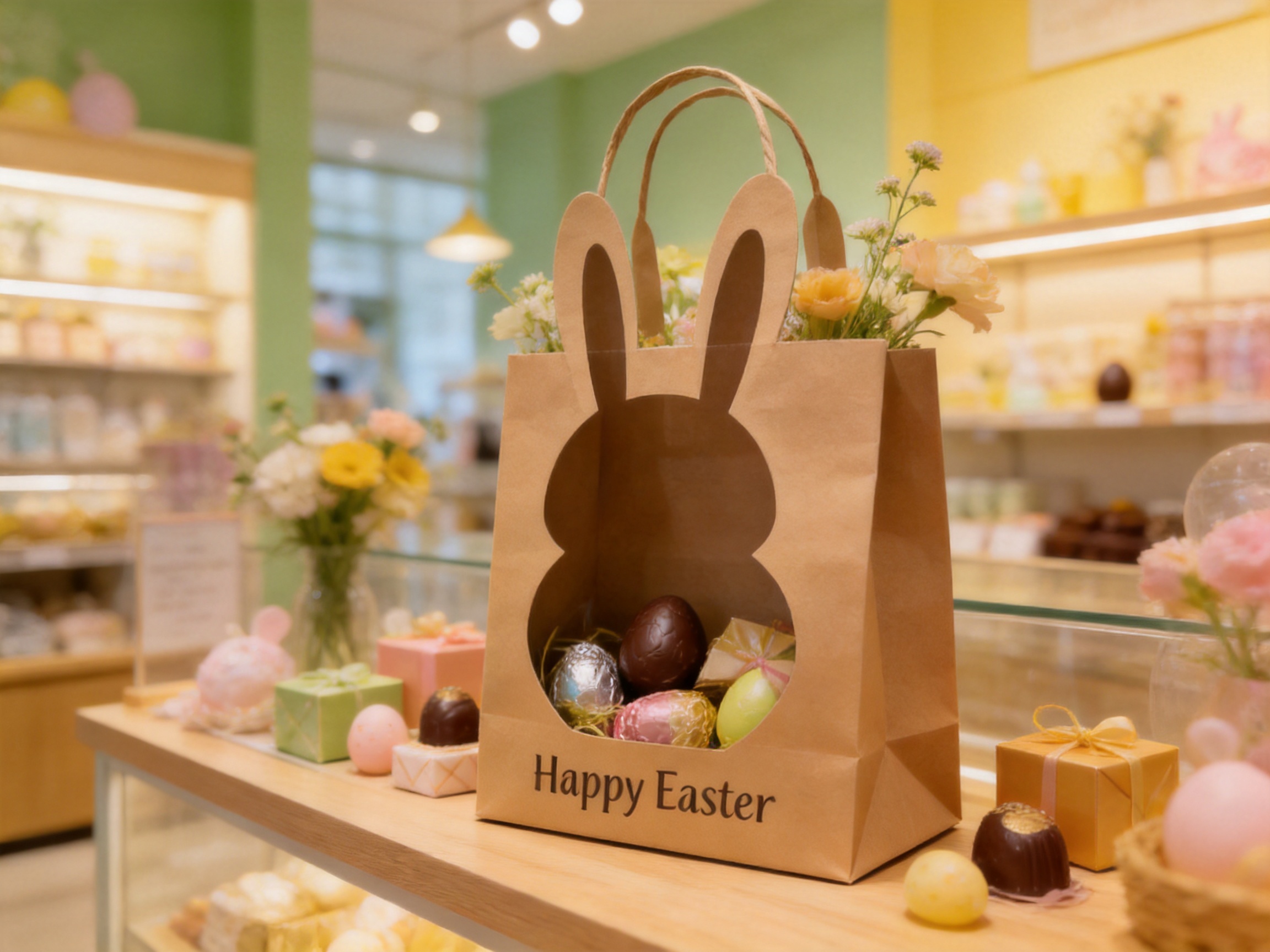
Easter packaging has a special role in seasonal merchandising. It must be attractive enough to create excitement, practical enough for carrying gifts, and economical enough for retailers, event organizers, bakeries, florists, and promotional campaigns. The Eco-Friendly Kraft Paper Easter Rabbit-Shaped Gift Bag meets these needs by combining a recognizable seasonal silhouette with the natural appearance and useful performance of kraft paper. Its rabbit-shaped design immediately communicates Easter gifting, while its handles make it convenient for customers to transport small presents, confectionery, accessories, toys, and other retail products.
Unlike ordinary paper shopping bags that rely mainly on printed decoration to create seasonal appeal, a rabbit-shaped bag uses the structure of the package itself as part of the visual presentation. The distinctive outline can make a product display more noticeable, support gift-ready merchandising, and reduce the need for additional decorative wrapping. At the same time, kraft paper gives the bag a warm, earthy appearance that suits brands seeking a natural or environmentally responsible packaging image.
This article examines the design, materials, manufacturing advantages, customization possibilities, applications, and purchasing considerations associated with this type of Easter gift bag. It also explains how Yiwu Magic Tree Gift Bag Co., Ltd. supports the production of custom paper packaging through integrated design, printing, finishing, bag making, and quality management capabilities.

Eco-Friendly Kraft Paper Easter Rabbit-Shaped Gift Bag
1. Product Overview
The Eco-Friendly Kraft Paper Easter Rabbit-Shaped Gift Bag is a seasonal paper packaging product designed for retail presentation and gift carrying. Its primary material is kraft paper, a widely used paper substrate valued for its natural appearance, printability, recyclability, and practical strength. The bag includes handles so that customers can carry purchases more comfortably after leaving a shop, event, or promotional venue.
The rabbit-shaped format is the product’s central visual feature. Easter rabbits are widely associated with spring celebrations, egg hunts, candy, family activities, and gift exchange. By incorporating the rabbit form into the bag design, the packaging can function as both a container and a seasonal decoration. This gives retailers an opportunity to make the package part of the customer experience rather than treating it as a disposable transport item.
The bag can be used for small and medium-sized gifts, depending on the selected dimensions, paper grade, handle construction, and bottom design. Typical contents may include chocolate eggs, boxed sweets, small toys, beauty products, stationery, accessories, candles, clothing items, promotional samples, and boutique merchandise. Final load-bearing performance should be evaluated according to the size, paper thickness, construction, and intended contents.
For businesses, the product offers a balance between visual character and production practicality. Kraft paper can accept logos, short messages, illustrations, seasonal patterns, and brand colors. This enables a retailer or brand to order a product that is both festive and commercially identifiable. The same basic format can also be adapted for different holidays or promotional events by changing the printed artwork and surface details.
2. Why Rabbit-Shaped Packaging Creates Stronger Seasonal Appeal
Standard bags often depend on printed graphics to communicate a holiday theme. Although printing remains valuable, the overall silhouette of a package can have an even faster visual effect. A rabbit-shaped gift bag is recognizable at a glance, which can help customers understand the intended occasion before reading any text. This is particularly useful in crowded retail environments, seasonal pop-up stores, school events, community celebrations, and gift displays.
The shape also gives the package a more playful personality. A conventional rectangular bag may be suitable for everyday shopping, but a rabbit-inspired format feels more connected to Easter gifting. It can help create a sense of discovery when children receive treats or small presents, and it can make a boutique purchase feel more carefully prepared. For brands that sell products through visual merchandising, this emotional quality can support a stronger connection between the package and the product inside.
Rabbit-shaped packaging can also support cross-selling. A retailer may place the bags near Easter chocolates, decorative eggs, plush toys, greeting cards, or spring-themed products. The bag itself can remind shoppers that they may need packaging for a gift. This turns a functional packaging item into a merchandising tool that encourages additional purchases.
Another advantage is memorability. A distinctive seasonal bag is more likely to stand out in photographs, gift tables, and customer-generated social media content than a plain shopping bag. When a customer carries a recognizable Easter bag through a public space, the package can reinforce the store’s seasonal identity. This benefit is especially useful for independent retailers and small brands that want their packaging to contribute to brand awareness without relying entirely on expensive advertising.
3. The Material Advantages of Kraft Paper
Kraft paper is widely selected for paper bags because it offers a practical combination of natural appearance, flexibility, and useful print performance. Its brown or earthy base color can communicate simplicity, authenticity, and connection with natural materials. These visual qualities are popular among retailers that want packaging to look less synthetic and more aligned with current consumer interest in responsible materials.
One important advantage of kraft paper is its suitability for recycling when it is produced and finished in a way that supports normal paper recovery systems. Recycling conditions can vary according to local facilities, coatings, laminations, adhesives, inks, and contamination. For that reason, responsible product communication should avoid treating every paper bag as automatically recyclable in every location. Nevertheless, kraft paper is commonly considered a more environmentally considerate packaging choice than many single-use plastic alternatives, particularly when the bag is appropriately designed and disposed of through available recycling channels.
Kraft paper can also be reused. A customer may use the bag to carry another small item, store craft materials, organize household goods, or prepare another gift. Reuse depends on the bag’s condition and construction, but a durable, attractive design is more likely to be kept than a plain package that has little visual value after purchase.
From a printing perspective, kraft paper provides a textured, natural background that can work well with dark inks, simple line art, white ink, seasonal colors, and minimalist branding. A business can print a logo, a short greeting, product information, a care message, or an illustrated Easter pattern. The printed result may intentionally retain some of the paper’s natural character, which can be desirable for rustic, handmade, organic, and boutique brand identities.
The material also supports a broad range of design directions. A manufacturer may produce an understated bag with one-color printing, a colorful seasonal version with multiple printed elements, or a premium-looking design using hot stamping and other decorative techniques. This flexibility allows the same kraft paper foundation to serve different market positions and price points.
4. Product Advantages Compared with Ordinary Seasonal Bags
| Feature | Rabbit-Shaped Kraft Paper Gift Bag | Plain Paper Shopping Bag | Decorative Plastic Gift Bag |
|---|---|---|---|
| Seasonal recognition | High, because the silhouette and artwork can both express Easter | Usually depends mainly on printing | May use colorful graphics but often has a less natural appearance |
| Material image | Natural, paper-based, and suitable for eco-conscious positioning | Natural, depending on paper grade and finish | Often associated with synthetic materials |
| Brand customization | Logo, message, pattern, color, and finishing options | Usually customizable but visually more conventional | Custom printing is possible but may not suit every brand image |
| Gift presentation | Strong, because the package itself becomes part of the gift | Functional, but generally less distinctive | Can be attractive but may feel less suitable for natural-positioned brands |
| Reuse potential | Can be reused when construction and condition permit | Depends on strength and design | May be reused, but disposal concerns can affect perception |
| Merchandising value | High for Easter displays, events, and seasonal promotions | Moderate | Moderate to high depending on design |
The comparison shows that the rabbit-shaped kraft paper bag is not simply an alternative container. It combines the practical role of a shopping bag with the communication value of a seasonal display item. It may be especially advantageous for businesses that want one product to support carrying convenience, gift presentation, and visual marketing at the same time.
Compared with a standard rectangular paper bag, the rabbit-shaped version offers greater thematic relevance. A conventional bag may be cheaper in some cases because its cutting and forming process is more standardized, but it may require additional tissue paper, stickers, ribbons, or printed inserts to create a comparable Easter presentation. A purpose-designed seasonal bag can reduce the need for some of these extra elements, although the total cost should always be assessed according to order quantity, material specification, artwork, finishing, and packaging requirements.
Compared with plastic gift bags, kraft paper can provide a different tactile and visual experience. The paper surface feels more substantial and can support a handmade or premium retail atmosphere. Businesses with sustainability-oriented messaging may also find it easier to align a paper product with their broader packaging strategy. Environmental performance, however, should be assessed across the full product life cycle, including raw materials, manufacturing, transport, use, and end-of-life treatment.
5. Custom Printing Opportunities
Printing is one of the most effective ways to adapt the Easter rabbit-shaped bag to a specific business. A shop may add its logo to improve recognition, while a gift supplier may print a general Easter greeting that can be used across several retail channels. Brands may also combine a small logo with seasonal artwork to make the bag festive without losing a consistent identity.
Common printed elements include company names, logos, slogans, website information, social media handles, product categories, care messages, and seasonal greetings. For example, a bakery may use a rabbit illustration with a short Easter message, while a children’s retailer may choose bright colors and playful patterns. A premium gift shop may prefer a restrained design with one or two ink colors on natural kraft paper.
Artwork should be prepared with the final bag structure in mind. The rabbit-shaped cutting line, handle area, side folds, bottom folds, and adhesive zones can affect where artwork may be placed. Important text and logos should not be positioned too close to edges or creases. A professional prepress review can help ensure that the approved design remains visually balanced after printing, cutting, folding, and assembly.
Color selection is also important. Dark colors often contrast clearly with brown kraft paper, while light or pastel shades may require special ink treatment to achieve the intended appearance. White ink can be used when a design requires stronger contrast, but it may alter the cost and production process. The final effect depends on the paper shade, ink system, printing method, coverage area, and finishing requirements.
Businesses ordering customized bags should provide clear information about the intended use, estimated quantity, artwork format, preferred paper color, handle style, size, and delivery schedule. A manufacturer can then recommend a suitable specification and identify potential production issues before mass manufacturing begins.
6. Manufacturing Process and Production Control
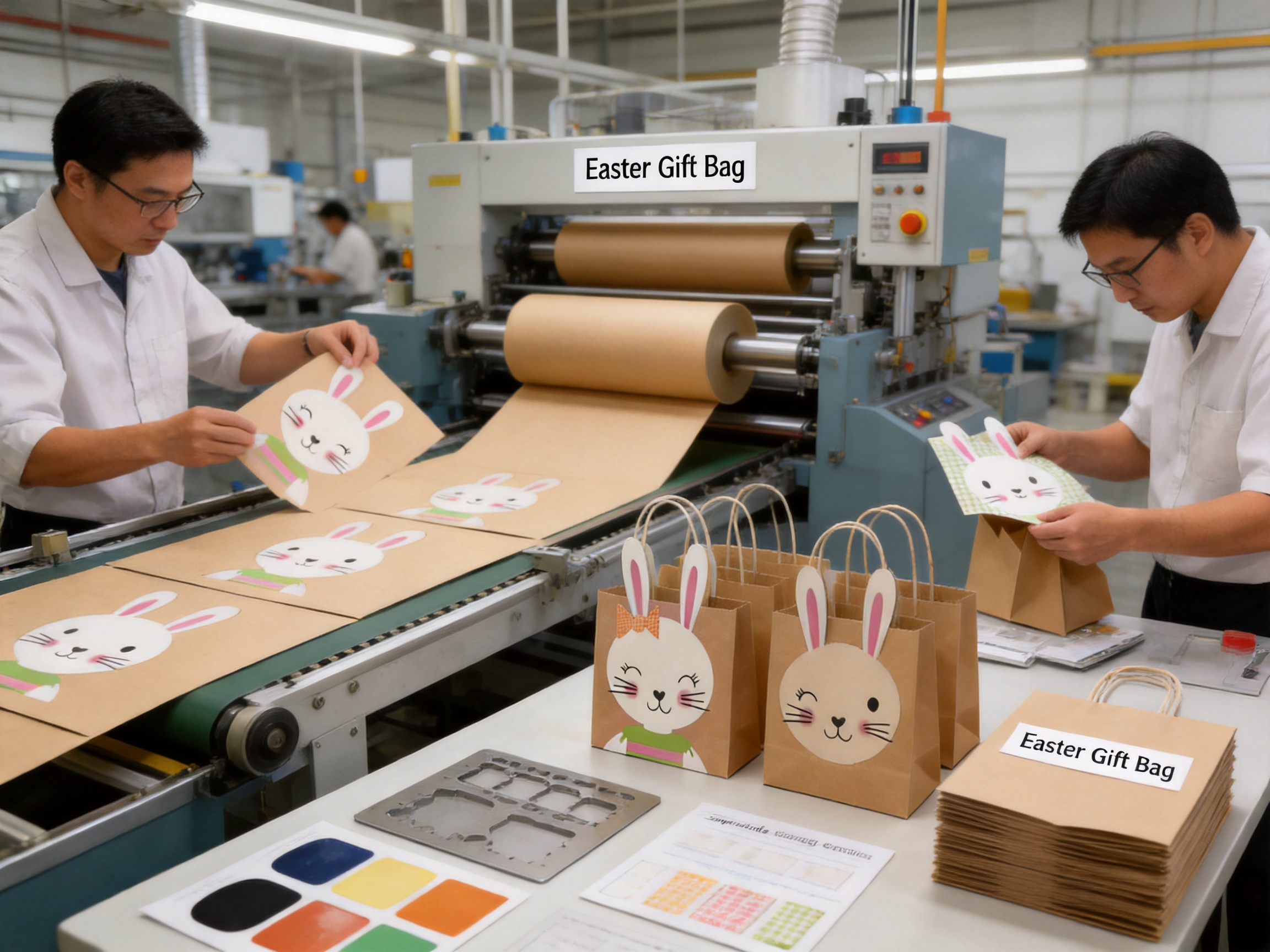
The quality of a paper gift bag is determined by more than its artwork. Paper selection, printing accuracy, cutting precision, folding, adhesive application, handle attachment, manual finishing, and final inspection all influence the finished product. An integrated factory is able to coordinate these stages more effectively than a supplier that outsources every operation to unrelated workshops.
6.1 Design and Prepress Preparation
The production process begins with design confirmation and prepress preparation. The manufacturer reviews the bag structure, artwork, color requirements, dimensions, folds, handle position, and decorative elements. At this stage, the design team can identify whether text may be hidden by a fold, whether an illustration is aligned with the rabbit-shaped outline, and whether the selected colors are appropriate for kraft paper.
Prepress preparation also includes checking image resolution, bleed allowances, color separations, print orientation, and the relationship between the front and back panels. These details are particularly important for shaped packaging because the visual balance of the finished bag depends on the cutting and folding geometry. Careful preparation reduces the chance of repeated corrections after printing has started.
6.2 Raw Material Selection
Paper selection affects appearance, strength, folding performance, and printability. Kraft paper may be specified by weight, thickness, color, surface character, and intended carrying capacity. A small bag for lightweight candy can use a different grade from a larger bag intended for boxed products or multiple retail items.
The factory’s experience with white cardboard, coated paper, and kraft paper enables it to match material selection with product requirements. A suitable paper should be compatible with the cutting process, folding lines, adhesive system, and printing method. It should also provide an appearance consistent with the customer’s brand positioning.
Material consistency is important for wholesale buyers. Variations in paper color, surface texture, or moisture can affect printing and folding. Effective production management includes checking incoming materials and maintaining clear specifications for each order.
6.3 Printing
Printing transfers the approved design to the paper surface. Depending on the artwork and order requirements, the process may include one-color printing, multiple-color printing, or other customized treatments. The goal is to maintain clear images, legible text, and consistent color across the production run.
Printing on kraft paper requires attention to the natural base color. The same ink can appear different on brown kraft paper compared with white paper or coated stock. Designers and purchasing teams should evaluate color expectations using appropriate proofs or production samples rather than relying only on screen images. This is especially important when a brand has strict color requirements.
Registration accuracy matters when the design includes several colors, borders, repeated patterns, or small details. A professional printing and inspection process helps maintain a consistent visual result across the bag quantity. The manufacturer’s in-house production capabilities can make it easier to communicate adjustments between the printing and bag-making stages.
6.4 Laminating and Surface Finishing
Laminating and other surface treatments may be selected according to the desired appearance, durability, and product positioning. A natural kraft paper bag may intentionally remain uncoated to preserve its paper texture and environmentally oriented image. In other cases, a protective or decorative finish may be considered for improved surface resistance or a more premium appearance.
Finishing choices should be evaluated carefully because coatings and laminations can influence recyclability, tactile quality, cost, and lead time. A business seeking a straightforward eco-friendly packaging solution may prefer a simpler specification, while a luxury retailer may prioritize decorative appearance. The manufacturer can help balance these objectives based on the intended application.
6.5 Hot Stamping and Decorative Details
Hot stamping can add a metallic or high-contrast decorative element to a design. On an Easter bag, it may be used for a logo, short greeting, small border, or selected illustration detail. Used selectively, this process can create a premium accent without covering the entire surface.
Decorative techniques should be planned around the bag’s folds and cutting lines. Small changes in placement can affect the final appearance, especially on a shaped product. Professional prepress and finishing coordination helps ensure that decorative elements are placed where they can be seen clearly and remain aligned after assembly.
6.6 Creasing, Cutting, and Bag Making
Creasing prepares the paper for controlled folding. Accurate creases help create clean side panels, bottom folds, and structural transitions. On a rabbit-shaped bag, the cutting die or cutting system must follow the approved outline so that the rabbit form remains recognizable and symmetrical.
Bag making combines the printed and cut components into a usable package. This can include folding, gluing, forming the base, attaching handles, and reinforcing selected areas. The quality of the adhesive bond is important because weak bonding may cause the bag to open during handling, while excessive adhesive may affect the appearance.
Handle attachment is another key production step. Handles should be positioned consistently and secured according to the intended load and paper specification. A comfortable handle can significantly improve the customer experience, especially when the bag contains several small items or is carried over a distance.
6.7 Manual Finishing and Inspection
Some paper packaging products require manual finishing after automated or semi-automated processing. Workers may inspect folds, adjust components, remove minor production residue, confirm handle attachment, and prepare the bags for packing. Manual finishing is particularly useful for products with unusual shapes, decorative components, or multiple assembly details.
Final inspection should evaluate print quality, shape accuracy, adhesive bonding, handle placement, surface condition, quantity, and packing. Quality standards should be agreed before production, especially for wholesale orders. Sample approval, production monitoring, and final inspection can help reduce the risk of receiving bags that do not match the approved specification.
7. Integrated Factory Strengths
Yiwu Magic Tree Gift Bag Co., Ltd. has a long manufacturing background in paper packaging. The company was founded in 1996 as Fushida Plastic Factory and was rebranded in 2019 as Magic Tree Paper Products Co., Ltd. With nearly three decades of experience, the company has developed capabilities covering several important paper packaging categories.
Its product range includes paper bags, gift bags, gift boxes, greeting cards, and patterned wrapping paper. This category breadth is useful for buyers seeking coordinated seasonal packaging. A retailer may require bags, boxes, cards, and wrapping paper with matching artwork. Working with a supplier that understands all of these products can simplify design coordination and purchasing communication.
The company’s manufacturing capabilities include professional design and prepress, laminating, hot stamping, creasing, printing, bag making, and manual finishing. These in-house processes support greater control over the production sequence. When design, printing, finishing, and assembly are managed within one manufacturing organization, it can be easier to resolve technical questions and maintain consistency among different product components.
Magic Tree operates its own factory and manages the production process from raw materials to finished products. This structure supports oversight of material selection, production scheduling, process coordination, and quality control. It also allows the factory to develop practical knowledge about how different papers behave during printing, folding, gluing, and finishing.
The company reports an annual output value exceeding 50 million yuan and serves customers in the United States, Canada, Mexico, the United Kingdom, Japan, and China. Experience with international customers can help a supplier understand the importance of packaging specifications, export preparation, communication, production timing, and consistent quality. International buyers should still confirm current certifications, testing documents, packaging requirements, and shipping terms for each order.
For businesses looking for more than a standard stock bag, the combination of design support and manufacturing capability is a significant advantage. A product such as the Easter rabbit-shaped gift bag may require careful coordination between the artwork and the unusual outline. A supplier with prepress, cutting, printing, bag making, and manual finishing experience can help transform a concept into a practical finished product.
8. Environmental Considerations
The environmental value of a paper package depends on responsible material selection and actual use. Kraft paper is widely associated with recyclable packaging, but the full specification matters. Paper weight, coatings, laminations, metallic elements, adhesives, ink coverage, transport distance, and disposal infrastructure can all affect the product’s environmental profile.
A practical approach is to design the bag with an appropriate amount of material rather than using excessive paper for a lightweight product. The bag should be strong enough for its intended contents but not unnecessarily overbuilt. Accurate sizing can also reduce wasted internal space and improve transport efficiency.
Printing and finishing should be selected according to the customer’s real needs. A simple one-color design may require fewer materials and less processing than a heavily decorated version. This does not mean that every product should be plain; rather, the design should balance visual impact, brand value, cost, and environmental objectives.
Reuse can extend the useful life of the package. A rabbit-shaped Easter bag may be kept for children’s crafts, seasonal storage, gift giving, or household organization. An attractive design and a sturdy construction can increase the likelihood that the customer will use the bag again before disposal.
Businesses should provide accurate disposal guidance where appropriate. If a bag includes non-paper components or surface treatments, the customer may need to follow local recycling instructions. Clear communication is more credible than making broad environmental claims without explaining the conditions that support them.
9. Applications Across Different Markets
9.1 Retail Stores
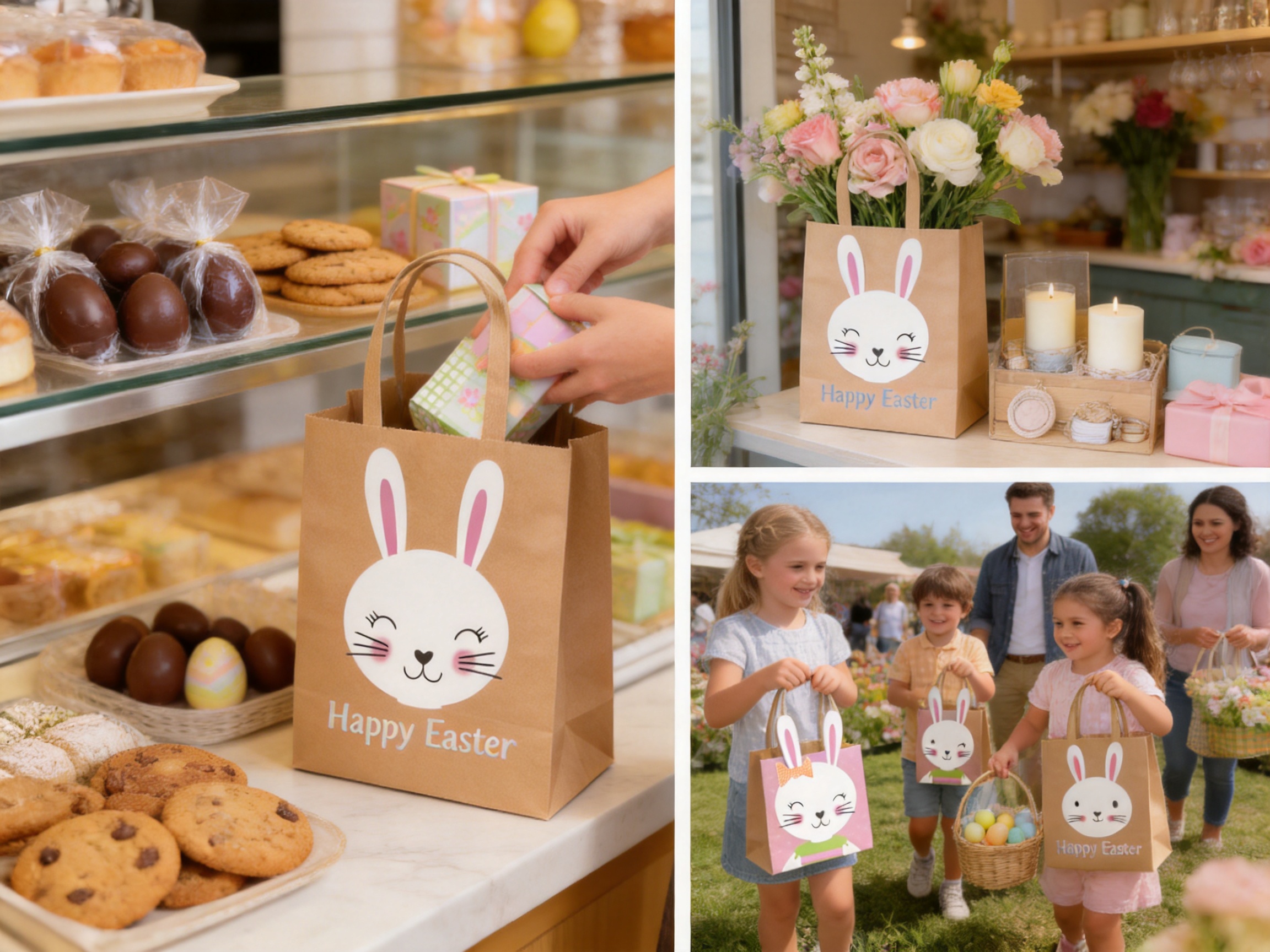
Gift shops, department stores, clothing boutiques, bookstores, toy shops, and specialty retailers can use the bags during Easter sales campaigns. The rabbit-shaped form gives even a small purchase a seasonal presentation. Retailers can print their logos to maintain brand visibility after the customer leaves the store.
9.2 Bakeries and Confectionery Brands
Bakeries and candy businesses can use the bags for chocolate eggs, cookies, boxed cakes, marshmallow products, and other seasonal treats. The bag should be selected in a suitable size and should not be used as direct food-contact packaging unless it has been specifically manufactured and approved for that purpose. Individually wrapped or boxed food items are generally more suitable for a secondary gift bag application.
9.3 Florists and Spring Gift Businesses
Florists and seasonal gift shops can use rabbit-shaped kraft bags for small plants, accessories, decorative items, and spring-themed gift sets. The natural paper surface can complement flowers, dried arrangements, and handmade products. A coordinated printed pattern can help unify the store’s Easter display.
9.4 Schools and Community Events
Schools, community centers, charities, and event organizers may use customized bags for Easter activities, egg hunts, promotional programs, and family events. A short message or event name can be printed on the bag, allowing it to serve as both a giveaway package and a keepsake.
9.5 Corporate Promotions
Companies can use seasonal gift bags for employee gifts, client packages, retail promotions, and spring campaigns. A discreet logo and a carefully selected Easter design can communicate a seasonal message without making the packaging feel overly commercial. The bag may be paired with a greeting card, gift box, or branded wrapping paper from the same production program.
9.6 Online Retail and Subscription Boxes
Online stores can use the bags for selected orders, influencer packages, limited-edition promotions, and seasonal customer gifts. The bag may be folded or packed in a manner that protects its shape during transport. Buyers should discuss shipping compression, carton packing, and handling requirements with the manufacturer before placing a large order.
10. Buying Considerations for Wholesale Customers
Wholesale customers should begin by identifying the products that will be carried in the bag. This determines the required dimensions, paper weight, base construction, handle type, and overall strength. A bag designed for lightweight candy does not necessarily have the same requirements as one intended for boxed cosmetics or multiple retail items.
Next, the buyer should determine whether a standard design or a custom design is more appropriate. A standard product may offer a shorter preparation period and simpler purchasing process. Custom printing can provide stronger brand recognition but may require artwork preparation, sampling, plate or setup costs, color confirmation, and a longer production schedule.
Order quantity is another major consideration. Larger quantities may provide better unit economics, while smaller quantities may be suitable for testing a new design or serving a limited seasonal campaign. Buyers should ask about minimum order quantities, sample procedures, production lead time, packing method, and available shipping options before confirming the order.
It is also important to clarify the environmental specification. Buyers should ask what type of kraft paper is used, whether the bag includes coatings or laminations, whether recycled content is available, and what documentation can be supplied. Environmental claims should be based on verifiable product information rather than general assumptions.
Artwork files should be supplied in the format requested by the manufacturer. Vector logos, high-resolution images, correct fonts, and clear color references can reduce delays. Buyers should approve a digital proof or physical sample before mass production, particularly when the bag has a shaped outline or complex printing requirements.
Packaging for shipment should be discussed in advance. Bags need protection from moisture, crushing, contamination, and excessive pressure. The manufacturer and buyer should agree on inner packing, outer cartons, quantity per carton, carton markings, and any pallet requirements relevant to the destination market.
11. Quality and Performance Checklist
| Inspection Area | Questions to Confirm | Why It Matters |
|---|---|---|
| Paper material | What paper grade, weight, color, and recycled content are specified? | Material affects strength, appearance, print result, and environmental positioning. |
| Dimensions | Are the finished width, height, side gusset, and bottom dimensions correct? | Accurate size ensures that the intended products fit properly. |
| Shape cutting | Is the rabbit outline clean, centered, and consistent? | The silhouette is a key part of the product’s seasonal appeal. |
| Printing | Are logos, patterns, text, and colors consistent with the approved proof? | Printing quality affects brand presentation and customer recognition. |
| Folding and creasing | Are folds clean, aligned, and free from unwanted cracking? | Good creasing supports appearance and structural assembly. |
| Handles | Are handles securely attached and positioned evenly? | Handle performance affects carrying comfort and product safety. |
| Adhesive bonding | Are seams and bottom areas firmly bonded? | Reliable adhesion helps prevent opening during normal use. |
| Finishing | Are hot stamping, lamination, or other finishes applied correctly? | Finishing details influence perceived quality and durability. |
| Shipment packing | Are bags protected from moisture, crushing, and contamination? | Proper packing helps preserve the finished product during transport. |
A written checklist can help buyers and suppliers share the same expectations. It is particularly useful when the order includes several related products, such as matching gift boxes, greeting cards, and wrapping paper. Consistent specifications make it easier to coordinate the entire seasonal packaging collection.
12. Coordinating the Bag with Other Paper Packaging
The rabbit-shaped gift bag can be used as part of a broader Easter packaging system. Matching greeting cards can carry a personal message, while patterned wrapping paper can provide additional decorative support for larger gifts. Gift boxes can be used for structured products, with the rabbit-shaped bag serving as the outer carrying package.
Coordinated packaging does not require every item to use exactly the same artwork. A brand may use a shared color palette, repeated illustration, common logo placement, or similar paper texture across all products. This creates a consistent visual identity while allowing each item to perform a different function.
For example, a retailer may choose natural kraft paper bags with dark green printing, matching greeting cards with a rabbit illustration, and wrapping paper with a repeating spring pattern. A more playful brand may use pastel colors, bold graphics, and contrasting handles. A premium brand may combine an understated kraft bag with a simple logo and a small hot-stamped detail.
Using one experienced manufacturer for several products can reduce the risk of mismatched colors, inconsistent paper tones, and differences in seasonal artwork. It may also simplify ordering, sampling, production communication, and shipment planning.
13. How the Product Supports Brand Positioning
Packaging is often the first physical contact a customer has with a brand after making a purchase. A well-designed bag can reinforce whether the brand feels practical, playful, premium, handmade, natural, or family-oriented. The Easter rabbit-shaped format immediately supports a cheerful and seasonal position, while kraft paper adds an earthy and approachable quality.
Small businesses may benefit particularly from customized bags because packaging can help them look more established. A clear logo and consistent design can make a local boutique, bakery, or gift shop more recognizable. At the same time, the rabbit shape gives the package character that a plain logo-only bag may lack.
For larger brands, the product can support limited seasonal campaigns. A company may use the bag for a specific Easter collection, promotional event, or short-term retail program without changing its year-round packaging system. Because the design can be adapted through printing and finishing, the product can be tailored to campaign objectives.
The bag can also encourage positive customer behavior. A customer who reuses an attractive paper bag may expose the brand logo or seasonal design to additional people. Although this secondary visibility cannot be guaranteed, it is one reason why useful and attractive packaging can contribute to longer-term brand recognition.
14. Frequently Asked Questions
Q1: What is the main purpose of the Easter rabbit-shaped gift bag?
The bag is designed to carry small and medium-sized gifts or retail purchases while providing a strong Easter-themed presentation. Its rabbit-shaped design makes it suitable for seasonal merchandising, gift giving, promotional activities, and event packaging.
Q2: Is kraft paper suitable for custom printing?
Yes. Kraft paper can accept logos, messages, illustrations, patterns, and seasonal artwork. Because its natural base color can influence the appearance of printed inks, customers should review artwork proofs and discuss color expectations with the manufacturer before production.
Q3: Can the bag be customized with a company logo?
Yes. Custom printing can include a company logo, slogan, contact details, seasonal message, or other approved artwork. The final customization options depend on the bag size, paper specification, printing method, order quantity, and finishing requirements.
Q4: Is the bag recyclable?
Kraft paper is commonly recyclable, but recyclability depends on the complete product specification and local recycling facilities. Coatings, laminations, metallic details, adhesives, and contamination may affect disposal. Buyers should confirm the exact material and finish before making specific recycling claims.
Q5: Can customers reuse the bag?
Yes, the bag may be reused for lightweight carrying, storage, crafts, or gift presentation when it remains in good condition. Reuse depends on the paper grade, construction, handle attachment, and the weight of the contents.
Q6: What products can be placed inside the bag?
Possible contents include wrapped sweets, chocolate boxes, toys, stationery, accessories, beauty products, small clothing items, promotional gifts, and boutique merchandise. The contents should match the bag’s dimensions and carrying capacity. The manufacturer can recommend a specification based on the intended product weight.
Q7: Can the rabbit-shaped design be changed?
The design can generally be discussed during the customization stage. Changes may include printed artwork, colors, logo placement, size, handle details, and selected finishing options. Structural changes to the rabbit outline may require new cutting tools or additional development work.
Q8: What manufacturing capabilities does Magic Tree provide?
The company’s stated capabilities include professional design and prepress, laminating, hot stamping, creasing, printing, bag making, and manual finishing. It operates its own factory and manages production from raw materials to finished products.
Q9: Can the bag be coordinated with gift boxes or greeting cards?
Yes. The company produces several paper packaging categories, including gift bags, gift boxes, greeting cards, and patterned wrapping paper. Buyers can discuss coordinated artwork, colors, materials, and seasonal themes for a broader packaging collection.
Q10: What should a buyer confirm before ordering?
Buyers should confirm the finished dimensions, paper grade, color, handle style, printing method, artwork requirements, order quantity, sample approval process, production time, packaging method, environmental claims, and shipping terms. These details help prevent misunderstandings and support consistent wholesale production.
15. Conclusion
The Eco-Friendly Kraft Paper Easter Rabbit-Shaped Gift Bag combines seasonal design, practical carrying function, customizable printing, and the natural visual appeal of kraft paper. Its rabbit silhouette helps it stand out from ordinary shopping bags, while the paper material supports a warm, approachable, and potentially recyclable packaging image. With suitable construction, it can carry small gifts and retail purchases while also contributing to the customer’s overall experience.
For retailers, bakeries, gift shops, schools, event organizers, and brands, the product provides more than a temporary container. It can support seasonal merchandising, increase visual recognition, improve gift presentation, and form part of a coordinated paper packaging program. Custom logos, messages, illustrations, and finishing treatments make it possible to adapt the product to different market positions.
The manufacturing process is equally important. Design and prepress preparation, material selection, printing, finishing, creasing, cutting, bag making, handle attachment, and manual inspection must work together to produce a reliable result. Yiwu Magic Tree Gift Bag Co., Ltd. brings nearly 30 years of paper packaging experience, in-house manufacturing capabilities, and a product range that includes bags, boxes, greeting cards, and patterned wrapping paper.
When purchasing this type of packaging, buyers should evaluate both visual appeal and technical performance. Clear specifications, approved samples, appropriate paper selection, accurate artwork, and effective quality control will help ensure that the finished bags meet the needs of the campaign. With the right configuration, an Easter rabbit-shaped kraft paper bag can become a memorable, practical, and brand-supportive part of seasonal retail packaging.
References
1. Company-provided product information for the Eco-Friendly Kraft Paper Easter Rabbit-Shaped Gift Bag.
2. Company-provided manufacturing and corporate information for Yiwu Magic Tree Gift Bag Co., Ltd.
3. General paper packaging principles relating to kraft paper selection, printing, creasing, bag making, and manual finishing.
4. General guidance on paper packaging reuse, recycling considerations, coatings, laminations, and disposal conditions.
5. General retail packaging practices for seasonal merchandising, gift presentation, branding, and wholesale purchasing.