中文简体
 русский
 Français
 Español
 Deutsch
 عربى

Greeting cards are often small products with a surprisingly important role. They carry congratulations, affection, appreciation, sympathy, celebration, and personal memories from one person to another. Although the format is familiar, the best greeting cards do more than provide a blank space for writing. They create an immediate visual impression, invite the recipient to look more closely, and make the message feel more memorable.
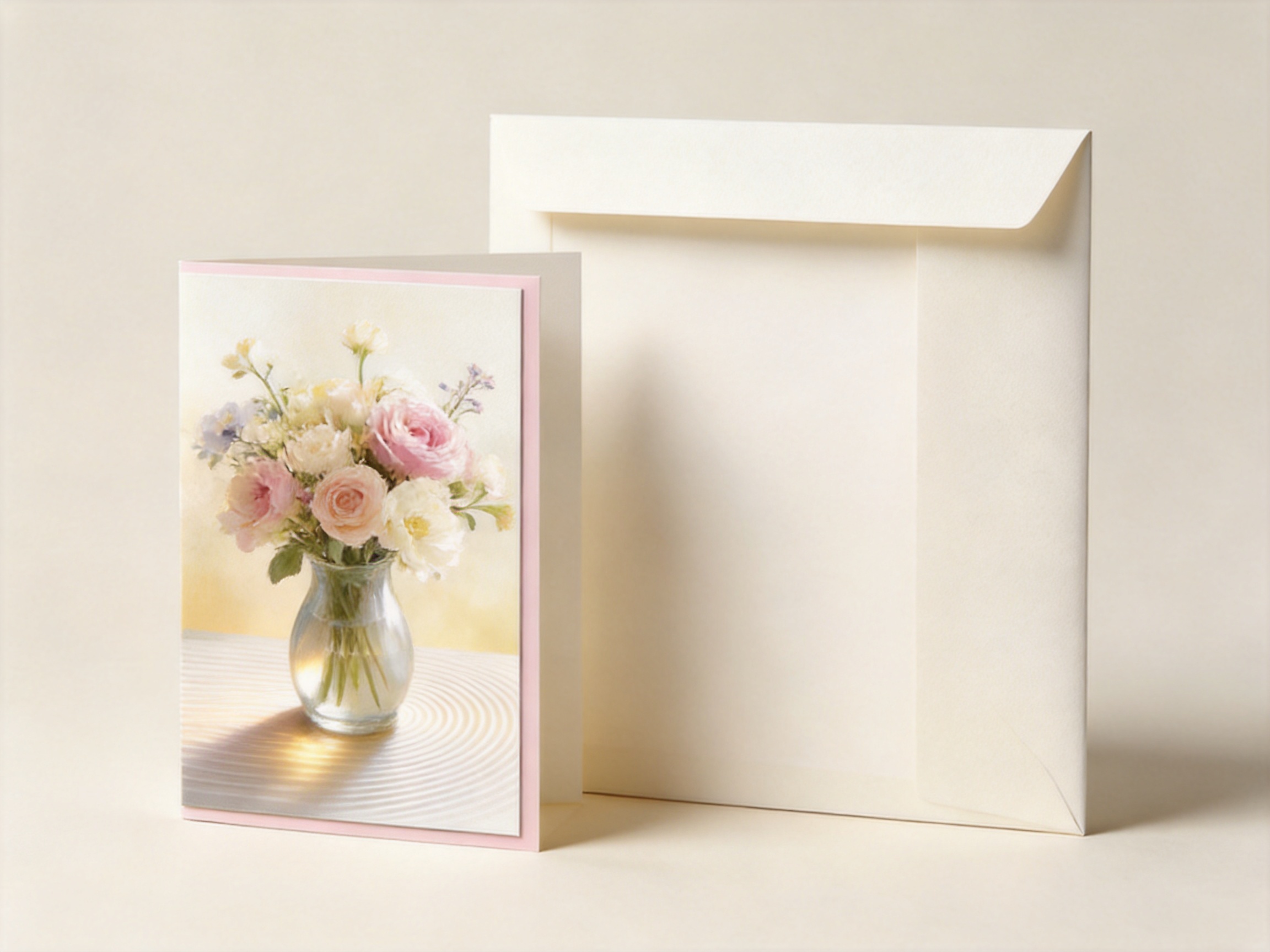
The Vase & Flowers’ Elegant Paper Greeting Card is designed around this idea. Its concept is simple: a vase filled with flowers. However, the card uses a lenticular board treatment that gives the image subtle visual movement when the card is tilted. Rather than relying on excessive decoration, glitter, bulky embellishment, or complicated construction, it uses controlled optical change to make a familiar floral image feel more engaging.
Measuring 12 x 17 cm, the card offers a comfortable writing area while remaining easy to handle, display, store, and package. The accompanying envelope measures 12.5 x 17.5 cm, allowing the card to slide inside without tight edges or unnecessary bending. Together, the card and envelope form a practical and presentation-ready stationery product suitable for retailers, gift shops, florists, lifestyle stores, stationery collections, seasonal assortments, and customized brand programs.
Its strongest commercial advantage is the balance between visual interest and production practicality. The card feels more distinctive than a conventional flat-printed greeting card, yet it does not depend on an overly complex format. This makes it suitable for buyers looking for an elegant product that can stand out on a shelf without becoming difficult to manufacture, pack, transport, or use.

Vase & Flowers' Elegant Paper Greeting Card
A Familiar Floral Theme with a More Engaging Presentation
Flowers and vases are enduring subjects in greeting card design because they communicate warmth, beauty, thoughtfulness, and elegance across many occasions. A floral image can be used for birthdays, thank-you messages, congratulations, anniversaries, get-well wishes, housewarming greetings, seasonal gifting, or simple personal correspondence. The subject is approachable and broadly appealing, which helps the card fit into several retail and gifting environments.
The challenge with a familiar theme is creating enough individuality to make the product noticeable. A standard printed vase-and-flowers illustration can be attractive, but it remains visually static. Once it has been viewed, there is no additional interaction. The Vase & Flowers’ Elegant Paper Greeting Card addresses this limitation with its lenticular board finish.
Lenticular printing uses a specially treated surface that allows the image to appear slightly different as the viewing angle changes. On this card, the transition is intentionally subtle. The flowers and vase shift between visual layers, creating a gentle sense of movement rather than a dramatic animation effect. This restrained approach supports the product’s elegant character. The card remains suitable for refined, understated gifting while offering more visual depth than an ordinary flat paper design.
When a customer picks up the card, the changing image encourages a second look. The recipient may tilt it in the hand, examine the transition, and notice how the flowers or vase appear to move slightly. This additional moment of interaction can increase the perceived value of the card. It transforms the product from a passive printed surface into a small tactile and visual experience.
For retailers, this quality can be valuable at the point of sale. Greeting cards are frequently displayed in rows or racks where products must compete for attention within a limited space. A design that reveals a change when handled can encourage customers to stop, pick it up, and explore it. The card does not need excessive size or elaborate accessories to create interest; the surface treatment provides its primary point of differentiation.
How the Lenticular Board Treatment Adds Value
The lenticular board treatment is the defining feature of this greeting card. It is not merely a decorative coating applied for shine. It changes the relationship between the viewer and the printed image. A conventional card can be appreciated from a single position, while this card rewards movement and inspection.
The effect is best understood as a controlled transition between image layers. As the card is tilted, the visible composition shifts. The vase and flowers do not appear to jump aggressively or create an exaggerated three-dimensional illusion. Instead, they move softly, giving the image an almost layered quality. This makes the card feel more dimensional while preserving a clean and elegant appearance.
Compared with ordinary flat-printed greeting cards, the lenticular finish offers several practical advantages:
First, it creates a stronger initial impression. The card may look familiar from a distance, but the changing surface gives it a distinctive quality when handled.
Second, it supports emotional memorability. A recipient may remember not only the written message but also the moment of tilting the card and discovering the changing image.
Third, it adds perceived sophistication without requiring a heavy construction. The card remains a paper-based stationery product, but its optical finish gives it a premium presentation.
Fourth, it can reduce the need for multiple decorative techniques. Some cards depend on several combined processes, such as foil, embossing, die-cutting, ribbons, layered inserts, or attached ornaments. While those features can be attractive, they may also increase production complexity, material usage, packing requirements, and cost. The lenticular treatment provides a strong visual feature through the surface itself.
Finally, the effect is appropriate for a broad range of recipients. It is interesting enough for customers who enjoy novelty, but subtle enough for people who prefer classic and tasteful stationery. This gives the card a wider positioning range than products that depend on a highly specific decorative style.
Product Specifications at a Glance
| Product Type | Paper greeting card |
| Design Theme | Vase and flowers |
| Card Size | 12 x 17 cm |
| Envelope Size | 12.5 x 17.5 cm |
| Surface Treatment | Lenticular board |
| Primary Visual Feature | Subtle image transition when viewed from different angles |
| Writing Function | Interior space for a personal message |
| Suggested Retail Position | Elegant, interactive, premium paper stationery |
| Suitable Sales Channels | Gift shops, stationery stores, florists, lifestyle retailers, seasonal collections, and online gift catalogs |
The dimensions are carefully balanced for everyday greeting-card use. At 12 x 17 cm, the card is large enough to provide a useful writing area but compact enough for standard retail display and storage. It can be presented in a card rack, placed inside a gift package, or included with a floral arrangement without overwhelming the accompanying gift.
The envelope, measuring 12.5 x 17.5 cm, is slightly larger in both dimensions. This allowance is important because it supports easy insertion and removal. A card that fits too tightly can develop bent corners, surface scratches, or creased edges during packing and handling. The slightly larger envelope helps protect the card while maintaining a neat presentation.
The card’s size also supports efficient merchandising. Retail buyers often need products that can be grouped with other designs without requiring unusual fixtures or oversized packaging. This format can sit naturally beside standard greeting cards while still offering a different visual proposition through the lenticular surface.
Elegant Design Without Unnecessary Excess
One of the product’s key strengths is restraint. The design is built around a straightforward image instead of a crowded composition. The vase and flowers provide a clear focal point, while the lenticular effect creates the visual movement. This gives the card a polished character without depending on an overload of patterns, text, glitter, or attached materials.
A restrained design can be advantageous in several markets. It may appeal to buyers seeking tasteful stationery for adult recipients, professional relationships, hospitality applications, or premium gift presentation. It can also fit into stores where the overall visual language is calm, modern, natural, or minimalist.
The card’s simplicity leaves room for the written message to remain central. Some highly decorated cards communicate so much through their external design that the personal message becomes secondary. This product takes a different approach. The front cover creates interest, but the card still feels like a genuine writing object rather than a decorative novelty.
The floral theme also gives retailers flexibility in merchandising. The card can be associated with birthdays, thank-you occasions, floral gifts, spring and summer collections, Mother’s Day, anniversaries, sympathy selections, or general-purpose correspondence. Its meaning does not depend on a single holiday or a highly specific phrase.
For customized programs, the same design philosophy can support adaptations in color, flower selection, background treatment, greeting text, or visual mood, subject to production review. Buyers may use the concept as a reference for developing a private-label collection that maintains the moving-image feature while aligning the artwork with a particular brand identity or seasonal direction.
Advantages Over Conventional Flat-Printed Cards
Many greeting cards compete primarily through artwork, paper quality, size, wording, or decorative finishing. These remain important factors, but they can be difficult to distinguish when multiple products are displayed together. A lenticular greeting card offers another route to differentiation: interaction.
In a conventional flat-printed card, the image is generally unchanged whether the viewer looks at it directly, from the side, or after picking it up. A lenticular card can produce a visible response to movement. This response gives the customer a reason to engage with the product before purchase.
The advantage is especially relevant in physical retail. A customer browsing a rack may first notice the floral image, then tilt the card and discover the transition. That small discovery can improve shelf performance because the card has demonstrated something that cannot be fully understood from a fixed thumbnail or distant view.
The card also compares favorably with highly elaborate constructions in terms of visual efficiency. A pop-up card, multi-layered card, or card with several attached components may create a dramatic experience, but it can require more assembly, more protective packaging, and more careful handling. The lenticular board approach concentrates the visual effect in the card surface, allowing the product to remain relatively straightforward in form.
Compared with cards that rely only on metallic foil or gloss varnish, the lenticular effect provides a more active viewing experience. Foil and gloss can improve reflectivity and visual polish, but they generally do not create the same sense of changing imagery. The optical transition helps the card feel more dynamic.
Compared with novelty cards designed around strong humor or loud visual effects, this product has a broader emotional range. It can be offered as a warm, graceful, and thoughtful item rather than only as an entertaining impulse purchase. That makes it more suitable for brands that want to communicate quality and consideration.
Compared with oversized greeting cards, the 12 x 17 cm format offers practical advantages in storage, shipping, and display. Retailers can place more units in a given area, while consumers can store the card or include it with a gift without needing oversized packaging.
These advantages do not mean that the card replaces every other greeting-card style. Different occasions call for different formats. Instead, its value lies in occupying a useful position between conventional stationery and more elaborate novelty products: visually distinctive, physically manageable, emotionally versatile, and suitable for premium presentation.
Writing Space and Recipient Experience
A greeting card must function as a writing product, not only as a cover image. The 12 x 17 cm format provides a comfortable area for a personal message. This is important for customers who want to write more than a short signature but do not need a large folded card designed for a long letter.
The writing area can accommodate birthday wishes, thank-you notes, short congratulations, affectionate messages, professional appreciation, or personal reflections. The card’s size also allows the sender to combine a concise message with a signature, date, or small handwritten addition without making the interior feel crowded.
The envelope’s slightly larger dimensions help maintain a positive user experience. The card can be inserted with less pressure, reducing the chance of damaging the edges or rubbing the treated surface against the envelope. For retailers and distributors, this can also make packing operations easier because the product does not require repeated adjustment to fit.
For recipients, the envelope creates a sense of completion. The card arrives protected and presented as a finished stationery set rather than as a loose printed sheet. This makes it suitable for direct retail sale and for inclusion with gifts, bouquets, boxed products, or customer orders.
The product’s physical interaction is also part of the recipient experience. Opening the envelope reveals a conventional card format, but tilting the cover introduces the lenticular movement. This sequence gives the card a small element of discovery. The effect is particularly suitable for gifts because it creates an additional moment after the package has been opened.
Applications Across Retail and Gifting Categories
Gift Shops
Gift shops often need products that can complement a wide range of purchases. The vase-and-flowers design can accompany candles, home accessories, small decorative items, floral gifts, ceramics, fragrances, and seasonal merchandise. Its elegant appearance makes it suitable for customers seeking a small but thoughtful addition to a larger gift.
Florists and Flower Boutiques
The floral theme gives the card an obvious connection with florists and flower boutiques. It can be offered alongside bouquets, preserved flowers, potted plants, wedding arrangements, and sympathy flowers. Because the design is not restricted to one specific occasion, it can support everyday purchases as well as seasonal gifting.
Stationery Retailers
Stationery stores can position the card as a premium or specialty item within a broader greeting-card assortment. Its lenticular treatment creates a clear reason for customers to compare it with flat-printed options. It may appeal to shoppers who value paper goods but want a design with an interactive feature.
Lifestyle and Homeware Stores
The vase and flower motif can align with home-focused product ranges, particularly where the store emphasizes calm interiors, natural forms, decorative objects, or refined paper goods. The card can be merchandised near journals, wrapping paper, gift boxes, and small home accessories.
Seasonal Collections
The card can fit spring collections, floral campaigns, appreciation events, Mother’s Day assortments, anniversary displays, and general celebration ranges. Depending on the final artwork and wording, it may also be adapted for specific regional or cultural markets.
Corporate and Hospitality Gifting
Businesses may use elegant greeting cards for client appreciation, employee recognition, hospitality welcome packages, or premium order fulfillment. The card’s understated style can be suitable when a company wants to communicate warmth without relying on a loud or highly promotional design.
Manufacturing Capabilities Supporting Product Quality
The product is manufactured by Yiwu Magic Tree Gift Bag Co., Ltd., a company with a long background in paper packaging and related paper products. The business was founded in 1996 as Fushida Plastic Factory and was rebranded in 2019 as Magic Tree Paper Products Co., Ltd. Its experience spans nearly three decades, providing a substantial foundation for paper product development, production coordination, finishing, and quality management.
Although the greeting card is a relatively compact product, consistent quality depends on many connected operations. Artwork preparation, material selection, printing, surface treatment, cutting, creasing, assembly, inspection, and packing must work together. A weakness in any one stage can affect the final result. For example, inaccurate registration may reduce the visual quality of the lenticular effect, while poor edge finishing may affect how the card enters the envelope.
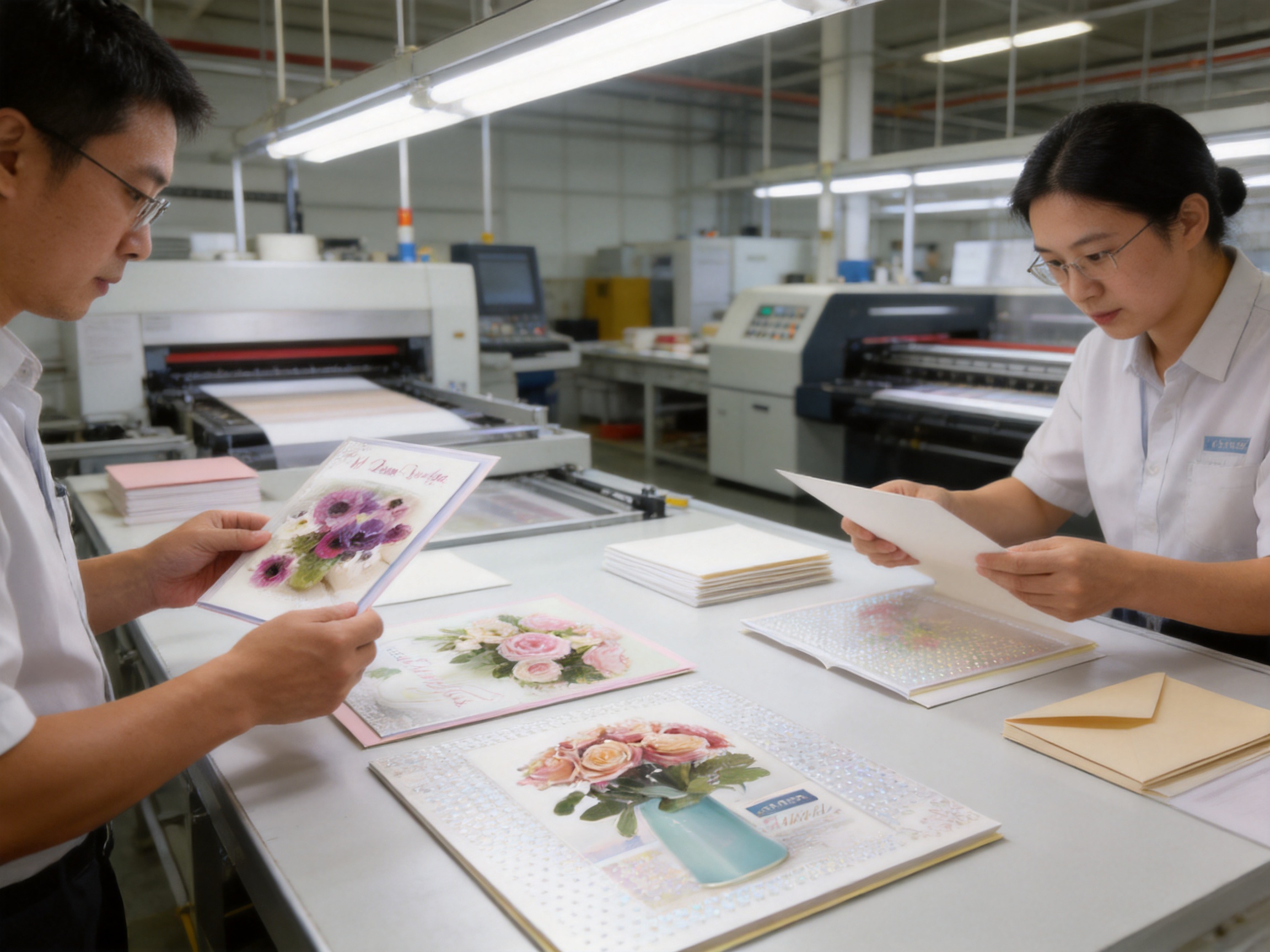
Magic Tree’s in-house capabilities include professional design and prepress, laminating, hot stamping, creasing, printing, bag making, and manual finishing. This range is significant because it allows the company to coordinate multiple stages internally rather than relying entirely on disconnected outside suppliers.
In-house design and prepress support can help prepare artwork for the requirements of specialized printing and finishing. Lenticular products require careful attention to image alignment, viewing direction, layer transitions, and surface application. Prepress control is therefore essential to ensure that the intended visual movement appears cleanly when the card is tilted.
Printing capability supports the production of consistent colors, clear floral details, and balanced contrast. A vase-and-flowers design may look simple, but subtle color variations can affect the feeling of depth and elegance. Controlled printing helps maintain a stable appearance across production batches.
Laminating and surface-finishing experience can contribute to the card’s durability and visual presentation. The lenticular board must be handled carefully during processing so that the optical surface remains clean, aligned, and free from avoidable marks. Appropriate process control also helps protect the product during subsequent cutting, folding, packing, and transportation.
Creasing and manual finishing capabilities are useful for maintaining accurate folding and neat final assembly. Even when the product is not structurally complicated, precise finishing affects how the card opens, how it sits in the envelope, and how it appears when displayed.
The company’s broader product experience includes white cardboard, coated paper, and kraft paper products, as well as paper bags, gift bags, gift boxes, greeting cards, and patterned wrapping paper. This cross-category background can be advantageous for buyers seeking coordinated packaging collections. A retailer may be able to source greeting cards alongside matching gift bags, boxes, or wrapping paper through one manufacturing partner.
Integrated Production from Raw Materials to Finished Goods
Magic Tree operates its own factory and manages the production process from raw materials to finished products. Integrated production can provide several benefits for wholesale buyers. It may improve communication between departments, simplify production scheduling, and make it easier to identify the source of a quality issue if one occurs.
For a greeting card with a specialized finish, process integration is particularly valuable. The card’s appearance depends on the relationship between the paper or board, printed artwork, optical treatment, finishing operations, and final packing. When these stages are coordinated within one production system, the manufacturer can review the product as a complete unit rather than treating each step as an isolated transaction.
Integrated manufacturing can also support more consistent repeat orders. Wholesale buyers frequently need products to remain visually and physically stable over time. If artwork, materials, and finishing are managed with clear production records, subsequent runs can be compared more effectively with approved samples.
Quality control should begin with incoming materials. Board thickness, surface condition, color, and compatibility with the intended printing and finishing processes can influence the final result. During production, inspection may focus on print clarity, registration, surface cleanliness, edge quality, folding accuracy, envelope fit, and overall appearance.
For the lenticular treatment, visual inspection from different angles is especially important. The image transition should be noticeable enough to provide the intended effect while remaining smooth and controlled. Defects such as misalignment, unwanted distortion, scratches, bubbles, or inconsistent transitions can reduce the perceived value of the card.
Final inspection also needs to consider practical use. The card should fit comfortably into the 12.5 x 17.5 cm envelope. Corners and edges should be checked for damage. The envelope should present the card neatly without excessive looseness or pressure. Packing should protect the treated surface during handling and shipment.
The company reports an annual output value exceeding 50 million yuan. This indicates an established manufacturing operation with experience supporting significant production activity. For wholesale buyers, an experienced factory can be better positioned to manage material purchasing, production planning, batch coordination, and delivery requirements than a small workshop with limited equipment or narrow capabilities.
Customization Potential for Wholesale Buyers
The existing design offers a ready-made concept, but the product category also has potential for customized development. Retailers and brands may want to modify the cover artwork, greeting text, color palette, flower style, or packaging presentation. Customization can help a buyer create a collection that fits a specific customer group or sales channel.
Possible customization directions may include different floral compositions, seasonal color schemes, alternative vase silhouettes, botanical themes, or coordinated designs for birthdays, weddings, anniversaries, appreciation messages, and general correspondence. The lenticular concept can remain the central feature while the artwork changes around it.
Businesses may also request private-label branding on the card, envelope, packaging sleeve, or bundled presentation. A retailer could develop a house stationery range, while a florist could create a branded card collection that complements its bouquet styles. A lifestyle brand might coordinate the card with gift boxes and patterned wrapping paper.
Customization should be evaluated carefully because lenticular printing has technical requirements. The image layers need to be prepared for the selected viewing effect, and the artwork should be tested at the intended card size. Strong contrast, clear subject separation, and carefully controlled movement can improve the final result. A design that contains too many fine details or unclear layers may not produce the desired visual transition.
Professional design and prepress support can help buyers move from a basic idea to production-ready artwork. The manufacturer can review dimensions, bleed areas, fold positions, surface treatments, and finishing requirements before mass production. This reduces the likelihood of costly errors and helps align expectations between the buyer and factory.
Wholesale customers should normally confirm the target market, order quantity, artwork requirements, paper specifications, packaging format, delivery schedule, and approval process at the beginning of a project. A physical sample or pre-production proof is especially useful for evaluating the lenticular effect, color balance, writing area, envelope fit, and overall tactile impression.
Material and Presentation Considerations
Paper-based products communicate quality through both appearance and handling. The card should feel substantial enough to support a premium impression while remaining practical for writing and mailing. The board treatment adds to the tactile experience, but the underlying paper and finishing quality remain important.
White cardboard can support clean, bright artwork and a polished presentation. Coated paper can provide a smooth printing surface and help reproduce detailed graphics. Kraft paper may be appropriate for packaging or coordinated collections that emphasize a natural or eco-conscious appearance. The most suitable material depends on the artwork, finish, target market, and product positioning.
The company specializes in white cardboard, coated paper, and kraft paper products, giving buyers several material directions for developing related packaging. A greeting card can be paired with a white or kraft paper gift bag, a printed gift box, or patterned wrapping paper to create a consistent presentation.
Surface protection is another consideration. Because the lenticular finish is central to the product’s appeal, the card should be handled and packed in a way that reduces the risk of scratching, scuffing, pressure marks, or contamination. Appropriate separators, inner packaging, or protective sleeves may be considered depending on the order format and distribution environment.
For retail display, the product should be presented so customers can safely handle it and observe the optical transition. Clear packaging may protect the card while still allowing the front design to remain visible. If the card is displayed without a protective sleeve, rack design and handling instructions may help preserve its appearance.
Eco-Conscious Paper Packaging Direction
Paper packaging buyers increasingly consider material responsibility, recyclability, sourcing, and production efficiency when selecting suppliers. Magic Tree presents itself as a manufacturer committed to high-quality, eco-friendly, and customized paper packaging solutions.
For this greeting card, an eco-conscious approach can involve selecting appropriate paper-based materials, avoiding unnecessary components, optimizing dimensions, and using packaging that protects the product without excessive volume. The compact card-and-envelope format supports efficient storage and transport compared with larger or heavily assembled alternatives.
Environmental claims should always be matched to specific material specifications and market requirements. Buyers may need to confirm paper composition, coatings, inks, certifications, recycling guidance, and packaging details according to the destination country and sales channel. The manufacturer’s experience with white cardboard, coated paper, kraft paper, and other paper products can support these discussions.
The card’s relatively simple structure may also support responsible product design. It does not require attached plastic ornaments, batteries, electronic parts, or complicated mixed-material mechanisms. Its primary components are paper-based, with the visual effect created through the treated board surface. The exact recyclability of the final product will depend on the materials and finishes selected, so project-specific confirmation remains important.
Why Manufacturing Experience Matters to Buyers
Manufacturing experience is valuable not only because it reflects time in business but because it can influence the reliability of everyday production decisions. A factory that has worked across paper bags, gift boxes, greeting cards, wrapping paper, and related products is familiar with the requirements of color reproduction, paper handling, finishing, assembly, and packaging.
Nearly 30 years of company experience gives Magic Tree a long operating history in the paper product sector. Its transition from Fushida Plastic Factory to Magic Tree Paper Products Co., Ltd. also reflects a broader development toward paper packaging and paper-based product manufacturing. The company’s capabilities now cover multiple stages, from design and prepress through final manual finishing.
For a buyer, this can simplify supplier management. Instead of coordinating one company for artwork, another for printing, a third for surface treatment, and another for assembly, an integrated factory may provide a more centralized path. This can make sample revisions, production questions, and quality discussions more direct.
The company serves customers in the United States, Canada, Mexico, the United Kingdom, Japan, and China. Experience with international customers can help a manufacturer understand the importance of packaging protection, communication, documentation, product consistency, and delivery coordination across different markets.
International wholesale supply also requires attention to differences in retail expectations. A card sold in a florist boutique may need a different presentation from one sold in a large stationery chain or an online gift catalog. A capable supplier should be prepared to discuss packaging, labeling, carton quantities, artwork, and delivery requirements according to the buyer’s channel.
Quality Factors to Review Before Ordering
Buyers considering this product should evaluate more than the front-cover image. A complete review should include the lenticular effect, paper feel, card dimensions, envelope fit, writing surface, edge quality, color accuracy, and packing protection.
The lenticular effect should be tested under normal retail lighting and from practical viewing distances. The transition should be visible without requiring an extreme angle. The image should remain attractive when viewed directly, since customers may first encounter the card in a fixed position.
The card should be checked for smooth opening and appropriate fold alignment. The envelope should accept the card easily while holding it securely. If the card is intended for mailing, the buyer should separately confirm postal requirements for the destination market, including weight, thickness, and envelope specifications.
Color approval is also important. Floral artwork often depends on delicate tones, gradients, and contrast between the vase, flowers, and background. A printed proof can help buyers compare the intended artwork with the manufactured result.
Packaging should be reviewed for protection during domestic or international transportation. The optical surface is the card’s principal differentiator, so scratches or pressure marks may have a disproportionate effect on perceived quality. Buyers should discuss carton construction, inner protection, unit packing, and handling instructions as part of the order plan.
Finally, repeat-order consistency should be considered. A reference sample, approved color standard, and documented specification can help maintain continuity across future production runs. These practices are especially useful for retailers building a permanent stationery collection.
Merchandising the Card for Stronger Retail Performance
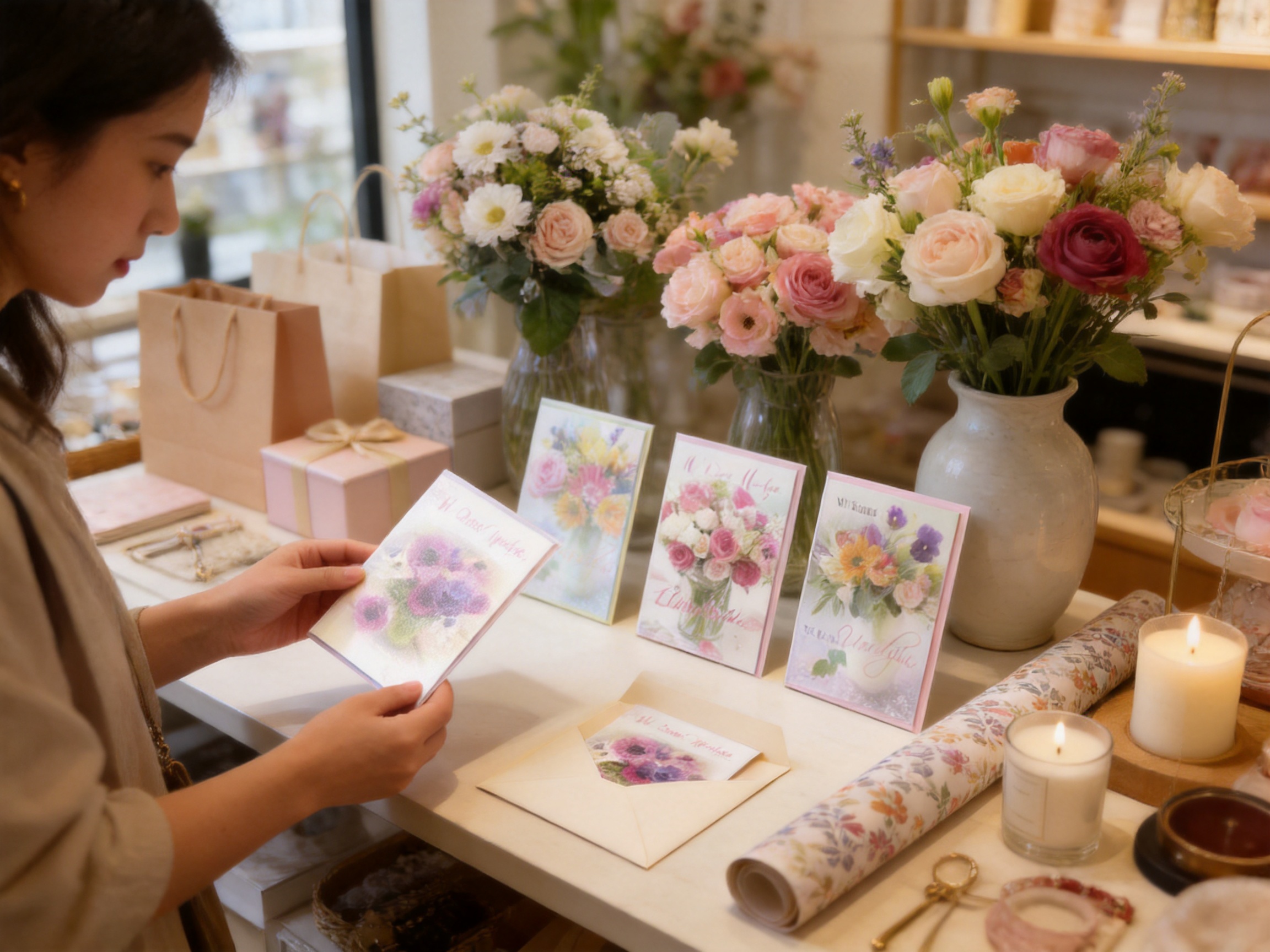
The card’s visual movement should be made part of the sales presentation. Retail staff or packaging copy can invite customers to tilt the card gently to observe the changing image. This helps explain the product’s main point of difference without requiring a long description.
In a card rack, the front design should remain visible and unobstructed. In a gift display, the card can be paired with flowers, vases, candles, wrapping paper, or gift boxes. The floral theme makes cross-merchandising natural, while the compact format allows it to be placed near the checkout area as an elevated impulse purchase.
For online stores, product photography should show the front design clearly and explain that the image changes when viewed from different angles. Since an online photograph cannot fully reproduce motion, a short visual demonstration may be useful if the sales platform permits it. Written product information should include the card size, envelope size, lenticular board treatment, and intended use.
For seasonal assortments, the card can serve as a bridge between everyday and event-specific products. It may be introduced during spring floral promotions, included in Mother’s Day displays, or positioned as a general-purpose elegant card throughout the year. Its lack of a highly specific printed occasion can extend its selling period.
Wholesale buyers may also sell the card in coordinated sets. A small collection could include several floral variations, different messages, or multiple colorways. Bundling the card with wrapping paper, gift bags, or boxes can increase average order value and create a more coherent gifting solution.
Positioning for Different Customer Segments
The product can be positioned differently depending on the retailer’s audience. For a traditional stationery buyer, its main appeal may be the refined floral artwork and comfortable writing format. For a younger gift shopper, the lenticular movement may be the primary reason to choose it over a standard card.
For premium gift stores, the card can be presented as a small luxury accessory. The optical finish gives it a distinctive quality without making the product excessively ornate. For florists, it can function as an attractive message card that visually reinforces the flower purchase.
For environmentally aware consumers, the paper-based format and restrained construction may be relevant, provided the final materials and finishes meet the retailer’s stated requirements. For corporate buyers, the design may be useful when a company wants a warm, professional item that does not look overly commercial.
The card’s versatility comes from the combination of a universal floral subject, an adaptable size, a practical envelope, and a subtle interactive feature. It is neither limited to a single age group nor dependent on a single holiday. That flexibility can help retailers manage inventory across several sales occasions.
Frequently Asked Questions
What makes this greeting card different from a standard printed card?
The card uses a lenticular board treatment. When it is tilted or viewed from different angles, the vase and flowers shift subtly between visual layers. This gives the card a sense of movement and depth that a conventional flat-printed card does not provide.
Is the visual effect dramatic or subtle?
The effect is intentionally subtle and elegant. It is designed to create a soft transition that encourages the viewer to look again, rather than producing an exaggerated animation or novelty effect.
What are the card dimensions?
The card measures 12 x 17 cm. This provides a practical writing area while remaining convenient for retail display, storage, gifting, and packaging.
What are the envelope dimensions?
The envelope measures 12.5 x 17.5 cm. It is slightly larger than the card, allowing the card to slide in more easily and helping reduce the risk of bent corners during insertion.
What type of occasions is the card suitable for?
The vase-and-flowers design can be used for birthdays, thank-you messages, congratulations, anniversaries, appreciation, get-well wishes, housewarming gifts, seasonal gifting, floral purchases, and general personal correspondence.
Who may be interested in purchasing this product wholesale?
Potential buyers include gift shops, florists, stationery retailers, lifestyle stores, homeware brands, online gift sellers, corporate gifting companies, and businesses developing private-label paper product collections.
Can the design be customized?
Customized development may be possible depending on the required artwork, order quantity, materials, printing specifications, packaging, and delivery schedule. Buyers should discuss the design concept and technical requirements with the manufacturer before production.
Why is prepress important for a lenticular card?
Lenticular artwork requires accurate preparation of image layers and viewing transitions. Professional prepress helps ensure that the printed image aligns correctly with the lenticular surface and produces a clean visual change when the card is tilted.
What manufacturing capabilities does the supplier provide?
The company’s stated in-house capabilities include professional design and prepress, laminating, hot stamping, creasing, printing, bag making, and manual finishing. It also operates its own factory and manages production from raw materials to finished products.
Does the manufacturer produce other paper packaging products?
Yes. The company specializes in white cardboard, coated paper, and kraft paper products, including paper bags, gift bags, gift boxes, greeting cards, and patterned wrapping paper. This may support coordinated packaging programs.
How should buyers evaluate a sample?
Buyers should review the image transition from several angles, color accuracy, surface cleanliness, paper feel, fold alignment, edge quality, writing space, envelope fit, and packaging protection. A physical sample is especially useful for confirming the lenticular effect.
Can the card be used with gift packaging?
Yes. Its compact dimensions and floral design make it suitable for pairing with bouquets, gift boxes, gift bags, wrapping paper, home accessories, and other presentation items.
Is the product suitable for international wholesale?
The company serves customers in the United States, Canada, Mexico, the United Kingdom, Japan, and China. Buyers should still confirm destination-specific requirements for packaging, labeling, mailing, materials, and import documentation before placing an order.
Conclusion
The Vase & Flowers’ Elegant Paper Greeting Card demonstrates how a familiar greeting-card concept can gain new value through a carefully selected finishing process. Its floral design is accessible and versatile, while the lenticular board surface provides a gentle visual transition that encourages interaction. The result is more distinctive than a standard flat card without becoming excessively complex or difficult to use.
The 12 x 17 cm card size offers comfortable writing space, and the 12.5 x 17.5 cm envelope supports easy insertion and a neat finished presentation. These practical dimensions make the card suitable for retail racks, florist counters, gift packages, seasonal displays, and online stationery collections.
Its advantages over conventional competitors are centered on visual engagement, perceived sophistication, and merchandising flexibility. The card can attract attention through movement rather than relying solely on bright decoration or bulky additions. It can also occupy a useful middle position between ordinary stationery and elaborate novelty products.
The manufacturing background of Yiwu Magic Tree Gift Bag Co., Ltd. adds further value for wholesale buyers. Nearly 30 years of experience, own-factory production, in-house design and prepress, printing and finishing capabilities, and expertise across paper bags, gift boxes, greeting cards, and wrapping paper provide a solid foundation for consistent supply and coordinated product development.
For retailers and brands seeking a refined paper greeting card with a clear point of difference, this product offers a practical and adaptable option. Its success comes from combining a timeless floral theme, an interactive lenticular finish, convenient dimensions, and the support of an experienced paper packaging manufacturer.
References
1. Product specification information for Vase & Flowers’ Elegant Paper Greeting Card, including card size, envelope size, and lenticular board treatment.
2. Company information supplied by Yiwu Magic Tree Gift Bag Co., Ltd., including manufacturing history, product categories, factory capabilities, and international service markets.
3. General principles of lenticular printing and multi-angle optical image presentation in printed products.
4. General retail merchandising practices for greeting cards, stationery, gift products, and seasonal paper collections.
5. General paper packaging considerations covering material selection, finishing, product protection, and coordinated gift presentation.