中文简体
 русский
 Français
 Español
 Deutsch
 عربى

Customizable Shopping Bags and Kraft Paper Gift Bags: A Practical Guide to Flexible Printed Packaging
Paper packaging has become an important part of the retail experience. A shopping bag is not only used to carry products from a store to a customer’s home. It can also support brand recognition, communicate product positioning, protect merchandise, and create a more complete presentation at the point of sale. Among the many packaging formats available today, customizable shopping bags and kraft paper gift bags remain especially useful because they combine practical construction with a wide range of printing and finishing options.
These bags can be produced in different sizes, paper grades, colors, handle styles, and print layouts. A company may choose a simple kraft paper bag for everyday retail use, a refined white paper bag for premium products, or a gift-oriented design with seasonal graphics and decorative finishing. The basic structure can remain consistent while the artwork, dimensions, or small details change from one order to the next.
This flexibility makes custom paper bags suitable for boutiques, department stores, gift shops, bookstores, cafés, bakeries, event organizers, promotional campaigns, and many other businesses. They can support a new product launch, a holiday collection, a temporary marketing event, or a long-term retail packaging program. Instead of treating packaging as a fixed item, buyers can use the bag as an adaptable communication tool.
Customizable shopping bags and kraft paper gift bags are also attractive to wholesale buyers because they can be manufactured through a coordinated process. Professional production includes paper selection, structural design, artwork preparation, printing, laminating when required, hot stamping, creasing, bag making, and manual finishing. When these stages are managed by one experienced manufacturer, the result can be more consistent than packaging assembled through several unrelated suppliers.
The following guide explains how these products are designed, manufactured, customized, and evaluated. It also examines their advantages over less flexible packaging alternatives and shows why a factory with broad in-house capabilities can provide value to stores, brands, importers, and distributors.

Customizable Shopping Bags and Kraft Paper Gift Bags (Fonts and Prints)
What Are Customizable Shopping Bags and Kraft Paper Gift Bags?
Customizable shopping bags are paper carry bags created for retail transactions, promotional distribution, events, or product presentation. Their main purpose is to hold purchased goods while presenting a visual identity through color, typography, logos, illustrations, patterns, or messaging. The bags may be printed on one or more sides and can include handles made from paper cord, cotton-like materials, ribbon, or other suitable components depending on the intended appearance.
Kraft paper gift bags are a related format with a more natural visual character. Kraft paper generally has a slightly coarse surface and a warm, organic appearance. This texture can make the packaging feel relaxed and approachable. It is often selected by businesses that want to communicate simplicity, handmade quality, environmental awareness, casual elegance, or a connection with natural materials.
The term “gift bag” does not mean that the product is limited to birthdays or holidays. These bags can be used for retail purchases, corporate gifts, wedding favors, product sampling, promotional kits, and seasonal sales. A plain kraft base can be suitable for everyday use, while a printed design can make the same basic format appropriate for a specific campaign.
The major feature of both product types is the ability to adapt the bag to different requirements. Customization may include the following elements:
• Bag width, height, and gusset size.
• Kraft paper, white cardboard, coated paper, or another selected paper grade.
• One-color, two-color, full-color, or specialty printing.
• Logo placement and brand typography.
• Seasonal artwork, illustrations, patterns, or short messages.
• Matte or glossy lamination.
• Hot stamping in metallic or decorative colors.
• Handle material, handle length, and attachment method.
• Folded edges, reinforced openings, bottom structures, and internal support.
• Special finishing for premium gift presentation.
Because these elements can be combined in different ways, one bag structure may serve several product lines. The artwork or size can change without requiring an entirely new packaging concept every time.
Why Paper Bags Continue to Matter in Retail
Retail packaging must perform several functions at once. It needs to hold products, withstand normal handling, fit efficiently in storage, and present the seller in a positive way. At the same time, many retailers want packaging that is visually clear and aligned with changing customer expectations. Paper bags address these needs with a familiar, adaptable format.
Compared with unprinted plastic carriers, paper bags offer a more visible surface for design. A logo or message can be read while the customer carries the bag through a shopping area, into a vehicle, or to a home. The bag therefore has a secondary role as a mobile display surface. Even a restrained design can improve recognition when the same colors, fonts, and visual elements appear consistently across packaging and other customer-facing materials.
Paper also supports different brand positions. A thick white bag with refined printing may suit cosmetics, fashion accessories, or premium gifts. A natural kraft bag may suit a craft store, bakery, plant shop, or casual lifestyle retailer. A colorful printed bag may support children’s products, seasonal promotions, or event merchandise. This range allows paper packaging to be used across multiple sectors without forcing every business into the same visual style.
Another advantage is the ability to keep the structural format stable over time. A buyer may establish a standard bag size for everyday sales and then order a second print design for a holiday campaign. The packaging system remains recognizable, while the artwork changes according to the season or promotion. This approach can reduce the need to redesign the entire package whenever a new campaign is introduced.
For wholesale buyers, the ability to repeat an established structure is also useful for purchasing and inventory planning. Once a specification has been tested and approved, the same format can be reordered with changes to quantity, artwork, or limited structural details. A dependable manufacturer can preserve the essential requirements from one production cycle to another.
Core Advantages Over Less Flexible Packaging Options
Adaptable visual identity
The strongest advantage of customizable paper bags is their ability to carry a specific visual identity. A business does not have to accept a generic stock bag that looks similar to packaging used by many other sellers. Instead, it can choose a typeface, logo, color palette, illustration, or short phrase that reflects its own products and customer base.
This advantage is particularly valuable for small and medium-sized retailers. A store may not have the advertising budget of a national chain, but a well-designed bag can still create repeated exposure. Customers carry the packaging beyond the store, and the printed surface can reinforce recognition in a natural way. The design does not need to be complicated. Clear typography, balanced spacing, and a consistent logo can be enough to create a recognizable result.
More campaign flexibility
Generic packaging is often limited to one purpose. Custom paper bags can be adjusted for different campaigns. A basic shopping bag may be printed with a permanent logo for routine use, while a special edition can include holiday artwork, a new product message, or an event date. This makes the product more useful than a fixed design that becomes outdated when the campaign ends.
Flexibility is also helpful when a company operates several product lines. A shared bag structure can be used for different departments, with color or artwork changes providing visual separation. Alternatively, different sizes can be maintained while the design language remains consistent. This creates a packaging family rather than a collection of unrelated items.
Natural kraft appearance
Kraft paper has a surface and color that can communicate a more natural and uncomplicated impression. Its slightly coarse texture is different from highly polished coated materials. Some buyers prefer this quality because it gives the package a relaxed appearance and helps avoid an overly artificial presentation.
The kraft look can be used in simple designs with one dark ink color, or it can serve as a background for more detailed printing. It can support handmade, organic, casual, rustic, or environmentally conscious product positioning. The final impression depends on the paper grade, ink coverage, artwork, and finishing choices, so the design should be prepared with the natural paper tone in mind.
Efficient long-term adaptation
A packaging program becomes more efficient when the same basic bag structure can continue in use while only selected details change. This may include a new print file, a different size, a revised message, or a limited finishing option. Such adaptation can be less disruptive than replacing the entire packaging format for every campaign.
This does not mean that every order should use identical specifications. Different products may require different dimensions or stronger paper. However, a stable design framework can make future decisions easier. The buyer knows how the bag folds, how it is handled, and how it fits the product. The manufacturer also has a clearer reference for future production.
Suitable for different market positions
Paper bags can be produced for economical daily use or developed as a premium presentation item. The final result depends on paper thickness, printing quality, finishing, handle selection, construction, and manual detailing. This range allows a manufacturer to serve customers with different budgets and market goals.
A low-complexity kraft bag may be appropriate for frequent transactions where cost control is important. A laminated, hot-stamped bag with a reinforced structure may be better for premium gifts or luxury retail. Both products can be made within the same broad category, but their specifications and production requirements are different.
Material Selection for Custom Paper Bags
Material selection should begin with the product’s intended use rather than appearance alone. The bag must support the expected product weight, handling conditions, storage period, and presentation requirements. A lightweight bag may be suitable for greeting cards or small accessories, while a deeper bag with stronger paper may be needed for boxed products or multiple retail items.
Kraft paper is often selected for its natural color and tactile quality. It can work well for casual retail, gifts, food-related presentation, craft products, and businesses that prefer an understated look. Since the base tone is not always pure white, artwork colors may appear different from the same inks printed on white paper. This should be considered during prepress preparation.
White cardboard can provide a cleaner and brighter printing surface. It is useful when a design depends on accurate color contrast, sharp details, or a more polished appearance. Coated paper can offer a smoother surface and may be selected for designs requiring strong image reproduction or a refined finish.
The appropriate paper grade depends on factors such as:
• Product weight and shape.
• Bag dimensions and depth.
• Handle design and attachment points.
• Expected frequency of handling.
• Whether the bag is intended for a gift, a daily purchase, or promotional distribution.
• Required printing coverage.
• Desired texture and surface appearance.
• Storage and shipping conditions.
• Target cost and order volume.
It is important to balance strength and appearance. A heavier paper may improve the sense of quality, but it can also increase material use and shipping weight. A professional manufacturer can help buyers compare the practical effect of different paper options before final approval.
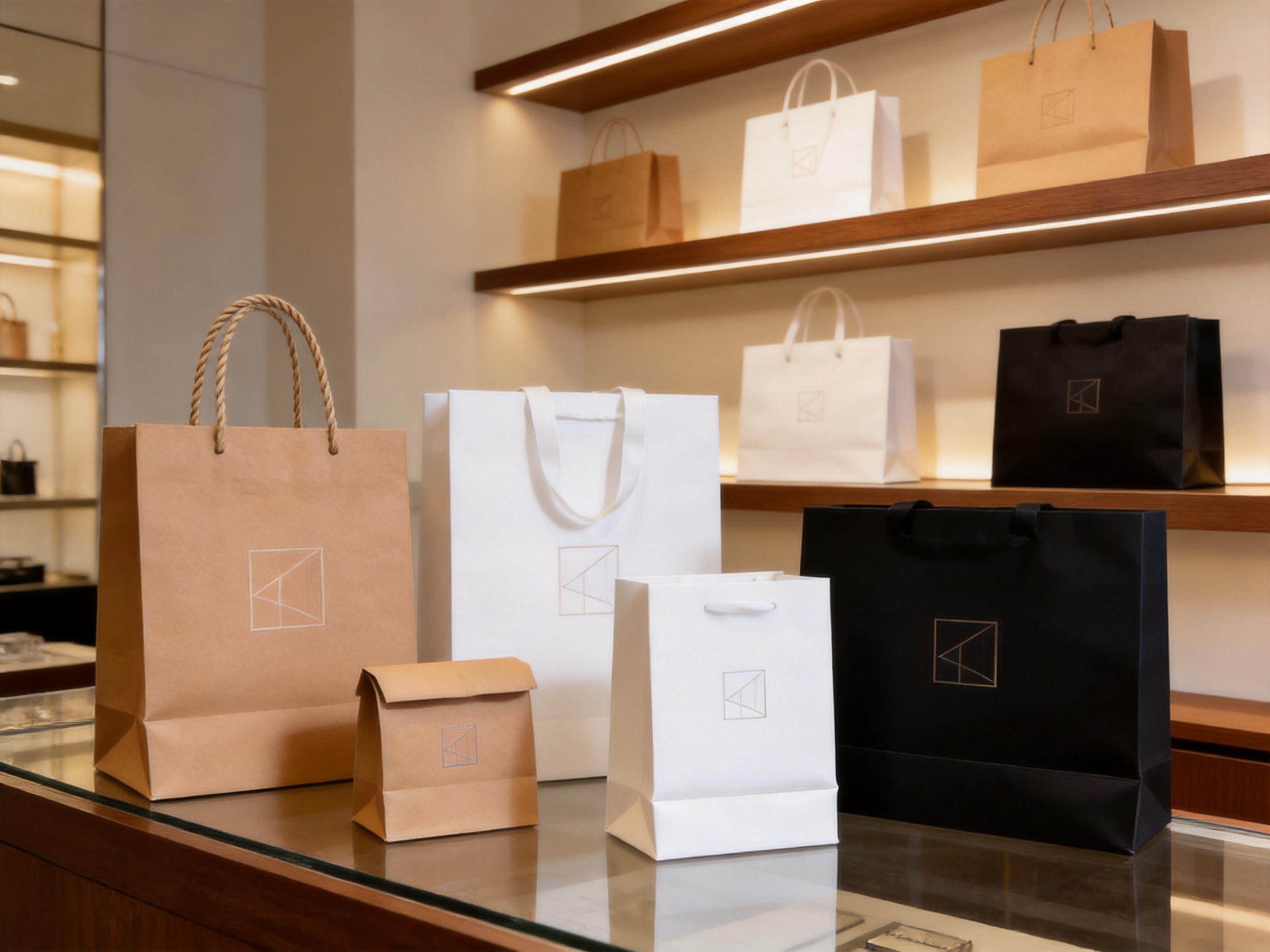
Printing and Design Possibilities
Typography and short messages
Typography is one of the simplest ways to customize a paper bag. A store name, slogan, product statement, or seasonal greeting can be printed without making the design visually complicated. The choice of font affects the personality of the packaging. Clean lettering may appear modern, while a decorative typeface may create a more traditional or gift-oriented impression.
Text should remain legible at the actual bag size. A design that looks attractive on a computer screen may become difficult to read when printed on a smaller side panel or placed near a fold. Prepress review should therefore consider the final dimensions, printing method, paper texture, and viewing distance.
Logos and simple graphics
A logo can be placed on one side, both sides, or several visible panels depending on the bag structure. Simple graphics may include lines, shapes, icons, patterns, or illustrations. When the kraft background is visible, a limited-color design can appear particularly effective because the paper contributes to the overall visual character.
Logo placement should also consider how the bag is held. If the handle, side gusset, or folded base covers part of the artwork, the design may not appear balanced in use. Professional structural planning helps ensure that important visual elements remain visible after the bag is folded and assembled.
Full-color artwork
Full-color printing provides greater freedom for photographs, detailed illustrations, gradients, and complex brand systems. It may be suitable for seasonal designs or packaging that depends on strong visual storytelling. However, more colors and greater ink coverage can influence production cost and appearance. Artwork should be prepared with the selected paper and finishing process in mind.
For kraft paper, the natural base color can affect bright tones and subtle shades. Designers may choose stronger contrast, darker line work, or a restricted palette to achieve a clear result. For white or coated paper, colors may appear brighter and more uniform, making those materials useful for designs that require a clean, high-contrast surface.
Patterned designs
Patterns can turn a basic carry bag into a more distinctive gift presentation. Repeated shapes, seasonal motifs, abstract forms, botanical elements, and geometric graphics can be used across the front, back, and gussets. A pattern may cover the entire bag or be limited to a border, panel, or handle area.
Pattern design should account for creasing and assembly. If the artwork needs to align across several panels, the dieline and folding sequence must be reviewed carefully. A manufacturer with experience in prepress and bag making can identify alignment risks before printing begins.
Manufacturing Process from Artwork to Finished Bag
1. Requirement review
Production begins with a review of the buyer’s requirements. This normally includes the desired bag type, dimensions, paper, color, printing coverage, handle, finishing, quantity, packaging method, and delivery expectations. The manufacturer may also need information about the products that will be placed inside the bags.
This stage is important because dimensions should be based on actual product measurements rather than assumptions. A bag that is too narrow may be difficult to load, while a bag that is unnecessarily large may waste paper and storage space. Product weight also affects paper selection and handle construction.
2. Structural design and dieline preparation
A dieline represents the flat structure of the bag before folding and assembly. It identifies cut lines, fold lines, glue areas, handle positions, and print boundaries. The artwork must be placed accurately on this structure so that the design appears correctly after production.
Structural planning also considers the bottom construction and side gussets. A stable bottom can improve the bag’s ability to stand and carry goods. Reinforcement may be added at handle attachment points or other areas exposed to stress. These decisions should be made before final printing because they affect both material use and finished appearance.
3. Professional design and prepress
Prepress is the stage where artwork is checked and prepared for manufacturing. The team reviews dimensions, resolution, color information, text, image placement, bleed, fold positions, and finishing areas. This helps prevent problems such as missing fonts, incorrect panel orientation, artwork placed over a crease, or insufficient space around a handle opening.
A manufacturer that provides in-house design and prepress support can make communication easier for buyers. Instead of sending artwork between several parties, the project can be reviewed alongside the actual production requirements. This is especially helpful for businesses that have a concept or logo but need assistance converting it into a practical packaging file.
4. Printing
Printing transfers the approved artwork onto the selected paper. The method and settings depend on the paper surface, design complexity, order requirements, and desired appearance. Printing quality affects text sharpness, color consistency, registration, and the way the bag communicates the intended brand position.
Consistent printing is particularly important when a company reorders the same bag. The color, logo scale, and design placement should remain sufficiently stable from one production cycle to the next. A controlled manufacturing process can help reduce variation and improve repeat-order reliability.
5. Laminating and surface treatment
Laminating adds a thin surface layer to the printed paper. It may be selected to create a matte or glossy appearance, improve surface protection, or change the tactile quality of the bag. Matte lamination can create a softer, more understated appearance, while glossy lamination can increase visual brightness and make colors appear more vivid.
Lamination is not necessary for every kraft paper bag. Many buyers prefer the natural texture of uncoated kraft paper and choose to leave the surface untreated. The decision should be based on the intended appearance, product positioning, handling expectations, and budget.
6. Hot stamping
Hot stamping can add a decorative metallic or solid-color detail to selected areas. It is often used for logos, borders, short text, or small graphic accents. Gold, silver, and other visual effects can create a stronger gift-oriented or premium impression.
Because hot stamping is a separate finishing process, the artwork must identify the stamping area clearly. Fine details may require special review to ensure that they reproduce cleanly at the finished size. Used selectively, hot stamping can provide visual emphasis without requiring the entire bag to be highly complex.
7. Creasing, cutting, and bag forming
After printing and surface treatments, the paper is prepared for folding and forming. Creasing creates controlled fold lines, while cutting establishes the final shape. Accurate creasing is important because it helps the bag form consistently and reduces unwanted cracking or distortion along the folds.
The bag-making stage brings the flat printed sheet into its three-dimensional form. Side seams, bottom folds, openings, and handle areas are assembled according to the approved structure. The quality of this stage influences whether the bag stands correctly, opens smoothly, and maintains a neat appearance.
8. Manual finishing and inspection
Some paper bags require manual finishing after machine processing. This may include handle attachment, reinforcement, detailed folding, correction of small assembly issues, or decorative elements. Manual work is especially useful for gift bags and customized products with requirements that cannot be completed entirely through automated equipment.
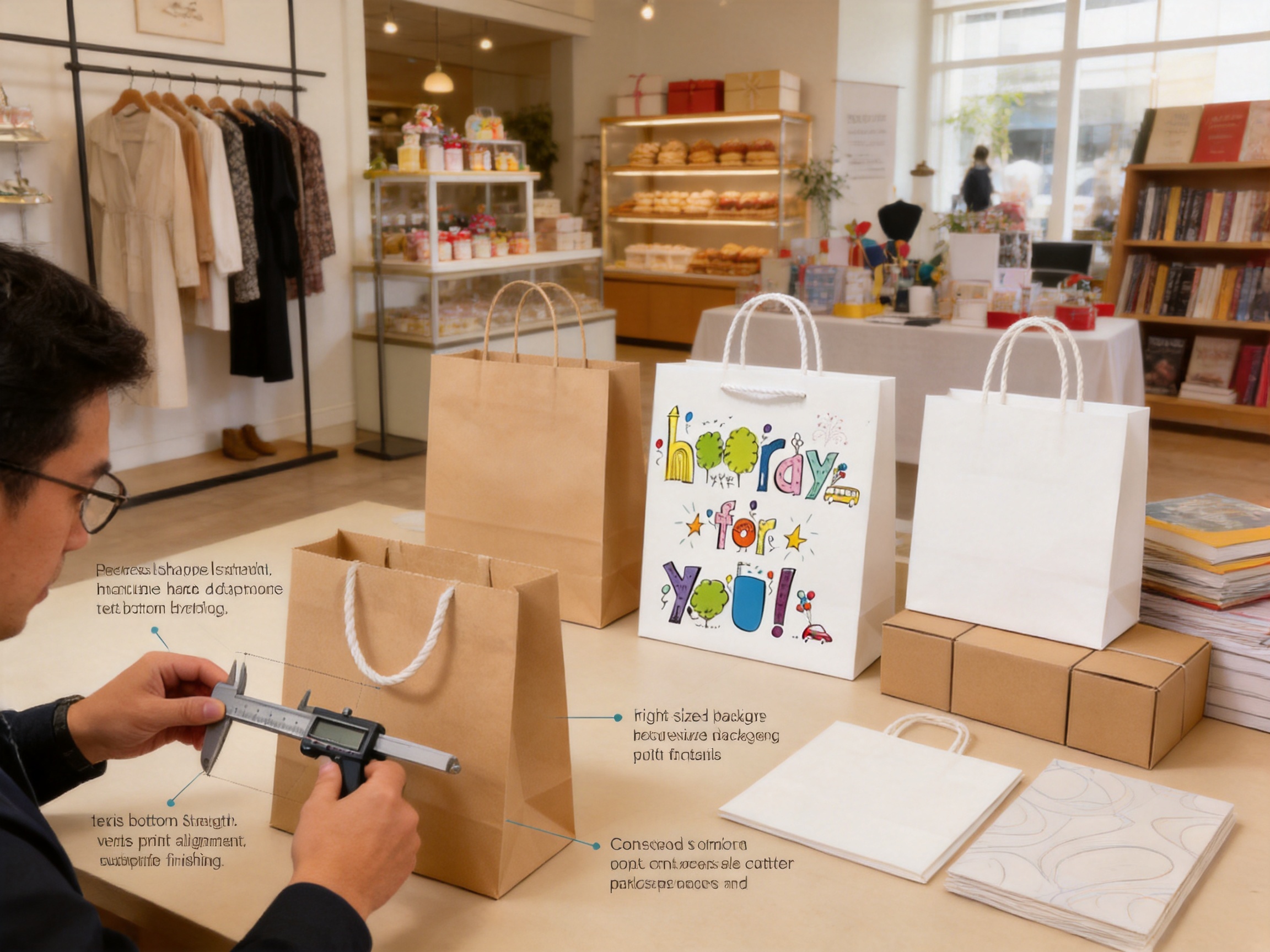
Inspection should cover both visual and functional details. The manufacturer can check printing alignment, surface condition, folding, adhesive areas, handle attachment, bag dimensions, and general cleanliness. For wholesale orders, inspection also helps identify repeated issues before products are packed for shipment.
9. Packing and delivery preparation
Finished bags should be packed in a way that protects them from dust, moisture, crushing, and unnecessary deformation. The packing method depends on bag size, handle structure, finishing, and shipping conditions. Proper preparation is important because even a well-made bag can be damaged if it is compressed or exposed to unsuitable storage conditions.
A factory that manages the full process can coordinate manufacturing and packing more efficiently. This reduces the number of handoffs and gives the buyer a clearer point of contact for questions about production status, specifications, and quality.
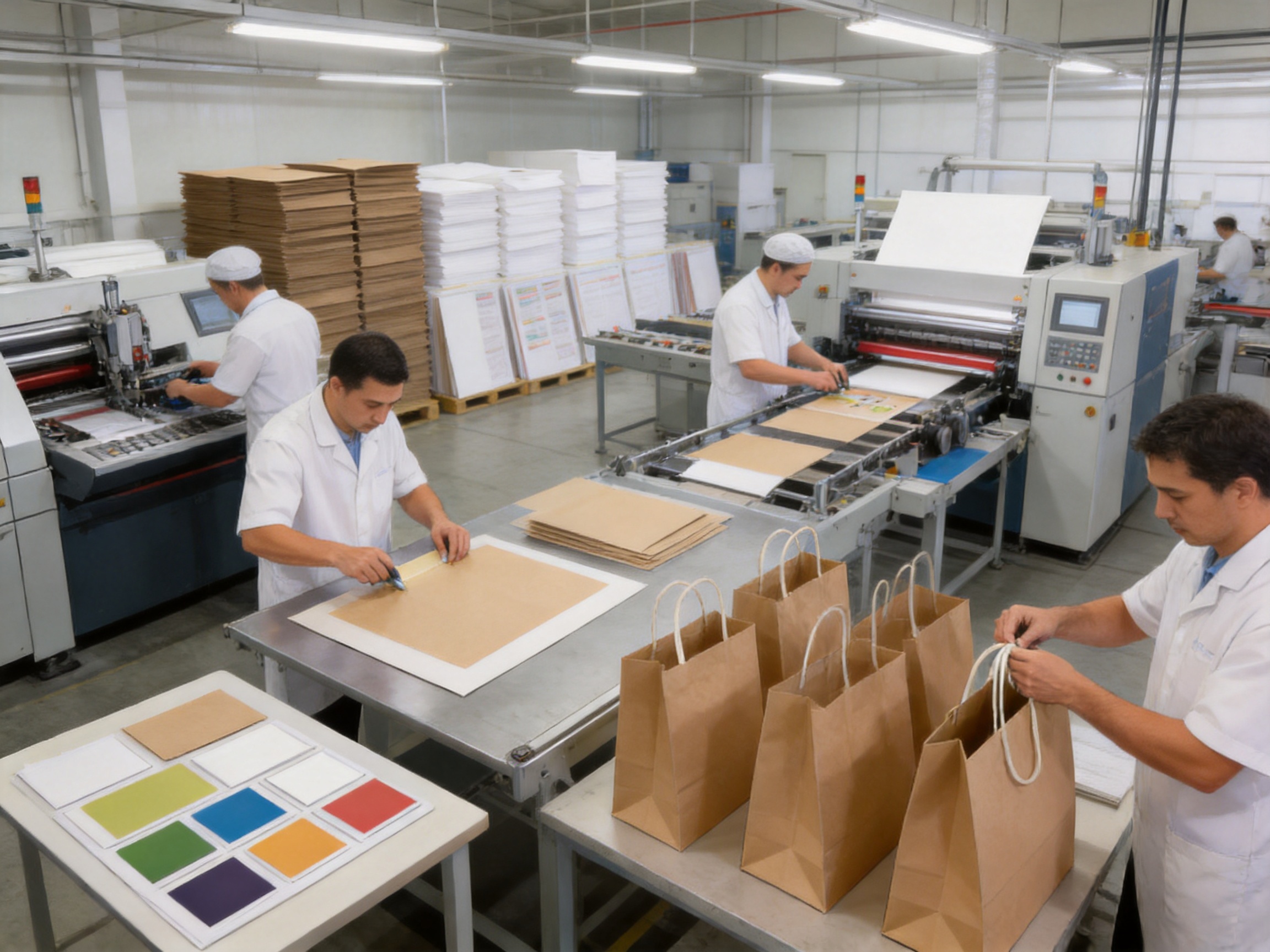
Why Integrated Factory Production Benefits Buyers
Integrated manufacturing means that multiple stages are handled within the same production organization. For customized paper packaging, this may include design support, prepress, printing, laminating, hot stamping, creasing, bag making, and manual finishing. The precise equipment and workflow may vary, but the main advantage is coordination.
When design and production are separated between unrelated suppliers, small misunderstandings can occur. A design file may not reflect the actual fold structure. A finishing supplier may interpret a stamping area differently from the printer. A bag assembler may work from an outdated specification. Integrated management can reduce these communication gaps by keeping the project information within one coordinated system.
In-house production also supports better control over quality standards. The same organization can review material selection, print output, structural assembly, and final finishing. If a problem appears, the source may be easier to trace. This can be valuable for repeat orders, where consistency is as important as the quality of the first production run.
Another benefit is process flexibility. A buyer may begin with a simple kraft bag and later request a different paper, a new print layout, hot stamping, or a larger size. A manufacturer with broad capabilities may be able to support these changes without forcing the buyer to search for a new supplier for every added feature.
For wholesale customers, integrated production can also make project planning more straightforward. The buyer can discuss order quantities, artwork, specifications, finishing, and delivery with one manufacturing partner. This does not eliminate the need for careful approval, but it can reduce administrative complexity.
Quality Factors Buyers Should Evaluate
Paper and structural strength
The paper should be appropriate for the intended load and dimensions. Buyers should ask whether the selected grade is suitable for the weight of the products and whether reinforcement is needed at the handles or bottom. A visually attractive bag that cannot withstand normal use will not deliver good value.
Print clarity and registration
Text should be sharp, logos should be properly aligned, and colors should be reasonably consistent across the order. Buyers should review a proof or sample when the project includes detailed artwork, multiple colors, or special finishing. Kraft paper may produce a different visual result from white paper, so the selected material should be represented accurately in the approval process.
Fold and assembly quality
Edges should be clean, creases should be controlled, and the bag should open and stand as expected. Side seams and bottom folds should be secure. If the bag includes handles, the attachment points should be positioned consistently and should not pull away during ordinary use.
Finishing consistency
Matte lamination, gloss lamination, and hot stamping should be applied evenly. Decorative effects should not cover important text or become misaligned with the main artwork. Premium finishing is most effective when it supports the design rather than distracting from it.
Repeat-order reliability
For an ongoing packaging program, buyers should consider whether the manufacturer can preserve approved specifications over time. This includes paper type, dimensions, color reference, logo position, handle style, and finishing. Good record management and production control are important for maintaining continuity across multiple orders.
Applications Across Different Industries
Fashion boutiques can use printed paper bags to create a recognizable presentation for clothing, shoes, accessories, and seasonal collections. A larger bag may be required for garments, while smaller formats can serve jewelry or small accessories. Different bag sizes can share the same logo and design system.
Gift shops can select kraft paper gift bags for a warm and approachable appearance. Short messages, seasonal illustrations, and decorative handles can make the bag suitable for birthdays, holidays, celebrations, and everyday gifting. The same structure may be produced with different artwork throughout the year.
Bookstores and stationery shops may use paper bags for books, notebooks, greeting cards, and small desk products. A simple printed design can support the store identity without making the packaging appear too formal. A kraft finish may also complement paper goods and printed products.
Food retailers, cafés, bakeries, and specialty product stores can use paper bags for selected dry goods, packaged items, or takeaway merchandise where the structure and material are appropriate. The bag can carry a logo, product message, or seasonal design while giving customers a convenient way to transport their purchase.
Corporate event organizers can customize bags for conferences, exhibitions, product launches, and promotional activities. The bag can hold brochures, samples, catalogs, or gifts. Because the printed surface is visible during and after the event, it can help extend the presence of the event identity.
Handmade and lifestyle brands may prefer kraft paper because it supports an informal and tactile presentation. A restrained logo, a single ink color, or a small decorative mark may be enough to create a cohesive packaging style. Brands can also use different sizes while retaining a consistent material and design language.
How to Plan a Successful Custom Bag Project
The first step is to define the bag’s purpose. Is it intended for daily retail use, gift presentation, event distribution, or a specific promotional campaign? The answer affects paper grade, size, printing, finishing, and quantity.
The second step is to measure the products that will be placed inside. Include the product’s length, width, height, packaging, and any space needed for easy loading. If several products may be combined, estimate the largest expected arrangement rather than designing only for a single item.
The third step is to decide how the bag should look and feel. Consider whether the desired impression is natural, modern, elegant, colorful, playful, minimal, or premium. Kraft paper can provide a natural base, while white cardboard or coated paper may offer a cleaner or brighter appearance.
The fourth step is to prepare the artwork in a production-ready format. Include the correct logo, fonts, colors, images, and text. If the buyer does not have final artwork, a manufacturer with design and prepress capabilities may be able to help develop the layout.
The fifth step is to confirm the required finishing. Not every bag needs lamination or hot stamping. These options should be used when they support the product position and budget. A simple bag can be highly effective when the material, printing, and structure are well coordinated.
The sixth step is to review a sample or proof when appropriate. Check the color, dimensions, handle placement, folding, surface, and overall feel. A sample review is especially valuable for complex designs, unusual sizes, or projects with multiple finishing processes.
The final step is to establish a repeat-order reference. Keep the approved artwork, paper specification, dimensions, finishing details, and sample records. This can make future orders faster and help maintain consistency when only the campaign message or design changes.
Comparison of Common Custom Bag Options
| Bag option | Typical visual character | Common advantages | Suitable applications | Important considerations |
|---|---|---|---|---|
| Natural kraft paper bag | Warm, relaxed, slightly textured | Approachable appearance and flexible basic printing | Gift shops, craft products, cafés, casual retail | Base paper color affects printed colors |
| White paper shopping bag | Clean, bright, straightforward | Clear logo reproduction and strong contrast | Retail stores, events, everyday shopping | Paper grade should match product weight |
| Coated paper bag | Smooth and refined | Suitable for detailed graphics and vivid artwork | Fashion, cosmetics, premium promotions | Surface and finishing choices affect cost |
| Laminated paper bag | Matte or glossy, more finished | Decorative surface effect and added protection | Premium gifts, campaigns, presentation packaging | Not always necessary for natural kraft designs |
| Hot-stamped gift bag | Decorative and premium | Metallic or accent details emphasize logos and messages | Luxury gifts, holidays, special events | Fine details require careful prepress review |
Environmental Considerations and Responsible Packaging Choices
Many buyers are reviewing packaging materials more carefully as they consider resource use, disposal, and customer expectations. Paper packaging can support a more responsible packaging strategy when the material, printing, finishing, order quantity, and product protection are considered together.
Choosing an appropriate bag size is one practical step. An oversized bag uses more paper and may require additional storage and shipping space. A bag that is too small may fail during use or require a second package. Correct sizing can help balance function and material efficiency.
Buyers should also consider whether a specific finishing process is necessary. A natural kraft bag with simple printing may meet the design and functional requirements without lamination. For another application, lamination or special finishing may be justified by the required appearance or surface performance. The best choice depends on the product and intended use rather than a one-size-fits-all rule.
Order planning can also reduce waste. Reusing a stable bag structure while changing only the artwork or selected details may reduce the need to redesign and re-engineer packaging for every campaign. Accurate forecasting is important as well, because excessive inventory can create unnecessary material use if the design becomes outdated.
Eco-friendly positioning should be communicated carefully. The actual environmental profile depends on the paper source, inks, coatings, adhesives, finishing, manufacturing conditions, product lifespan, and end-of-life handling. A professional packaging supplier can help buyers understand the available material grades and make choices that fit their requirements.
Manufacturing Strengths of an Experienced Paper Packaging Supplier
An experienced supplier brings more than machinery to a custom packaging project. Long-term production experience can improve understanding of paper behavior, folding, printing, finishing, and assembly. This knowledge helps the factory identify practical issues before they become expensive production problems.
A supplier with its own factory can maintain closer control over the production schedule and manufacturing sequence. It can coordinate raw materials, printing, finishing, bag making, and manual work within a unified plan. This is particularly valuable when an order includes several processes or when the packaging must be delivered according to a retail campaign schedule.
Professional design and prepress capability is another important strength. Buyers may have a logo or rough concept but need help adapting it to a bag structure. In-house support can address artwork proportions, folding areas, color preparation, and print limitations before the project reaches the production floor.
Broad manufacturing capabilities also support product variety. A buyer may need shopping bags for everyday sales, kraft gift bags for special occasions, gift boxes for premium products, greeting cards for seasonal communication, or patterned wrapping paper for a coordinated presentation. A supplier experienced in several paper product categories may be able to help create a more consistent packaging collection.
Quality control across the full process can improve consistency. Instead of inspecting only the finished item, the production team can monitor paper selection, printing, laminating, stamping, creasing, assembly, and manual finishing. This approach helps connect the final result to the earlier manufacturing decisions.
For international wholesale customers, service and communication are also important. Clear specifications, reliable samples, organized production records, and responsive coordination can reduce uncertainty during purchasing. The strongest manufacturing relationship is not based only on a single low price. It is based on a balance of product quality, process control, customization, delivery capability, and long-term support.
Frequently Asked Questions
What is the difference between a shopping bag and a gift bag?
A shopping bag is generally designed for carrying retail purchases and may prioritize practical strength, efficient production, and routine use. A gift bag often places greater emphasis on appearance, decorative printing, finishing, and presentation. In practice, the two formats can overlap. A well-designed shopping bag may also be suitable for gifting, while a kraft gift bag may be used for everyday retail purchases.
Can kraft paper bags be fully customized?
Yes. Kraft paper bags can usually be customized in size, printing, handle style, folding structure, and selected finishing options. The natural paper color and texture should be considered when preparing the artwork because they influence how printed colors appear.
Can a business change the design while keeping the same bag structure?
Yes. This is one of the main benefits of a stable packaging system. A business can keep the approved dimensions and construction while updating the logo treatment, message, seasonal artwork, or color scheme. The exact feasibility depends on the artwork and production requirements.
Are paper bags suitable for heavy products?
They can be suitable when the paper grade, dimensions, bottom structure, handle, and reinforcement are selected correctly. Heavy or unusually shaped products may require stronger paper or additional structural support. The manufacturer should review the actual product weight before confirming the specification.
What printing options are available?
Common options include single-color printing, multi-color printing, full-color artwork, patterned printing, and specialty details such as hot stamping. The best choice depends on the design, paper surface, visual goal, order quantity, and budget.
Does kraft paper affect printed color?
Yes. Kraft paper has a natural base tone that may change the appearance of bright or delicate colors. Designers often account for this by choosing stronger contrast, darker artwork, or a limited color palette. A proof or sample is useful when color accuracy is important.
Is lamination required for every custom bag?
No. Lamination is an optional surface treatment. It may be used for a matte or glossy appearance, added surface protection, or a more refined presentation. Many buyers prefer unlaminated kraft paper because it preserves the natural texture of the material.
What is hot stamping used for?
Hot stamping is commonly used to emphasize a logo, short message, border, or decorative detail. Metallic gold and silver are popular choices, but other colors may also be available. It is especially useful for gift bags and premium packaging.
Why is prepress important?
Prepress checks whether the artwork will work correctly on the actual bag structure. It helps identify problems involving fold lines, handle openings, bleed, text placement, resolution, color preparation, and finishing areas. Careful prepress can reduce errors before printing begins.
How can a buyer maintain consistency across repeat orders?
The buyer should keep the approved artwork, material specification, dimensions, finishing details, color references, and sample records. Working with a manufacturer that maintains organized production information can also help preserve the approved appearance from one order to the next.
Can one supplier produce other paper packaging products?
A manufacturer with broad paper packaging capabilities may also produce gift boxes, greeting cards, patterned wrapping paper, and related products. Using one supplier for coordinated items can help maintain similar colors, graphics, and finishing across a complete packaging collection.
What information should be provided when requesting a quotation?
Useful information includes the bag type, finished dimensions, paper preference, printing requirements, artwork status, handle style, finishing options, order quantity, packing expectations, and delivery destination. Product weight and intended use should also be provided so the construction can be evaluated accurately.
Conclusion
Customizable shopping bags and kraft paper gift bags offer a practical way to combine carrying function with visual communication. Their main value lies in flexibility. Businesses can choose natural kraft paper, white cardboard, coated paper, or other suitable materials. They can add logos, fonts, messages, patterns, seasonal artwork, lamination, or hot stamping. They can also maintain a familiar bag structure while adapting the design for changing campaigns and product lines.
Compared with generic packaging, custom paper bags provide stronger opportunities for identity, presentation, and customer recognition. Compared with rigid packaging systems that require extensive redesign, they can be easier to adapt over time. Their usefulness extends across everyday retail, gifting, events, specialty products, and promotional distribution.
The quality of the final result depends on more than the printed artwork. Paper selection, structural design, prepress, printing, creasing, bag making, finishing, manual assembly, inspection, and packing all contribute to the product. A manufacturer with an integrated factory, professional design support, in-house production processes, and experience with several paper product categories can coordinate these stages more effectively.
For wholesale buyers, the best packaging partner is one that can balance appearance, function, customization, consistency, delivery, and responsible material choices. With the right specifications and production planning, a paper bag can remain simple enough for daily use while still giving a store or brand room to communicate something distinctive.
References
1. General principles of paper packaging structure, folding, and bag construction.
2. Packaging design practices for retail shopping bags and gift presentation products.
3. Material selection considerations for kraft paper, white cardboard, and coated paper packaging.
4. Prepress and artwork preparation guidelines for printed paper products.
5. Standard quality control considerations for printing, laminating, hot stamping, creasing, and manual finishing.
6. Sustainable packaging planning principles related to material use, sizing, reuse, and finishing selection.
7. Manufacturer-provided product and process information for custom paper bags, gift bags, gift boxes, greeting cards, and patterned wrapping paper.