中文简体
 русский
 Français
 Español
 Deutsch
 عربى

Introduction
A greeting card can be a small product, but it often carries a large emotional purpose. It may accompany a birthday present, mark a childhood milestone, celebrate a family occasion, or serve as a keepsake long after the original event has passed. For that reason, the quality of a greeting card depends on more than its printed image. The paper, structure, surface treatment, envelope fit, writing space, and overall presentation all influence how the recipient experiences it.
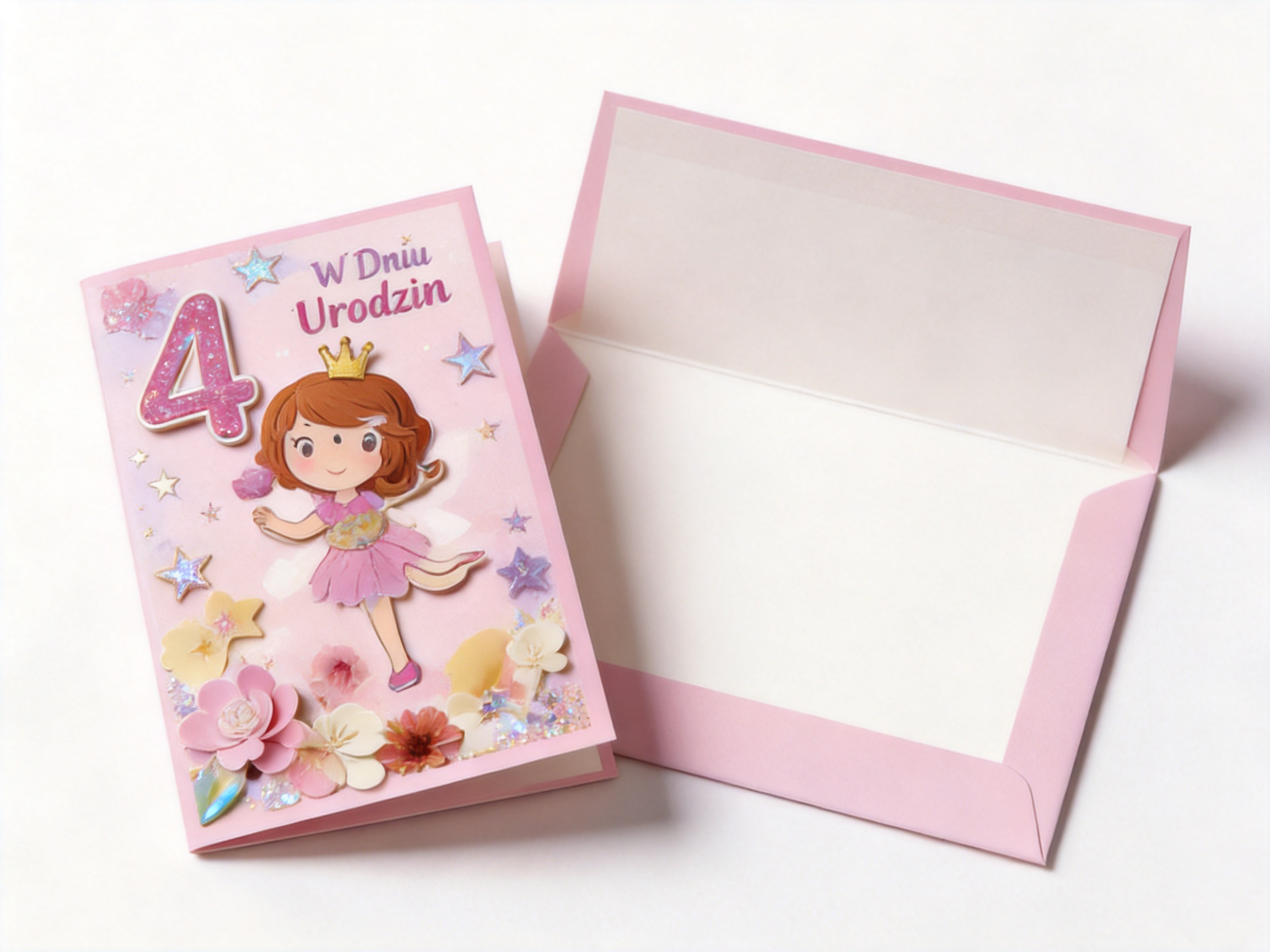
The Princess Childhood Paper Gift Greeting Card is designed around these practical and emotional requirements. Measuring 12 x 17 cm, it provides a balanced writing area while remaining easy to hold, display, package, and mail. Its matching envelope measures 12.5 x 17.5 cm, creating a proportionate presentation that protects the card without making the package feel unnecessarily large. The result is a compact greeting product with enough surface area for decorative detail and personal writing.
Its main visual character comes from the combination of 3D paper details, holographic foil, and glitter. These treatments create changes in texture and reflection that are more engaging than a standard flat print. When the card is moved, the holographic elements catch light from different angles. Slightly raised areas can also be felt by hand, giving the design a tactile quality that supports its princess-themed childhood appeal.
Although the card is decorative, its interior remains clean for writing. This balance is important. A highly embellished card can become difficult to use if the inside is crowded with patterns, glitter, or heavy printing. By reserving a clear writing area, the design allows a short greeting, a longer personal message, or a signature to remain readable and visually separate from the exterior decoration.
The product also reflects the broader capabilities of its manufacturer, Yiwu Magic Tree Gift Bag Co., Ltd. The company specializes in paper packaging and paper gift products, including gift bags, gift boxes, greeting cards, and patterned wrapping paper. Its manufacturing structure includes design and prepress, printing, laminating, hot stamping, creasing, bag making, and manual finishing. These capabilities are valuable because products that combine several decorative processes require coordination from artwork preparation through final inspection.
This article examines the card in detail, explains where it has advantages over more basic greeting card alternatives, and describes the production strengths that support consistent quality. It also considers applications, purchasing factors, customization possibilities, quality control, packaging, sustainability considerations, and frequently asked questions.

Princess Childhood Paper Gift Greeting Card
Product Overview
The Princess Childhood Paper Gift Greeting Card is a paper greeting product with a decorative exterior and a writable interior. Its design is positioned toward princess-themed celebrations and childhood occasions, although the exact use can be adapted according to the buyer’s market and customer base. It can be offered as a standalone greeting card, paired with a gift bag or gift box, or included in a coordinated paper packaging collection.
The card has a size of 12 x 17 cm. This format provides a practical compromise between portability and visual impact. A card that is too small may restrict the message area and make detailed decorative treatments difficult to appreciate. A card that is too large may be harder to package, display, or mail economically. The 12 x 17 cm format gives the design enough room for its princess artwork, while keeping the product suitable for common retail and gifting situations.
The accompanying envelope measures 12.5 x 17.5 cm. The slightly larger envelope allows the card to be inserted without excessive force and helps reduce the possibility of edge damage during handling. Its close proportional relationship with the card also gives the complete set a neat appearance. The envelope does not overwhelm the card, and the card does not appear loose or undersized inside the envelope.
The exterior uses three principal treatments: 3D paper tips, holographic foil, and glitter. These treatments perform different functions. The raised paper elements introduce physical depth. Holographic foil produces shifting reflections. Glitter adds sparkle and visual emphasis to selected areas. Used together, they create a layered appearance that is more expressive than relying on one finish alone.
The interior is intentionally less decorated. This gives users sufficient room to write a personal message without having to work around a busy background. For retailers and brands, this feature increases the card’s versatility. Some buyers may want to add only a name and a short phrase, while others may write several sentences. A clean inside layout supports both uses.
| Product Attribute | Specification | Practical Value |
| Product Type | Paper greeting card | Suitable for personal messages, gifts, and retail presentation |
| Card Size | 12 x 17 cm | Balanced format for decoration, writing, handling, and mailing |
| Envelope Size | 12.5 x 17.5 cm | Close fit that supports protection and neat presentation |
| Surface Treatment | 3D paper details, holographic foil, and glitter | Creates texture, reflection, and visual depth |
| Interior | Clean writing area | Allows flexible personal messages and signatures |
| Main Style | Princess and childhood theme | Appropriate for children’s celebrations and gift occasions |
Why the Design Appeals to Buyers
The product’s appeal begins with the way it combines visual recognition and tactile discovery. A printed princess image can communicate a theme immediately, but raised paper, foil reflection, and glitter give the recipient reasons to look more closely. The card can appear different under direct light, indoor lighting, or natural daylight. This changing surface quality encourages interaction and makes the card feel more like a keepsake than a disposable message carrier.
For children, sparkle and dimensional details can make the product especially engaging. For parents, relatives, and gift buyers, the same features can communicate care and celebration. A card with multiple finishing effects may appear more special when attached to a present because it adds another layer of presentation to the overall gift.
The princess theme is also commercially flexible. It may be associated with birthdays, childhood celebrations, family parties, congratulatory moments, or imaginative play. Retailers can display the card in children’s stationery sections, gift shops, party supply stores, seasonal collections, and curated paper goods displays. Brands may also adapt the visual theme to suit a particular customer group while retaining the basic structure and finishing approach.
Another advantage is the balance between decoration and usability. Some novelty cards concentrate so heavily on exterior effects that they provide little room for a message. Others leave a large writing area but look visually plain. This card takes a middle position. The outside is expressive and layered, while the inside remains functional. That balance can make it easier for retailers to explain the product’s value to customers.
The card is also suitable for display. Its 12 x 17 cm format is large enough for the artwork to remain visible on a shelf or greeting card rack, but compact enough to fit within standard merchandising areas. The matching envelope helps keep the set organized and may allow the product to be presented as a complete ready-to-give item.
Advantages Over Basic Greeting Card Alternatives
More Than Flat Printing
A basic greeting card often depends mainly on printed color and graphic composition. Printing remains an important part of any card, but a flat surface can limit how much the recipient notices after the first glance. The Princess Childhood Paper Gift Greeting Card adds dimensional paper details and reflective finishing, creating a multi-sensory experience that standard flat printing cannot provide on its own.
The 3D paper details create visible relief. Slightly raised elements can separate parts of the artwork, make selected motifs more prominent, and create shadows that change the appearance of the design. The raised construction can also be felt by touch, which gives the product a stronger physical identity.
More Dynamic Surface Effects
Holographic foil provides movement without requiring electronic components or complex mechanical structures. As the card is tilted, the reflective surface shifts. This makes the artwork appear lively and gives the recipient a reason to interact with the card. Glitter provides additional brightness and can highlight areas that are intended to attract attention, such as decorative clothing, stars, crowns, borders, or other princess-inspired features.
Compared with a single matte or gloss coating, the combination of foil and glitter allows different areas of the card to respond differently to light. This contrast can make the design appear more detailed and premium. It also gives retailers a stronger visual selling point when the card is displayed under store lighting.
Better Writing Function
Many decorative cards are attractive on the outside but difficult to personalize. The clean interior of this product addresses that problem. The user can write directly on the inside without competing with heavy graphics or glitter. A clear writing surface also supports different handwriting styles and writing tools, subject to the final paper specification selected for production.
This practical feature is particularly important for family gifting. A child may receive a card with a short handwritten greeting, while an adult family member may want to write a longer message. The card’s interior can support both approaches.
Balanced Dimensions
The 12 x 17 cm card size gives the product a more substantial presence than a very small note card, while avoiding the bulk of oversized formats. Its proportions allow the manufacturer to arrange decorative layers without making the front feel crowded. The 12.5 x 17.5 cm envelope provides a close and coordinated fit, which supports a polished final presentation.
Stronger Gift Compatibility
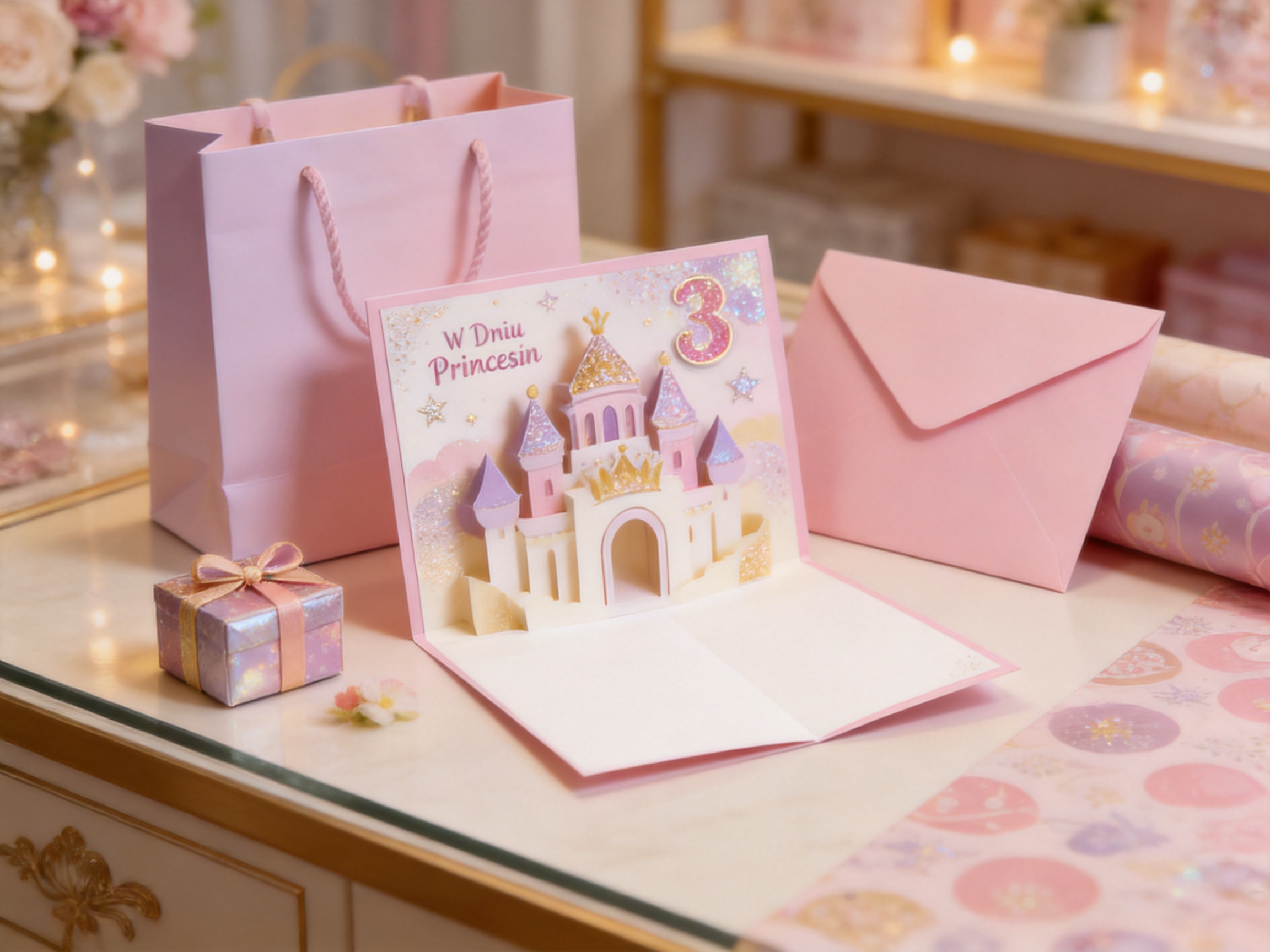
A greeting card is often purchased together with another item. The princess design can coordinate naturally with gift bags, gift boxes, and patterned wrapping paper. When these products are developed as a collection, colors, motifs, foil treatments, and paper textures can be aligned across the full package. This creates a more unified gift presentation than combining unrelated products from different sources.
Material and Structural Considerations
The quality of a greeting card depends heavily on the paper selected for its structure and finish. The card needs to be firm enough to support raised details, foil application, glitter, folding, writing, and handling. If the paper is too thin, the card may bend easily or lose its shape during transportation. If it is too rigid, folding and mailing may become less convenient.
The supplied product description identifies the card as having a firm feel rather than a thin, fragile construction. This is useful for both retailers and end users. A firm card can retain a cleaner appearance on display and can help protect the decorative surface during ordinary handling. It also provides a better base for layered paper elements and other finishing processes.
Magic Tree’s broader material expertise includes white cardboard, coated paper, and kraft paper products. These materials serve different purposes across the company’s product range. White cardboard can support a clean, bright presentation and detailed printing. Coated paper can provide a smooth surface for color reproduction and selected finishes. Kraft paper can support a more natural visual direction and is often considered for packaging concepts that emphasize an unbleached or earthy appearance.
For this particular card, the final material specification should be selected according to the desired appearance, finishing complexity, writing performance, shipping requirements, and target price. A design with raised paper details and foil may require a different paper structure from a simple one-color card. The manufacturer’s ability to evaluate these factors during prepress and production planning is an important advantage.
Structural planning also includes the fold, edge alignment, envelope compatibility, and placement of decorative elements. Raised components should not interfere with the closing area. Foil and glitter should be placed carefully so that the card remains comfortable to handle and can be inserted into its envelope without unnecessary friction. These details may appear small, but they influence the final user experience.
Advanced Manufacturing Capabilities
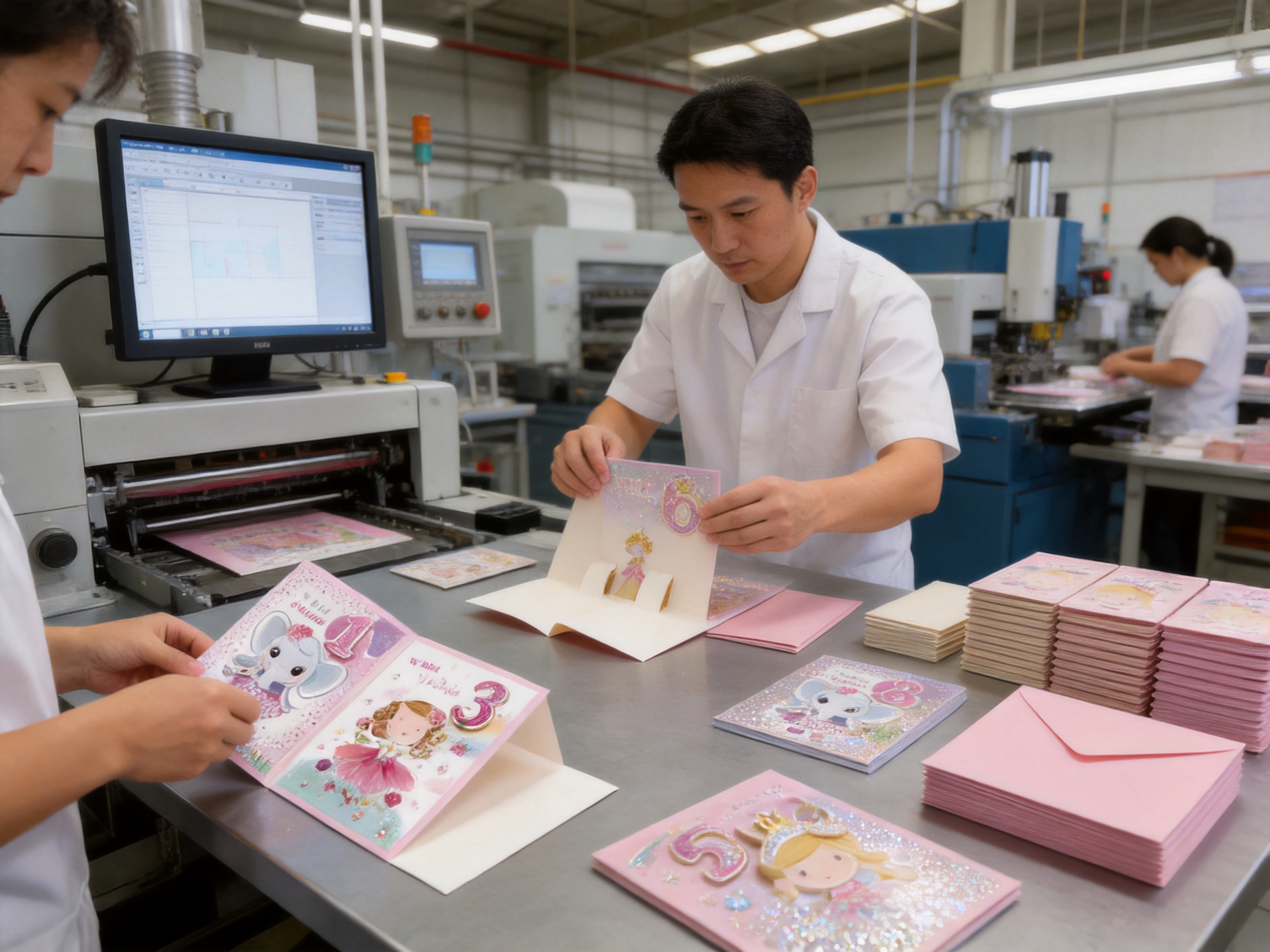
The manufacturer’s strength is not limited to one printing machine or one finishing technique. Magic Tree manages a range of processes that are relevant to paper gift products. Its in-house capabilities include professional design and prepress, laminating, hot stamping, creasing, printing, bag making, and manual finishing. This integrated structure allows different stages to be coordinated under one production system.
Design and Prepress
Design and prepress are important for a product that contains multiple layers and surface effects. Before production begins, artwork must be checked for dimensions, bleed, fold positions, foil areas, glitter areas, raised paper components, color separation, and envelope compatibility. Prepress preparation helps reduce errors that might otherwise appear only after materials have been printed or finished.
For a princess-themed card, prepress may also involve checking the visual hierarchy of the artwork. The main character or central motif should remain clear, while foil and glitter should enhance rather than obscure the printed image. The position of raised details should support the composition and avoid unnecessary crowding. Good prepress planning helps each process contribute to the same design goal.
Printing
Printing establishes the base image, colors, text, and background elements. Consistent printing is important when the card forms part of a wider gift collection. If the card is paired with a gift bag or wrapping paper, color coordination becomes part of the customer’s perception of quality. A capable production team can manage artwork files and print specifications to support a closer visual relationship between different paper products.
Printing quality also affects the appearance of the holographic foil and glitter. These materials are usually most effective when applied to clearly defined areas. Strong underlying color and clean registration allow the decorative treatments to appear intentional instead of random.
Hot Stamping and Foil Application
Hot stamping is one of the processes available within the manufacturer’s production capabilities. It can be used to create reflective accents and emphasize selected parts of a design. On the Princess Childhood Paper Gift Greeting Card, holographic foil contributes to the changing light effect that distinguishes the product from a standard printed card.
Foil application requires attention to pressure, temperature, positioning, and material compatibility. If registration is inaccurate, the reflective area may not align properly with the artwork. If pressure or temperature is not properly controlled, the finish may appear uneven. Production experience helps the manufacturer manage these variables and maintain a consistent result across a batch.
Creasing and Folding
Creasing supports a clean fold and helps reduce the risk of cracking or uneven bending. This matters when the card includes a firm paper base, printed coatings, foil, or layered decorative elements. Proper creasing gives the card a more controlled structure and supports a neat relationship between the front, back, and interior writing panel.
Creasing also affects packaging efficiency. A card that folds accurately is easier to stack, count, insert into envelopes, and pack into shipping cartons. Consistency in folding can reduce irregularities during final packing and improve the appearance of retail-ready units.
Manual Finishing
Manual finishing is particularly useful for products with dimensional paper components and detailed decorative arrangements. Some 3D paper elements may need to be assembled, positioned, pressed, or checked by hand. Manual finishing allows workers to inspect the relationship between individual pieces and correct visible irregularities before the product is packed.
Hand finishing should not be understood as a substitute for process control. Its value is greatest when it works together with accurate printing, stable materials, clear work instructions, and systematic inspection. For gift products, the combination of automated and manual capabilities can provide a practical balance between production efficiency and decorative detail.
Integrated Factory Management
Magic Tree operates its own factory and manages the production process from raw materials to finished products. This level of control can simplify communication and make it easier to coordinate specifications. Instead of dividing printing, finishing, assembly, and packing among unrelated suppliers, an integrated factory can manage the relationship between these stages.
Integrated management may also support more consistent scheduling. A project involving printing, foil, glitter, dimensional paper, folding, envelope matching, and manual inspection has several points where delays can occur. Coordinating these operations within one manufacturing structure can help reduce handoff problems and support more predictable delivery planning.
Quality Control and Consistency
Quality control for a decorative greeting card should cover both appearance and function. A card may look attractive in a photograph but still have problems such as loose glitter, misaligned foil, uneven raised elements, damaged folds, incorrect envelope dimensions, or insufficient writing space. A professional production process therefore needs inspection criteria that address the entire product.
At the material stage, paper should be checked for surface consistency, color, firmness, and suitability for the selected treatments. Material variation can affect printing, foil adhesion, folding, and the feel of the finished card. Inspecting incoming materials helps reduce the risk of defects later in production.
During printing, checks may include color consistency, image clarity, registration, and the positioning of artwork relative to the fold. During foil and glitter application, inspection may focus on coverage, alignment, adhesion, and cleanliness. For 3D paper details, workers can review placement, bonding, edge condition, and the overall visual balance of the design.
Final inspection should confirm that the card measures correctly, opens and closes properly, has a clean writing area, and fits into the matching envelope. The envelope should also be checked for size, folding quality, and surface condition. A complete set should be packed together so that the card and envelope reach the buyer as a coordinated unit.
Consistency is particularly important for wholesale buyers. A retailer ordering a collection needs repeated units to have a similar appearance. Variations that may be acceptable in a handmade one-off product can become a commercial problem when they appear across a large batch. The manufacturer’s experience with paper bags, gift boxes, cards, and wrapping paper supports a broader understanding of repeat production requirements.
Customization Opportunities
The standard Princess Childhood Paper Gift Greeting Card provides a clear reference design, but the same manufacturing capabilities can support customization for brands, retailers, event organizers, and distributors. Customization may involve artwork, colors, wording, dimensions, paper choice, decorative treatments, packaging, or coordinated product development.
Artwork and Theme Adaptation
Buyers may request changes to the princess character, clothing, background, decorative elements, or overall color direction. A soft pastel palette may suit a children’s birthday range, while brighter colors may be more appropriate for a festive retail collection. The basic concept can also be adapted toward fairytale, fantasy, royal celebration, or storybook themes.
Brand and Retail Customization
Retailers and brands may want a distinctive visual identity across their paper products. The card can be developed to match a gift bag, gift box, or wrapping paper series. Shared colors, borders, patterns, foil treatments, and illustration styles can help create a recognizable collection. Coordinated products may encourage customers to purchase several items together rather than selecting separate pieces from unrelated ranges.
Message and Language Customization
The interior may be left blank, as in the described product, or customized with a printed greeting. A blank interior offers maximum flexibility for end users. Printed wording can be useful when a card is designed for a specific event, seasonal campaign, retail program, or institutional purchase. Depending on the target market, text can be prepared in different languages or adapted to local cultural conventions.
Finishing Customization
Buyers may select the balance between 3D paper details, holographic foil, glitter, and other available treatments. Not every design requires the same level of decoration. A premium limited edition may use several layers of finishing, while a larger-volume retail line may use selected effects to control cost and simplify handling. The manufacturer can evaluate the relationship between the desired appearance, material choice, production method, and order requirements.
Packaging Customization
The card can be supplied with a matching envelope and packed as an individual retail unit or as part of a larger paper gift set. Packaging may include a belly band, sleeve, label, insert, or coordinated gift bag. These options should be planned early because the final card thickness and decorative relief may affect packing dimensions and protection requirements.
Applications and Target Markets
The product is naturally suited to children’s birthday celebrations. Its princess styling, sparkle, dimensional details, and personal writing space make it appropriate for family members, classmates, friends, and party guests. It can be sold in stores that carry children’s stationery, toys, party supplies, gifts, and seasonal products.
It may also be used for broader childhood milestones. Examples include congratulations, school achievements, first performances, family celebrations, and imaginative-themed events. The product does not need to be restricted to one specific occasion if the front artwork and interior wording remain sufficiently flexible.
Gift shops may position the card as an accessory to a wrapped present. Because the design has a more decorative exterior than a plain note card, it can contribute visibly to the presentation of the gift. Retailers may display it near princess-themed gift bags, pastel wrapping paper, children’s gift boxes, or small toys.
Online sellers can present the product through close-up images that show the dimensional paper, holographic reflection, glitter, card size, and envelope. Since some of the product’s value is tactile and reflective, product photography should show the surface from more than one angle. Written specifications should clearly state the card and envelope dimensions so buyers understand the scale.
Wholesale distributors may include the card in a wider catalog of paper packaging products. Magic Tree’s product range includes gift bags, gift boxes, greeting cards, and patterned wrapping paper, allowing buyers to source related categories from one manufacturer. This can simplify purchasing for businesses that want coordinated paper goods across several product lines.
Packaging, Storage, and Shipping Considerations
Decorative greeting cards should be protected from bending, compression, moisture, and surface friction during storage and transportation. The firm paper structure helps the card retain its shape, but packaging still needs to account for the raised components and surface treatments. Excessive pressure may flatten dimensional details or mark foil and glitter.
Cards should be stacked in a way that distributes weight evenly. If they are packed too tightly or exposed to uneven pressure, raised elements may rub against adjacent cards. Protective interleaving, sleeves, or carefully designed cartons may be considered depending on the order format and the level of relief.
The matching envelope should remain with the card throughout packing and distribution. Separating the two components can create inventory errors and reduce the product’s ready-to-give convenience. A clear packing method can help ensure that every card reaches the customer with the correct envelope.
Storage areas should be dry, clean, and protected from excessive heat or humidity. Paper products can respond to environmental conditions, and decorative adhesives or coatings may also be affected by unsuitable storage. Retailers should avoid placing heavy items on top of greeting card cartons and should protect displayed products from repeated rubbing.
For international shipments, carton planning should consider the card count, envelope count, unit protection, and outer carton strength. Efficient packing can help reduce unnecessary volume while preserving the condition of the decorative surfaces. Since Magic Tree serves clients in markets including the United States, Canada, Mexico, the United Kingdom, Japan, and China, experience with international customer requirements can support export-oriented orders.
Sustainability and Material Responsibility
Paper products can support sustainability goals, but responsible sourcing and production depend on the exact materials, coatings, adhesives, inks, and finishing methods selected for an order. The company offers paper packaging products using white cardboard, coated paper, and kraft paper, and can discuss suitable material directions with buyers according to project requirements.
An environmentally conscious approach begins with choosing an appropriate paper specification rather than simply using the lightest possible material. The paper must be strong enough to protect the card and support its decorative elements. If it bends, tears, or becomes unusable easily, premature replacement may offset the benefit of reduced material weight.
Design efficiency can also contribute to responsible production. Accurate prepress reduces misprints, while coordinated production planning can lower avoidable waste from incorrect dimensions, poor registration, or unsuitable finishing. Managing processes in an owned factory may make it easier to review material usage and production outcomes across the complete workflow.
Buyers seeking environmentally oriented packaging should confirm the details that matter for their market, such as paper grade, recycled content, coating selection, ink system, adhesive type, packaging format, and relevant documentation. The phrase “eco-friendly” should be connected to specific material and production information rather than treated as a general assumption.
The card’s durability also has a practical environmental dimension. A well-made greeting card can remain attractive for longer, be displayed as a keepsake, or be stored with personal mementos. The product is designed to create an emotional connection, and that connection may encourage recipients to keep it rather than immediately discard it.
How the Product Supports Retail Value
Retail value is created by the relationship between product appearance, function, quality, cost, and customer expectation. The Princess Childhood Paper Gift Greeting Card offers several features that can support a stronger value proposition: a recognizable theme, tactile details, shifting foil reflection, glitter, a firm paper feel, a clean writing area, and a matching envelope.
These features give sales staff and online listings clear points to communicate. Customers can understand that the card is not simply a printed sheet. It is a complete paper gift product with a decorative exterior and a usable interior. The envelope reinforces the idea that the card is ready for presentation.
The product may also work well in tiered collections. A retailer could offer a basic printed card, a card with selected foil, and a more elaborate dimensional glitter version. Such a range allows customers to choose according to budget and desired presentation. The manufacturer’s ability to handle different processes can support multiple product levels within one broader collection.
For wholesale buyers, the ability to coordinate the card with other packaging products can improve assortment planning. A store may order a matching gift bag, gift box, wrapping paper, and card under a shared theme. This can create more shelf impact and give customers an easy way to build a complete gift presentation.
Recommended Buyer Evaluation Checklist
Before placing an order, buyers should review the final artwork and confirm the exact card size, envelope size, paper specification, finishing treatments, and interior layout. The design should be evaluated both digitally and through a physical sample because reflective foil, glitter, and raised paper details cannot be judged fully on a flat screen.
Buyers should also confirm the intended use of the card. A product for children’s birthday retail may require different colors, wording, packing, and display information from a card intended for private-label gift sets. Defining the sales channel early helps the manufacturer recommend a suitable production approach.
Sample approval is important when multiple treatments are combined. Buyers should inspect the foil alignment, raised detail placement, glitter distribution, fold quality, paper feel, envelope fit, and interior writing performance. If the card will be sold internationally, packaging and labeling requirements should also be reviewed before mass production.
Production planning should include order quantities, delivery schedule, artwork deadlines, packaging format, carton requirements, and inspection standards. Clear communication at the beginning can reduce revisions later. The manufacturer’s integrated capabilities can be used most effectively when all required specifications are documented in one coordinated project brief.
Q&A
What are the dimensions of the card?
The card measures 12 x 17 cm. This format provides room for princess-themed artwork, layered paper details, foil, glitter, and a personal message while remaining practical for retail display and mailing.
What size is the matching envelope?
The matching envelope measures 12.5 x 17.5 cm. Its slightly larger dimensions allow the card to fit neatly without appearing loose or being forced into the envelope.
What decorative treatments are used?
The product uses 3D paper details, holographic foil, and glitter. Together, these treatments create raised texture, changing reflections, and sparkling accents across the design.
Does the inside contain printed decoration?
The described product leaves the inside clean for writing. This gives the user room for a short greeting, a longer personal message, or a signature without competing with heavy interior graphics.
Is the card suitable for children’s birthdays?
Yes. The princess and childhood theme, combined with the dimensional and reflective surface effects, makes it suitable for children’s birthday celebrations and related family occasions. The final wording and artwork can also be adapted for other events.
How does this card differ from a basic printed greeting card?
A basic card may rely primarily on flat printing. This product adds dimensional paper elements, holographic foil, and glitter, giving it greater tactile interest and a more dynamic appearance under changing light.
Can the card be customized?
Customization may include artwork, colors, wording, paper, dimensions, finishing effects, envelope design, and coordinated packaging. The exact options should be confirmed according to the project requirements and production plan.
What manufacturing processes support the product?
The manufacturer has capabilities covering design and prepress, printing, laminating, hot stamping, creasing, bag making, and manual finishing. These processes support the card’s printed image, reflective elements, structure, and dimensional details.
Why is in-house production useful?
In-house production can improve coordination between materials, printing, finishing, assembly, and inspection. It can also simplify communication and help the factory manage quality and scheduling across the complete production process.
Can the card be sold with other paper gift products?
Yes. It can be paired with gift bags, gift boxes, and patterned wrapping paper. Coordinating the artwork, colors, paper, and finishing methods can create a unified gift presentation.
What should buyers check before mass production?
Buyers should check the physical sample, paper firmness, card and envelope dimensions, artwork registration, foil alignment, glitter distribution, raised details, fold quality, writing area, packing method, and shipping protection. Environmental and labeling requirements should also be confirmed for the target market.
Is the product available for international buyers?
The manufacturer serves clients in several international markets, including the United States, Canada, Mexico, the United Kingdom, Japan, and China. Buyers should discuss order specifications, packaging, documentation, and delivery requirements directly during project planning.
Conclusion
The Princess Childhood Paper Gift Greeting Card combines a compact, practical format with a more elaborate decorative experience. Its 12 x 17 cm card size and 12.5 x 17.5 cm envelope create a neat, usable set. The clean interior preserves space for personal writing, while the firm paper structure supports handling and helps carry the layered exterior design.
Its main advantage over a basic greeting card is the combination of 3D paper details, holographic foil, and glitter. These treatments introduce depth, reflection, sparkle, and touch-based interest. The product can therefore function not only as a message carrier but also as part of the gift presentation and, potentially, as a small keepsake.
The manufacturing capabilities behind the product strengthen its commercial value. Design and prepress support accurate preparation, printing establishes the artwork, hot stamping contributes reflective effects, creasing supports a clean fold, and manual finishing helps manage dimensional details. The company’s wider expertise in paper bags, gift boxes, greeting cards, and wrapping paper also makes it suitable for coordinated packaging programs.
For retailers, distributors, and brands, the card offers a flexible foundation for children’s and princess-themed product collections. It can be sold as a standalone card, combined with a gift package, or customized for a specific visual identity. With careful material selection, quality control, packaging protection, and production planning, it can provide a consistent and attractive paper product for both domestic and international markets.
References
1. Product specification supplied for the Princess Childhood Paper Gift Greeting Card, including card size, envelope size, interior layout, and surface treatments.
2. Manufacturing capability information supplied for Yiwu Magic Tree Gift Bag Co., Ltd., including design, prepress, printing, laminating, hot stamping, creasing, bag making, and manual finishing.
3. Company information supplied for Magic Tree’s paper product range, including white cardboard, coated paper, kraft paper, gift bags, gift boxes, greeting cards, and patterned wrapping paper.
4. General paper packaging quality considerations covering paper structure, printing, folding, decorative finishing, inspection, storage, and transportation.
5. General product development considerations for coordinated paper gift packaging collections and customized retail stationery.