中文简体
 русский
 Français
 Español
 Deutsch
 عربى

A custom postcard colorful printed greeting card combines the directness of a postcard with the visual appeal of a carefully designed greeting card. It can carry a handwritten message, a seasonal expression, an invitation, a promotional statement, or a compact brand story. Unlike a plain communication card, a custom printed card can use color, imagery, typography, patterns, and finishing details to create a stronger emotional and visual response.
For retailers, event organizers, stationery brands, hospitality companies, artists, and businesses preparing promotional materials, the product offers a flexible communication format. It can be designed for personal use, included inside a gift package, distributed at an event, or mailed directly to a customer. Its relatively compact format also makes it convenient for storage, handling, packing, and shipping.
The quality of a colorful printed greeting card depends on more than the artwork shown on the screen. Paper selection, printing accuracy, color management, cutting, creasing, surface treatment, and final inspection all influence the finished result. A strong manufacturing partner must therefore combine creative support with reliable production control.
Magic Tree Gift Bag Co., Ltd., also known as Magic Tree Paper Products Co., Ltd., manufactures paper packaging and paper communication products, including greeting cards, gift bags, gift boxes, and patterned wrapping paper. Founded in 1996 as Fushida Plastic Factory and rebranded in 2019, the company brings nearly three decades of manufacturing experience to customized paper products.
This article explains how a custom postcard colorful printed greeting card is developed, what advantages it can offer compared with ordinary cards, how professional production processes improve consistency, and what buyers should consider when selecting a supplier.

Custom Postcard Colorful Printed Greeting Card
Understanding the Custom Postcard Colorful Printed Greeting Card
A postcard-style greeting card is a paper product designed to communicate a message in a compact, visually accessible form. It may be produced as a single flat card, a folded card, or a postcard-inspired format with a printed front and a writing area on the reverse. The final configuration depends on the intended use, mailing method, presentation style, and brand requirements.
The word “custom” refers to more than adding a logo. Customization can include the card dimensions, paper type, thickness, color palette, artwork, typography, message, back-panel layout, writing lines, envelope pairing, and finishing treatment. For a business, the card can follow an existing visual identity. For an individual or creative brand, it can express a distinctive illustration style or seasonal theme.
Color is one of the product’s most important design elements. Soft neutral tones can communicate calmness, elegance, and warmth. Pastel combinations often suit baby celebrations, weddings, wellness brands, and personal stationery. Stronger colors can create energy and visibility for retail promotions, birthday messages, product launches, festivals, and event invitations.
Because the card has a limited physical area, design efficiency is important. A professional layout should make the main message easy to understand without overcrowding the surface. Images, patterns, text, and decorative elements need enough space to remain clear after printing and trimming. Good production planning helps preserve the relationship between the artwork and the final physical dimensions.
Common applications
Custom colorful greeting cards can support a wide range of communication needs. Retailers may sell them as standalone stationery items or include them with gift purchases. E-commerce brands can place a thank-you card inside an order to encourage customer loyalty. Hotels, restaurants, and event venues can use them for welcome messages, celebration packages, or seasonal campaigns.
Artists, photographers, illustrators, and designers may use postcard cards to present original work in an accessible format. Companies can print promotional messages on one side and contact or product information on the other. Schools, nonprofit organizations, and community groups can also use custom cards for invitations, announcements, fundraising, and appreciation campaigns.
For personal occasions, the product may be used for birthdays, weddings, anniversaries, graduations, holidays, baby showers, thank-you notes, and simple expressions of friendship. The same manufacturing capabilities that support commercial printing can also help create smaller collections for special occasions.
| Application | Recommended Design Direction | Potential Customization |
|---|---|---|
| Retail greeting card | Distinctive front artwork with clear shelf appeal | Brand colors, barcode area, envelope, coordinated packaging |
| Thank-you insert | Warm, concise message with easy-to-read typography | Logo, social media information, handwritten message area |
| Event invitation | Theme-led composition with prominent date and location | Special color palette, folding format, envelope, decorative finish |
| Promotional postcard | Strong headline and visual hierarchy | Product imagery, offer details, response information |
| Artist or photographer card | Image-focused layout with minimal supporting text | Signature, collection name, reverse-side information |
| Seasonal greeting | Emotionally engaging colors and illustrations | Holiday message, pattern, matching gift bag or wrapping paper |
Advantages Over Ordinary Printed Cards
A standard off-the-shelf card can be useful when a buyer needs a quick, low-commitment solution. However, it may not reflect a particular brand, campaign, event, or personal style. A custom postcard colorful printed greeting card gives the buyer greater control over how the message appears and how the product supports a larger presentation.
More relevant visual communication
Custom artwork allows the card to speak directly to its audience. A brand can use its established colors and typography instead of adapting its message to a generic design. An event organizer can coordinate the card with invitations, decorations, menus, or gift packaging. A retailer can create a unified collection that looks intentional across multiple products.
Visual relevance is especially important when a card is part of a customer experience. A thank-you card that matches the packaging can make an order feel more considered. A greeting card that reflects the character of a gift can support the emotional value of the purchase. These details can help a product feel more distinctive without requiring a complex format.
Better control over color and layout
Generic cards are produced for broad market appeal, so their color combinations and message placement may not fit every buyer. Custom production offers greater control over the relationship between text and image. It also allows a buyer to make adjustments after reviewing a proof or sample.
The card surface can support detailed printing of images, patterns, and text when the artwork is properly prepared. A carefully managed print process helps maintain the clarity of small lettering, the balance of color areas, and the alignment of graphic elements. This is particularly valuable for designs that use multiple colors or contain fine decorative details.
Stronger brand consistency
Packaging is often judged as a complete system rather than as separate pieces. A greeting card can be coordinated with paper bags, gift boxes, wrapping paper, labels, tissue paper, and other printed materials. Matching visual features across these products can create a more recognizable customer experience.
A company that sells premium products may use a restrained palette, clean typography, and a smooth surface treatment. A children’s brand may use bright colors, playful illustrations, and energetic patterns. A natural or handmade brand may prefer kraft-inspired tones, simple graphics, and an understated message. Custom printing makes these directions easier to apply consistently.
Greater flexibility for different occasions
A custom card can be adapted for seasonal collections, promotional campaigns, corporate communications, and personal milestones. Instead of relying on one permanent design, a buyer can develop several versions for different audiences or sales periods.
For example, a retailer may produce a spring collection using light colors, a summer collection with bright illustrations, and a winter collection with deeper tones and metallic-looking design elements. A business may create separate versions for new customers, repeat customers, wholesale partners, and special events.
Opportunity for coordinated packaging
One of the product’s strongest commercial advantages is its ability to work with other paper products. A card can be packed inside a gift bag, placed in a gift box, or paired with patterned wrapping paper. When these items share complementary colors and artwork, the complete package can look more professional than a collection of unrelated components.
Magic Tree’s product range includes paper bags, gift bags, gift boxes, greeting cards, and patterned wrapping paper. This broader product capability can simplify the development of coordinated packaging programs. Buyers can discuss related paper items with one manufacturing partner instead of managing every component through a separate supplier.
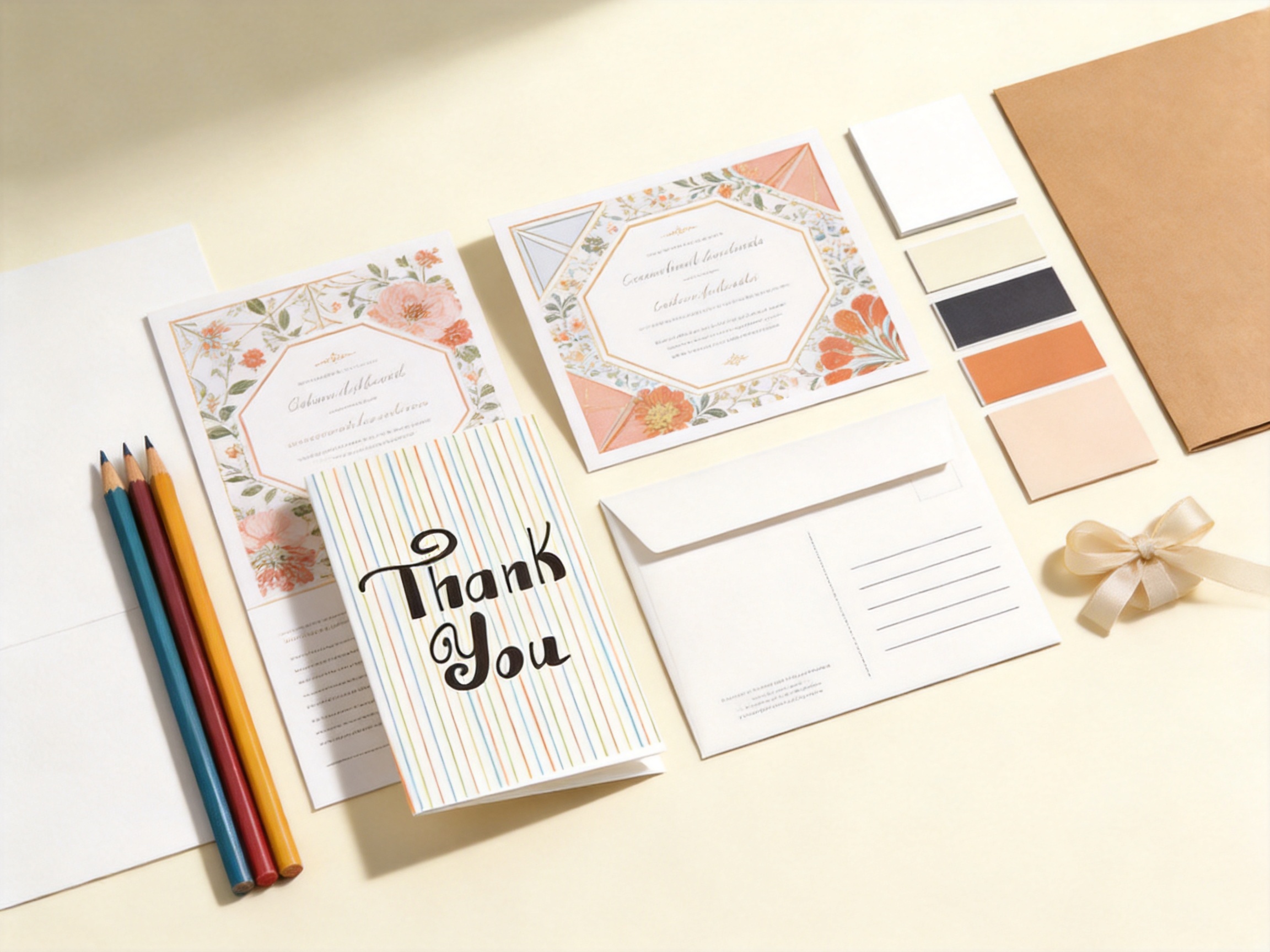
Paper Selection and Surface Performance
Paper is the physical foundation of a greeting card. It affects stiffness, color appearance, writing comfort, folding behavior, perceived value, and shipping weight. The correct paper should be selected according to the card format, printing method, design style, intended use, and budget.
White cardboard
White cardboard is suitable for designs that require a clean and bright base. Its neutral surface can help printed colors appear vivid and balanced. It is often appropriate for greeting cards, invitations, retail stationery, and promotional postcards where image clarity and a polished appearance are important.
A white cardboard surface can support a broad range of artwork, from minimal black-and-white typography to colorful illustrations. It can also provide a consistent background for brand colors. When the design includes large light-colored areas, the paper’s surface and whiteness become especially important because unevenness can affect the overall appearance.
Coated paper
Coated paper is commonly chosen when the design contains detailed images, smooth color fields, or a refined visual finish. The coating can help ink sit more evenly on the surface, contributing to crisp text and clear graphics. It is suitable for colorful designs in which the printed image is the primary feature.
Depending on the chosen specification, a coated surface may provide a smooth, bright, or more polished impression. Buyers should consider whether the card needs to be written on by hand. If a message area is required, the writing surface should be planned separately or left untreated where appropriate.
Kraft paper
Kraft paper can create a natural, warm, or handmade visual direction. Its characteristic tone influences how printed colors appear, so the artwork should be prepared with the paper color in mind. Darker inks, simple illustrations, and earthy palettes can work particularly well on kraft-style materials.
Kraft paper may be a suitable choice for brands that want to communicate simplicity, craft, sustainability-minded design, or an organic product story. However, the material should not be selected only for appearance. Thickness, folding behavior, print coverage, and the intended writing method should also be reviewed before production.
Writing and handling considerations
A greeting card should not only look attractive; it should also be practical to use. If customers are expected to write on the card, the selected paper and surface treatment should allow pens or pencils to mark the intended area comfortably. Excessive gloss or an unsuitable coating may reduce writing comfort.
For postcard-style products, the reverse side may need a message area, address area, lines, or a small brand statement. These elements should be included in the artwork from the beginning. If the card will be inserted into packaging, the size and thickness should be checked against the dimensions of the bag or box.
Colorful Printing and Design Preparation
Colorful printing is most successful when design preparation and production planning are treated as one process. A digital file can look different from a physical printed product because screens use light while printed paper reflects light. Paper color, ink behavior, surface texture, and finishing can all influence the result.
Color planning
Designers should establish a clear color direction before preparing the final artwork. The palette may be soft, bright, muted, monochromatic, contrasting, or seasonal. A limited palette can create a refined appearance, while a broader palette may produce a lively and expressive result.
Color selection should support the intended message. Soft blue, cream, pale green, and muted pink may create a gentle mood. Orange, yellow, turquoise, and strong red may create energy and celebration. Deep navy, burgundy, forest green, and warm white can contribute to a more formal or premium impression.
Typography and readability
Greeting card designs often combine a short message with decorative artwork. The words should remain readable even when the design includes patterns or illustrations. Type size, line spacing, contrast, and placement should be considered together rather than independently.
Very thin fonts may lose clarity at small sizes. Text placed over a complex image may require a quiet background area or a contrasting panel. Decorative lettering can be attractive for a short headline but may be less suitable for longer information. A professional prepress review can identify potential legibility problems before printing.
Image and pattern preparation
Images should have sufficient resolution for the final physical size. Low-resolution artwork may appear soft or pixelated, especially when it contains fine lines or small details. Patterns should also be checked for repetition, alignment, and edge behavior after trimming.
If an image extends to the edge of the card, the artwork should account for trimming. Important text or facial details should not be placed too close to the cut line. These technical considerations help prevent unwanted borders or the accidental removal of important design elements.
Proofing before mass production
A proof or sample allows the buyer to evaluate the design as a physical object rather than only as a digital file. It can reveal differences in color, paper texture, text size, folding position, and finishing appearance. Reviewing a proof is particularly valuable for colorful products because large color areas can appear different from expectations.
The proofing stage is also an opportunity to confirm the reverse side, writing area, barcode or product information, logo placement, and package compatibility. Once the design is approved, changes may become more expensive or may affect the production schedule. Clear approval procedures reduce the risk of avoidable errors.
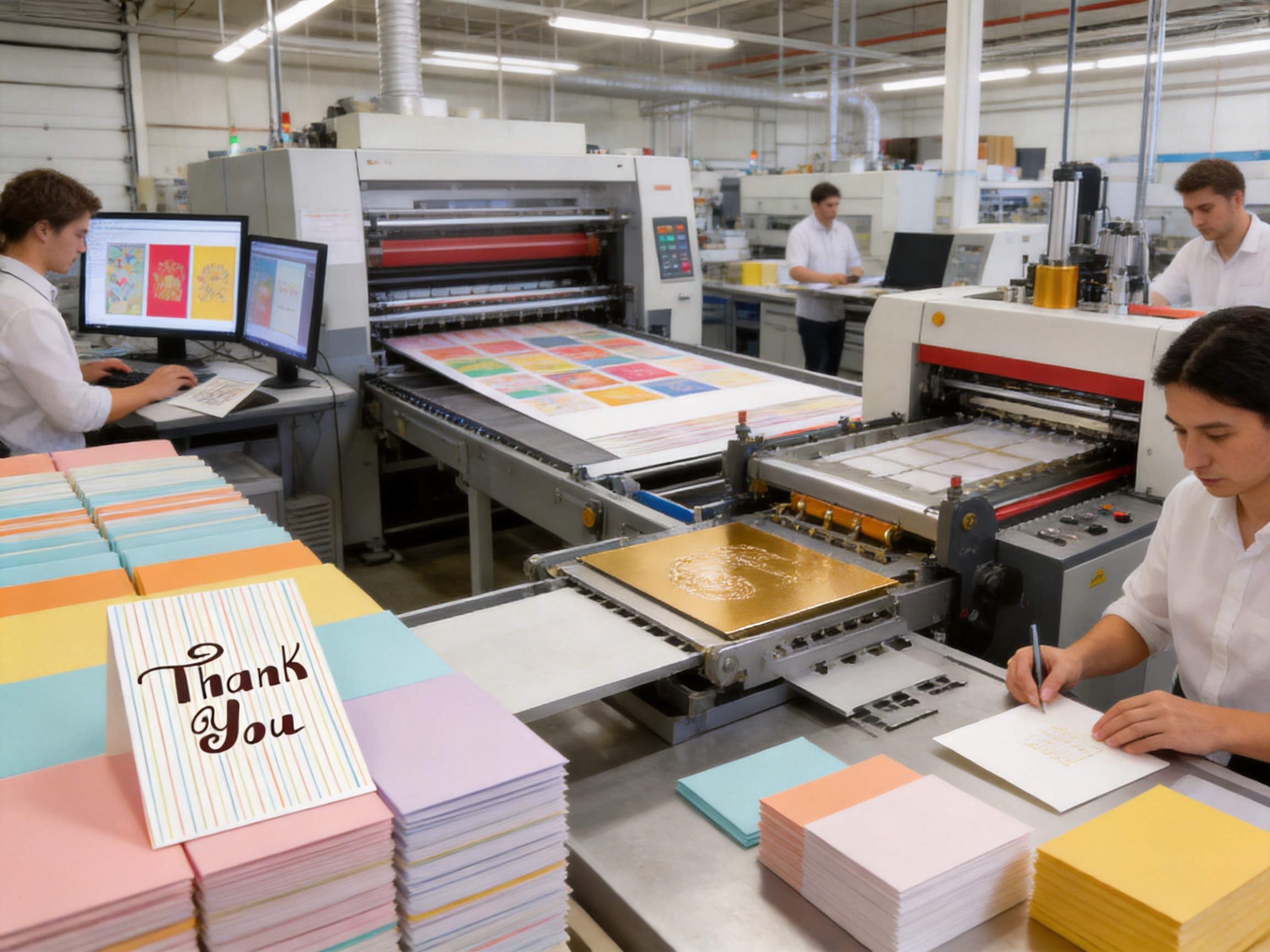
Manufacturing Process for a Custom Greeting Card
Professional manufacturing converts an approved design into a consistent finished product. The process requires coordination among material purchasing, design and prepress, printing, surface treatment, cutting, creasing, folding, manual finishing, inspection, and packing.
1. Requirement review and product planning
Production begins with a review of the buyer’s requirements. The manufacturer considers the card format, dimensions, quantity, paper choice, artwork, color direction, finishing needs, packaging method, and delivery expectations. If the card is part of a larger packaging program, the dimensions and visual relationship between related items should also be discussed.
This stage helps identify technical issues early. A folded card requires different planning from a flat postcard. A design with edge-to-edge color requires trimming allowances. A card intended for handwriting may need an uncoated or specially selected writing surface. Early planning can prevent later adjustments that affect cost or schedule.
2. Professional design and prepress
Prepress prepares the digital artwork for production. This may include checking image resolution, confirming color settings, reviewing fonts, adding bleed, verifying cut and fold lines, and ensuring that all text is correct. A professional prepress team can also examine whether the artwork is suitable for the selected paper and finishing process.
Magic Tree maintains in-house capabilities for professional design and prepress. This is an important strength because design support can remain closely connected to manufacturing. Instead of treating the artwork and production as unrelated steps, the team can evaluate how the file will behave during printing, cutting, creasing, and finishing.
3. Material preparation
Materials are selected and prepared according to the approved specification. The paper must be checked for size, thickness, surface quality, and compatibility with the intended printing and finishing processes. Consistent material preparation supports more stable color and handling throughout production.
For buyers developing a collection, material consistency can be especially important. If several card designs are intended to be sold together, differences in paper tone or thickness may make the collection appear uneven. Coordinated material planning can help maintain a unified presentation.
4. Printing
Printing transfers the approved artwork to the paper. The selected process must support the design’s color coverage, image detail, text size, and required production quantity. During printing, operators monitor registration, ink coverage, color balance, and surface appearance.
Colorful greeting cards benefit from stable printing because the design may contain several adjacent colors, gradients, fine lines, or large solid areas. Consistent registration helps keep text and images aligned. Controlled ink coverage helps reduce unwanted variation between sheets or batches.
5. Laminating and surface treatment
Laminating can add a protective layer and change the visual or tactile character of the card. It may contribute to a smoother surface, increased durability, or a more polished appearance. The correct treatment depends on whether the card is intended to be written on, folded, mailed, displayed, or placed inside packaging.
Not every design requires lamination. A natural paper look may be more suitable for a kraft-inspired product, while a high-impact colorful design may benefit from a smoother finish. Surface treatment should therefore be selected as part of the design strategy rather than added automatically.
6. Hot stamping and decorative enhancement
Hot stamping can be used to highlight selected details such as a short title, border, emblem, or decorative element. Metallic-looking accents may increase the perceived value of an invitation or seasonal card. The effect is usually strongest when applied selectively rather than across every part of the design.
Decorative enhancement must be coordinated with the artwork, paper, and card format. Small details should be large and clear enough to reproduce successfully. The production team should also confirm that the selected area is suitable for stamping and that the result supports the intended visual hierarchy.
7. Creasing, cutting, and folding
Creasing helps prepare paper for clean folding, particularly when the stock is relatively thick or when the card must maintain a precise fold position. Cutting establishes the final dimensions and affects the overall accuracy of the product. Proper alignment is essential when artwork extends to the edges or when the card contains symmetrical elements.
For folded greeting cards, the fold should be checked for position, cleanliness, and ease of opening. For flat postcards, the edges should be even and free from visible damage. These physical details influence how the card feels in the hand and how it appears when displayed.
8. Manual finishing and assembly
Some products require manual finishing after machine processing. This may include assembling components, checking decorative details, inserting cards into envelopes, pairing products, or preparing coordinated packaging sets. Manual work can be especially useful when a design contains specialized details that require careful handling.
Magic Tree lists manual finishing among its in-house capabilities. Combining automated production with controlled manual work gives the manufacturer flexibility for different product structures and presentation requirements.
9. Inspection and packing
Finished cards should be inspected for printing quality, color consistency, cutting accuracy, folding alignment, surface condition, and quantity. Packaging should protect the cards from bending, moisture, abrasion, and compression during storage and transportation.
Inspection is not limited to identifying obvious defects. It should also confirm that the product matches the approved sample and specification. For wholesale buyers, stable quality across the complete order is often as important as the appearance of an individual card.
Integrated Manufacturing Strengths
A supplier’s manufacturing structure can influence the reliability of the entire purchasing experience. When design, prepress, printing, finishing, and packing are distributed across unrelated providers, communication gaps may occur. An integrated factory can simplify coordination and make it easier to trace decisions from the original artwork to the finished product.
Experience across paper products
Magic Tree has nearly 30 years of experience in manufacturing paper packaging products. Its product scope includes paper bags, gift bags, gift boxes, greeting cards, and patterned wrapping paper. This breadth is relevant to buyers who need more than one type of paper item for a collection, campaign, or retail program.
Experience across related categories can also improve practical problem-solving. A greeting card may need to fit inside a gift box. A gift bag may need to coordinate with wrapping paper. A seasonal card may be sold as part of a complete gift presentation. Understanding these relationships can support better dimensional and visual planning.
In-house production capabilities
The company’s stated in-house capabilities include design and prepress, laminating, hot stamping, creasing, printing, bag making, and manual finishing. This range covers many of the key stages required to produce and complete paper products.
In-house control can help reduce unnecessary handoffs. It may also make it easier to discuss revisions, clarify technical requirements, and coordinate schedules. While every project still requires careful communication, centralized production can provide a more direct route from approved artwork to finished goods.
Factory-based process management
Magic Tree operates its own factory and manages the production process from raw materials to finished products. Factory-based management can support greater visibility into material handling, production scheduling, process coordination, and final inspection.
For wholesale buyers, this structure may be valuable when the order involves multiple product types or repeated production. A stable process can help maintain visual consistency between batches, provided that the artwork, paper specifications, and approved standards remain controlled.
International service experience
The company serves clients in the United States, Canada, Mexico, the United Kingdom, Japan, and China. Experience with customers in different markets can help a manufacturer understand that packaging expectations, communication styles, product specifications, and delivery requirements may vary by region.
International buyers should still provide complete specifications, including dimensions, paper preferences, artwork files, packaging instructions, labeling requirements, and delivery terms. Clear information allows the factory to prepare a more accurate quotation and production plan.
Production capacity and business continuity
Magic Tree reports an annual output value exceeding 50 million yuan. This indicates an established manufacturing operation with experience managing commercial production. Capacity is important for buyers who need regular replenishment, coordinated product launches, or larger wholesale quantities.
Capacity alone does not determine suitability. Buyers should also review communication, sample quality, production controls, packaging methods, lead times, and the supplier’s ability to meet the specific requirements of the project. A strong partnership depends on the fit between the buyer’s needs and the factory’s capabilities.
Eco-Conscious Paper Packaging Considerations
Paper products are often selected by brands seeking packaging options with a more paper-focused material story. White cardboard, coated paper, and kraft paper can support different visual and functional requirements. However, environmental suitability should be evaluated through the complete product specification rather than through general assumptions.
Material weight, surface treatment, ink coverage, lamination, adhesive use, packaging density, and transportation all affect the product’s overall impact. Buyers should ask for clear information about the available paper grades and finishing options, especially when they have specific environmental requirements.
A design can also reduce unnecessary material use through efficient dimensions and compact packaging. A card that fits neatly into an existing gift box or bag may reduce empty space during storage and shipping. Coordinated product planning can therefore support both presentation and operational efficiency.
Magic Tree describes its paper packaging solutions as high-quality, eco-friendly, and customized. Buyers should confirm the precise material and finishing specifications for each order and select the option that aligns with their own sustainability policy, market claims, and regulatory responsibilities.
How to Develop a Successful Card Collection
A single greeting card can be effective, but a collection often creates stronger retail and brand opportunities. A collection may contain several messages, seasonal themes, color variations, or coordinated formats. The key is to create variety without losing a recognizable visual relationship.
Define the target audience
The intended audience affects the message, color palette, artwork, paper choice, and price position. A premium stationery customer may value restrained design and refined finishing. A family-oriented audience may respond to bright illustrations and friendly language. A corporate audience may prefer a clean layout with a subtle brand presence.
Understanding the audience also helps determine whether the card should be primarily decorative, emotional, informative, or promotional. A product sold in a gift shop may need strong front-panel appeal. An insert packed inside an order may prioritize a concise message and a clear call to action.
Create a visual system
A collection can use a shared logo position, type family, border style, illustration treatment, or color structure. These repeated elements help customers recognize that different cards belong to the same series.
Variation can come from the central illustration, message, accent color, or pattern. A common visual system makes it easier to expand the collection later without redesigning every foundational element.
Coordinate cards with packaging
When cards are sold with gifts, the relationship between the card and the package should be considered early. The card may repeat a pattern from the wrapping paper, echo the colors of the gift bag, or fit inside a dedicated slot in a gift box.
Magic Tree’s ability to produce greeting cards alongside gift bags, gift boxes, and patterned wrapping paper can support this type of coordinated development. One supplier may be able to review the dimensions and visual details of related products together, reducing the risk of mismatched colors or incompatible sizes.
Plan for storage and distribution
Cards should be packed in a way that protects corners, surfaces, and folds. Retail quantities may require inner packs, cartons, labels, or barcode placement. If the card is shipped directly to customers, packaging may need additional protection against bending.
Wholesale buyers should share their distribution method with the manufacturer. A card destined for retail shelves may require different packing from a card used as an e-commerce insert. Clear distribution information helps the supplier recommend a practical packing solution.

Quality Evaluation Checklist
Before approving a production order, buyers should evaluate the card from both visual and functional perspectives. A high-quality appearance is important, but the product must also perform well during handling, writing, storage, and distribution.
| Evaluation Area | Questions to Review | Why It Matters |
|---|---|---|
| Artwork | Are all images sharp and all text correct? | Prevents visible design errors in the finished product |
| Color | Does the physical sample match the approved direction? | Supports collection consistency and brand recognition |
| Paper | Is the thickness, tone, and texture appropriate? | Influences stiffness, writing comfort, and perceived value |
| Edges | Are the cuts clean and accurately aligned? | Improves appearance and handling quality |
| Folding | Does the card open and close smoothly? | Reduces cracking, misalignment, and poor presentation |
| Finishing | Are lamination or stamped details even and secure? | Ensures decorative treatments support durability and appearance |
| Quantity | Does the packed quantity match the order? | Supports inventory control and delivery accuracy |
| Packaging | Are cards protected during storage and transport? | Reduces bending, abrasion, and corner damage |
Ordering Guidance for Wholesale Buyers
Wholesale buyers can improve the ordering process by preparing a complete product brief. The brief should include the intended use, card format, finished size, paper preference, artwork requirements, number of versions, quantity, packaging method, delivery location, and desired timing.
Artwork files should be supplied in the format requested by the manufacturer. The buyer should identify the final text, colors, logos, images, and any legal or product information that must appear on the card. If the card includes a personalized message or variable information, the required data structure should be discussed before production.
Buyers should also state whether the card will be written on, mailed, displayed, inserted into a package, or sold with an envelope. These details can affect paper selection and surface treatment. A card intended for handwriting may require a different specification from a decorative card placed inside a gift box.
Sampling is recommended for new designs, complex color combinations, special finishes, and coordinated packaging collections. The sample should be reviewed under normal lighting and handled as a customer would handle it. Buyers should check the front, reverse, edges, fold, writing area, and compatibility with related packaging.
Once the sample is approved, the buyer should retain a reference record containing the final artwork, paper specification, approved color direction, finishing details, packing method, and any inspection requirements. This record can support repeat orders and help reduce variation between production runs.
Why Choose an Experienced Paper Packaging Manufacturer
The supplier of a greeting card contributes to more than the printing stage. An experienced manufacturer can help connect design decisions with materials, finishing, packaging, and delivery requirements. This is particularly important when the buyer is building a collection or ordering several related paper products.
Magic Tree’s history began in 1996 and continued through its rebranding in 2019. Its nearly three decades of experience provide a manufacturing foundation for buyers seeking custom paper products. The company’s product categories cover the same areas that frequently appear in a coordinated gift presentation: greeting cards, gift bags, gift boxes, and patterned wrapping paper.
The company’s capabilities in design, prepress, printing, laminating, hot stamping, creasing, bag making, and manual finishing support a broad production workflow. Its own factory and process management structure can provide a direct manufacturing relationship for wholesale customers.
For brands, the main advantage is the possibility of combining product customization with production practicality. A card can be designed to match a package, adjusted for the selected paper, reviewed through prepress, printed, finished, inspected, and packed within a connected manufacturing system.
Magic Tree serves customers in multiple international markets and offers customized paper packaging solutions for wholesale buyers. Buyers should discuss project details directly with the company to confirm available materials, order quantities, production timing, finishing choices, packaging requirements, and shipping arrangements.
Frequently Asked Questions
What is a custom postcard colorful printed greeting card?
It is a customized paper card that combines postcard-style communication with the visual appeal of a colorful greeting card. It can be produced as a flat or folded format and may include personalized artwork, messages, patterns, logos, colors, and finishing details.
Can the card be used for business purposes?
Yes. Businesses can use it as a thank-you insert, promotional postcard, event invitation, seasonal communication, product announcement, or brand message. The design can include brand colors, logos, product imagery, and a writing area when needed.
What paper types are available?
Magic Tree works with white cardboard, coated paper, and kraft paper products. The best selection depends on the intended appearance, printing detail, writing requirements, folding method, surface treatment, and budget.
Is a colorful design suitable for detailed images and text?
Yes, provided that the artwork is prepared correctly and the paper and printing process are suitable. Image resolution, typography, color contrast, bleed, and layout should be checked during prepress before mass production.
Can the card match a gift bag or gift box?
Yes. A card can be designed with colors, patterns, typography, or illustrations that coordinate with a gift bag, gift box, or patterned wrapping paper. Producing related items through one paper packaging manufacturer may simplify visual and dimensional coordination.
What finishing options can be considered?
Depending on the approved design and material, options may include laminating, hot stamping, creasing, folding, and manual finishing. The appropriate treatment depends on the desired appearance, writing needs, card structure, and intended use.
Why is a physical sample important?
A physical sample allows the buyer to check color, paper feel, thickness, folding, cutting, surface treatment, and writing comfort. It also confirms whether the card fits correctly inside the intended gift bag, box, envelope, or package.
Can the product be ordered for international markets?
Magic Tree serves clients in the United States, Canada, Mexico, the United Kingdom, Japan, and China. International buyers should provide complete specifications and confirm production, packing, labeling, and delivery requirements with the company before placing an order.
What should be included in a quotation request?
A quotation request should include the finished dimensions, card format, quantity, paper type or preferred material, number of artwork versions, printing requirements, finishing details, envelope or packaging needs, delivery destination, and target schedule.
How can color consistency be improved between orders?
Buyers should keep the approved artwork, paper specification, sample, color direction, finishing details, and inspection requirements on record. Repeat orders should reference the approved standard so that the manufacturer can follow the same production expectations.
Conclusion
A custom postcard colorful printed greeting card offers a flexible way to combine personal communication, visual design, and brand presentation. Its advantages over generic cards include greater control over color, layout, imagery, paper, message, finishing, and coordinated packaging. It can serve personal occasions, retail collections, promotional campaigns, event communications, and e-commerce customer experiences.
The quality of the finished product depends on the complete manufacturing process. Paper selection, design preparation, prepress, printing, laminating, hot stamping, creasing, cutting, folding, manual finishing, inspection, and packing all contribute to the final result. A supplier that manages these stages effectively can help reduce production risks and improve consistency.
Magic Tree Gift Bag Co., Ltd. combines long-term paper product experience with in-house design and prepress, printing, finishing, and factory-based production capabilities. Its wider range of gift bags, gift boxes, greeting cards, and patterned wrapping paper also supports coordinated packaging programs for brands and wholesale buyers.
For the best result, buyers should prepare a detailed product brief, review a physical sample, confirm the paper and finishing specifications, and maintain an approved production reference. With careful planning and an experienced manufacturing partner, a colorful printed greeting card can become more than a message: it can become a memorable part of the complete product and customer experience.
References
1. Magic Tree Gift Bag Co., Ltd. Company information and product materials supplied for custom paper packaging products.
2. Magic Tree Paper Products Co., Ltd. Manufacturing capability information covering design, prepress, printing, laminating, hot stamping, creasing, bag making, and manual finishing.
3. General principles of commercial print production, including artwork preparation, color management, proofing, cutting, creasing, folding, and quality inspection.
4. General paper packaging design practices concerning material selection, writing surfaces, coordinated packaging, product protection, and wholesale order planning.
5. Product information for custom postcard colorful printed greeting cards, including applications for handwritten notes, seasonal greetings, event invitations, product promotions, and thank-you messages.