中文简体
 русский
 Français
 Español
 Deutsch
 عربى

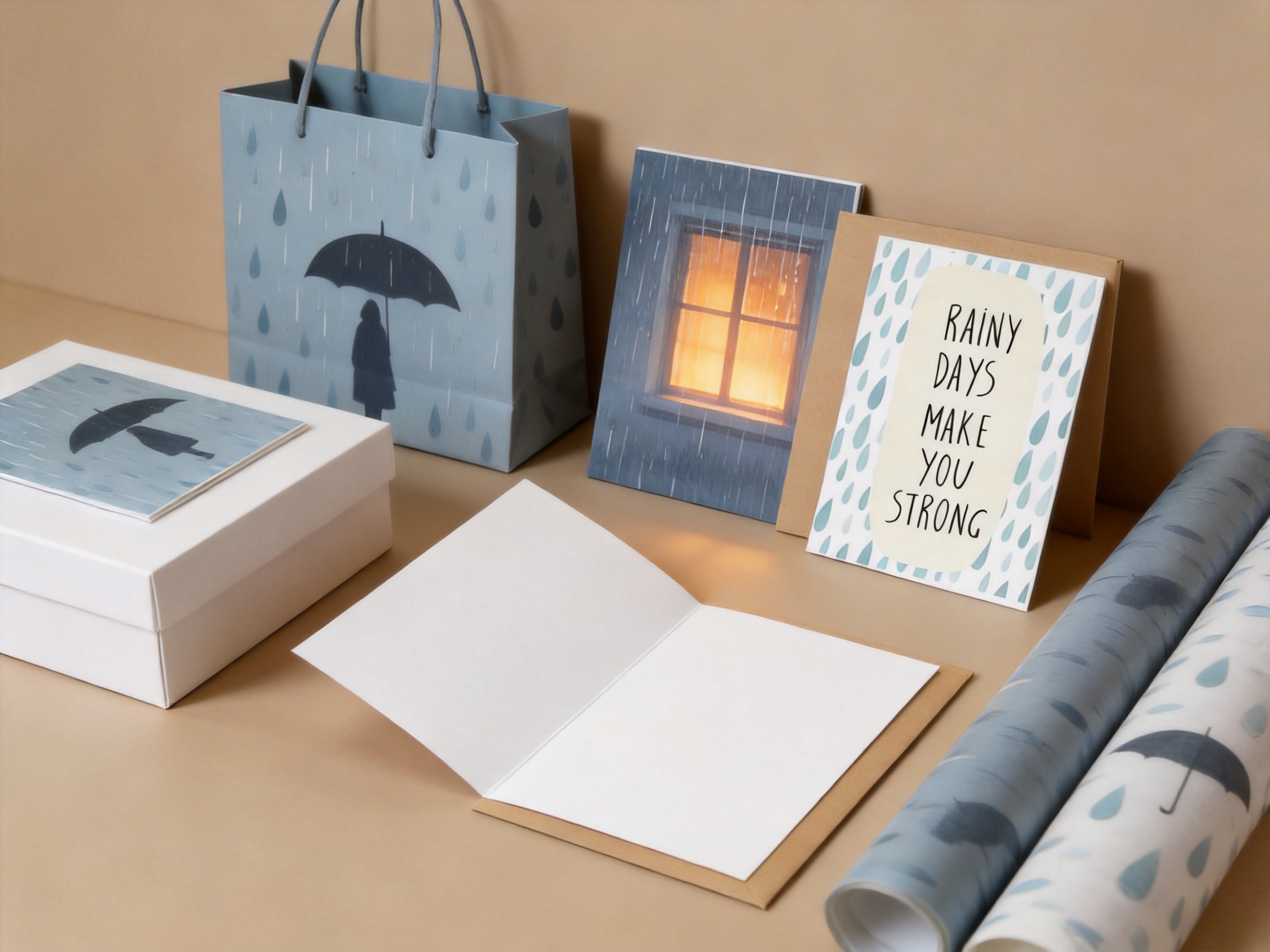
A greeting card can be a small product, but its emotional value is often much greater than its physical size. A carefully designed card gives people a way to communicate when a message, text, or social media post does not feel personal enough. The Custom Rainy Day Series Greeting Card is created for these quiet, meaningful moments. Its visual language is simple and atmospheric: soft raindrops, a single umbrella, or a warmly lit window. Each scene suggests comfort, reflection, companionship, and hope without relying on overly complicated decoration.
The card combines an understated design with practical customization. Its interior arrives blank, allowing the sender to write a personal note, memory, greeting, or name. For customers who prefer a professionally prepared message, the supplied text can be printed exactly as provided. This flexibility makes the product suitable for retailers, stationery brands, gift shops, event suppliers, subscription services, and organizations that need a considerate paper communication product.
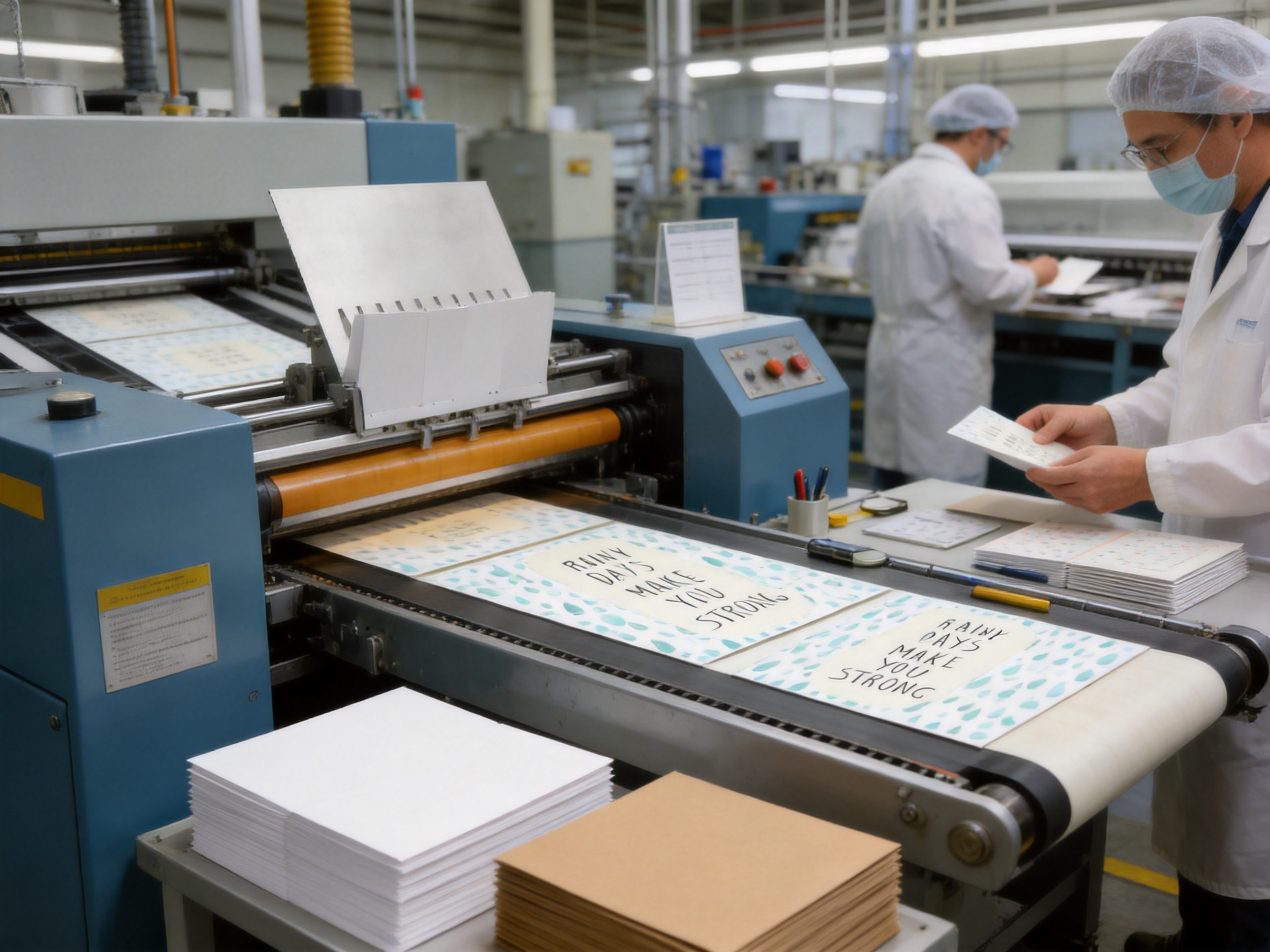
Produced by Yiwu Magic Tree Gift Bag Co., Ltd., the card benefits from a manufacturing background that covers paper selection, professional design and prepress, printing, laminating, creasing, manual finishing, and quality control. These capabilities support a consistent production process from raw material preparation to finished goods. The same manufacturing foundation also supports related paper products, including gift bags, gift boxes, and patterned wrapping paper, allowing buyers to create coordinated packaging and stationery collections.
A Greeting Card Designed Around Quiet Emotion
Many greeting cards compete for attention through vivid colors, heavy decoration, glitter, foil, or complex illustrations. Those styles have their place, but they are not suitable for every message. The Rainy Day Series takes a more restrained approach. Its design focuses on ordinary scenes that feel emotionally recognizable. Rain against a window, an umbrella in wet weather, or a light shining from a home can suggest that someone is remembered and supported.
This visual direction gives the product a broad emotional range. It can communicate encouragement without appearing overly cheerful. It can express sympathy without becoming solemn. It can accompany a birthday message, a get-well wish, a thank-you note, or a spontaneous message sent simply because somebody came to mind. The design does not force the sender into one specific occasion. Instead, it creates enough atmosphere for the handwritten or printed message to determine the final meaning.
That flexibility is a significant advantage in the greeting card market. Retailers often need products that can serve more than one seasonal period. A card designed only for a birthday, holiday, or romantic event may have limited selling windows. A quiet, general-purpose card can remain relevant throughout the year. It can be displayed in a general stationery section, a sympathy and encouragement collection, a gift shop, or a lifestyle store.
The product is also suited to customers who value a more personal and less commercial tone. A simple image leaves room for the recipient's feelings. Rather than overwhelming the reader with a large slogan on the cover, the card creates a visual pause. The cover invites the recipient to open it and discover the message inside.
Material and Surface Advantages
The card is printed on smooth cardstock selected to provide a stable, pleasant writing and viewing surface. Cardstock is important because a greeting card must perform several functions at once. It needs enough body to feel substantial in the hand, enough smoothness to support clear printing, and enough compatibility with writing instruments to make personalization comfortable.
The gentle matte coating adds another practical advantage. Matte surfaces reduce the sharp reflections that can appear on glossy cards under store lighting or daylight. This allows the artwork and printed words to remain easier to view from different angles. The understated finish also supports the calm character of the Rainy Day Series. It feels refined and tactile without appearing excessively shiny or decorative.
The coating is designed to resist everyday smudges while avoiding an overly slippery feel. This balance matters during packing, display, handling, and writing. A highly glossy surface can show fingerprints quickly, while an excessively slick coating may feel less natural when the sender writes a message. The gentle matte finish provides a more controlled surface for both presentation and use.
Compared with thin, low-grade greeting cards, a well-selected cardstock construction can offer a more premium impression. The card is less likely to feel flimsy when removed from an envelope or placed on a gift. It also provides a stronger platform for printed artwork, allowing subtle rainy-day details to appear cleaner and more stable.
Material selection is not only a question of appearance. It influences production consistency, folding performance, printing quality, packaging protection, and customer satisfaction. Paper products that are too thin may crease unpredictably or appear inexpensive. Paper products that are too heavy may increase shipping weight and create unnecessary material consumption. The appropriate cardstock specification provides a practical middle ground for a card intended for retail and direct mailing.
Why a Matte Finish Works for This Product
The Rainy Day Series depends on mood and atmosphere. A matte coating supports that mood in several ways. First, it softens the visual impact of the printed surface. Second, it helps delicate tones, shadows, and line details appear more natural. Third, it contributes to a tactile experience that feels calm and paper-like rather than highly reflective.
Matte finishing can also support brand collections that emphasize natural materials, thoughtful gifting, minimalism, and emotional storytelling. Retailers that sell candles, books, handmade gifts, home décor, or self-care products may find that this kind of greeting card fits comfortably beside their existing merchandise.
For wholesale buyers, surface consistency is equally important. A coating must be applied evenly across production batches. Uneven coating can create visible differences in gloss level, color perception, or texture. Professional laminating and finishing capabilities help manufacturers manage these details more reliably than small workshops that depend entirely on manual or outsourced processing.
Personalization That Leaves Room for the Sender
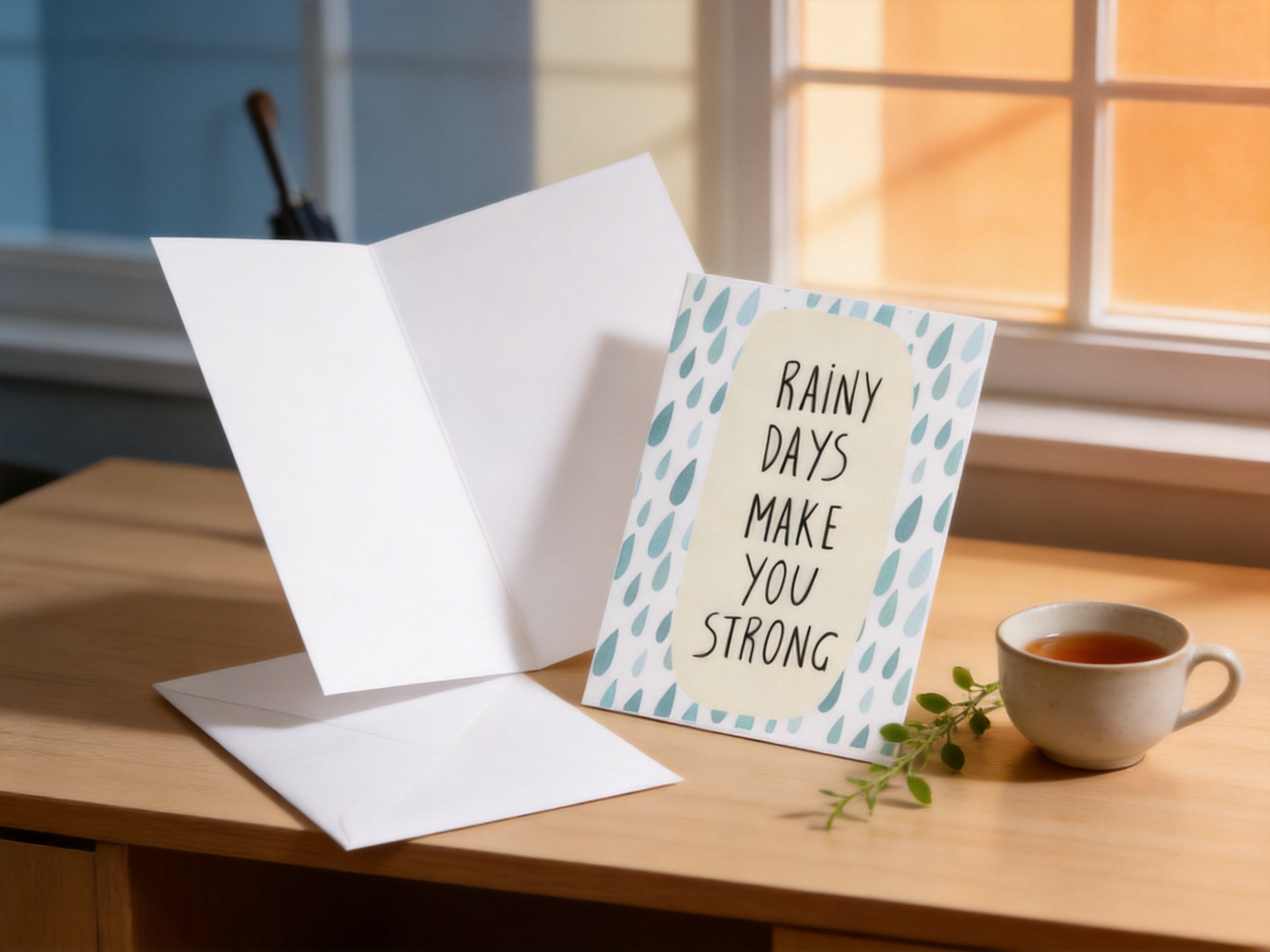
The interior of the card arrives blank, which is one of its defining strengths. A blank interior gives the sender control over the message and makes each card feel more personal. The sender may write only a few words, add a detailed memory, include an inside joke, or simply write the recipient's name. This flexibility makes the card suitable for people who dislike prewritten sentiments that do not match their relationship or occasion.
For business buyers, the blank interior also creates an opportunity for customized fulfillment. Retailers can sell the card as a ready-to-write product, while gifting services can add a message before dispatch. Corporate customers can provide a specific text for printing, including customer appreciation notes, event messages, or seasonal greetings. The production process supports exact message reproduction according to the supplied copy, subject to standard proofreading and approval procedures.
Exact message printing is especially valuable for professional buyers. It reduces the need for employees or fulfillment teams to write large quantities of cards by hand. It also helps maintain consistent spelling, punctuation, and wording across multiple orders. When the card forms part of a customer experience program, consistency can be just as important as visual quality.
At the same time, the product does not remove the warmth of personal communication. The design remains emotionally open, and the recipient can still receive a message that feels individual. Buyers may choose blank interiors for direct retail sales, printed interiors for institutional or corporate orders, or a mixed program that includes both versions.
Applications for Different Occasions
The card can be used when a friend needs quiet encouragement. It can accompany a care package, a small gift, flowers, a meal delivery, or a personal visit. Because the cover is not tied to a specific holiday, it can be used whenever a supportive message feels appropriate.
It is also suitable for get-well wishes. The rainy-day imagery acknowledges a difficult moment without making the message feel clinical. A warm note inside can provide reassurance and companionship while allowing the recipient to interpret the cover in a hopeful way.
Birthdays are another application. A birthday card does not always need bright balloons or large celebratory lettering. Some recipients prefer a more restrained, artistic, or literary style. The Rainy Day Series can be paired with a personal birthday message that focuses on shared memories, gratitude, or hopes for the coming year.
The card can also be used without any formal occasion. This is an increasingly important category in stationery retail. Many consumers want to send a note simply to say that they are thinking of someone. A product that supports spontaneous communication can help retailers serve customers looking for meaningful, low-pressure ways to connect.
Competitive Advantages in the Greeting Card Market
The greeting card market includes mass-produced cards, handmade cards, luxury stationery, digital alternatives, and highly customized printed products. The Custom Rainy Day Series Greeting Card occupies a useful position between standardized commercial stationery and fully bespoke artistic production. It offers a distinctive design direction, a quality paper surface, and customization potential without requiring every buyer to develop artwork from the beginning.
One advantage over highly generic cards is the emotional specificity of the artwork. Soft raindrops, a lone umbrella, and a lit window create a recognizable atmosphere. The product can feel more considered than a plain card with a generic phrase, while remaining more versatile than a card committed to a single event.
One advantage over heavily embellished cards is practical simplicity. There are no requirements for complex decorative elements to communicate the message. A restrained matte card is easier to store, display, pack, and coordinate with other paper goods. It may also appeal to customers who prefer a modern, understated aesthetic.
One advantage over digital messages is physical presence. A card can be held, displayed, saved, or placed beside a photograph. It becomes a tangible reminder of the relationship between sender and recipient. In a market where many communications disappear into crowded inboxes and message histories, a physical card can create a more memorable experience.
One advantage over small-scale manual production is manufacturing consistency. Professional design, prepress, printing, laminating, creasing, and finishing capabilities make it possible to manage repeat orders with greater stability. Wholesale buyers need confidence that later batches will maintain similar construction, print quality, and finishing standards. A factory-based process is better positioned to meet that requirement than an informal production arrangement.
Another advantage is the ability to coordinate the card with other paper packaging products. A retailer can develop a complete rainy-day or comfort-themed collection with matching gift bags, gift boxes, tissue materials, and wrapping paper. A brand can use the card as part of a broader packaging experience rather than treating it as an isolated stationery item.
| Product characteristic | Benefit for buyers | Benefit for recipients |
|---|---|---|
| Atmospheric rainy-day artwork | Supports a versatile, year-round product range | Creates an emotional setting without excessive wording |
| Smooth cardstock | Provides a stable base for printing, folding, and packing | Feels substantial and comfortable to handle |
| Gentle matte coating | Offers a refined surface with reduced glare and smudge resistance | Looks calm and feels pleasant to touch |
| Blank interior option | Allows retailers and senders to personalize each card | Leaves room for an authentic personal message |
| Exact message printing | Supports corporate, subscription, and fulfillment programs | Delivers a clear and consistent message |
| Factory-integrated production | Improves process coordination and repeat-order management | Supports more consistent product quality |
Professional Manufacturing from Design to Finished Card
The quality of a greeting card is shaped by more than the visible artwork. It depends on how the design file is prepared, how the paper is handled, how color is controlled, how the coating is applied, how the sheet is creased and folded, and how the finished product is inspected. A manufacturing partner with multiple in-house capabilities can coordinate these stages more effectively.
Magic Tree's production background includes professional design and prepress. These stages are essential for converting a creative concept into a manufacturable card. Prepress preparation can include file checking, image resolution review, color setup, bleed management, layout adjustment, type treatment, and production proofing. Careful preparation helps reduce avoidable defects such as trimmed artwork, uneven borders, missing elements, or text that sits too close to a fold.
For a design based on subtle rain, light, and shadow, prepress discipline is particularly important. Delicate artwork can lose impact if color values are not prepared correctly. Small variations in contrast may affect the visibility of raindrops, umbrella lines, or window illumination. A controlled process helps preserve the intended atmosphere throughout printing.
Printing and Color Reproduction
Printing must reproduce both visual detail and emotional tone. Bright colors can attract attention, but a rainy-day design often depends on softer tones and controlled contrast. Consistent ink application supports a stable appearance across the front cover and any printed interior message.
Professional printing equipment and trained production personnel also help manage registration. Registration refers to the alignment of different printed elements and color layers. When registration is poor, edges may look blurred or illustrations may appear displaced. For a minimal design, even a small alignment issue can become noticeable because there are fewer decorative elements to distract the eye.
Production planning also considers paper absorption, coating behavior, drying, and handling. Different paper surfaces interact with ink in different ways. A paper stock that looks attractive before printing may require adjusted settings to maintain clarity after coating. Integrating material selection and printing knowledge is therefore a major advantage for a factory that handles both paper preparation and finishing.
Laminating and Surface Finishing
Laminating and coating processes help protect the printed face of the card and establish its final tactile character. The selected gentle matte finish is intended to resist everyday smudges while retaining a natural, non-slippery feel. Applying a finish evenly requires attention to surface cleanliness, material compatibility, pressure, temperature where applicable, and handling conditions.
Finishing is not merely a decorative step. It can influence the card's resistance to handling marks, its visual consistency, and its perceived value. A well-finished card is more likely to arrive at a store or customer in presentable condition. It can also make the product easier to manage during packing because the printed face is less vulnerable to ordinary contact.
Manufacturers that offer multiple finishing capabilities can help buyers compare the advantages of matte, gloss, soft-touch, foil, or uncoated options. For this particular series, the matte approach supports the intended design. However, the wider production capability can be useful if a buyer later develops a coordinated collection with different surface treatments.
Creasing, Folding, and Structural Accuracy
A greeting card must open cleanly and close neatly. Creasing creates a controlled fold line that helps prevent random cracking, uneven folding, or damage to the printed surface. This is especially important when the cardstock has a coating, since an uncontrolled fold can stress the surface and affect appearance.
Accurate creasing also supports a professional retail presentation. Cards that do not fold squarely may look misaligned inside envelopes or may not stand correctly when displayed. Consistent structural work improves the experience for both the retailer and the recipient.
Production teams must consider the relationship between paper grain, sheet layout, crease position, coating direction, and folding sequence. These details may not be visible as separate features, but they influence whether the finished card feels polished. Coordinating them during manufacturing helps reduce waste and improves repeatability.
Manual Finishing and Quality Attention
Not every finishing step can be reduced to machine processing. Manual finishing may be used for inspection, sorting, assembly, packing, bundling, or special customization. Skilled workers can identify issues that automated systems may not detect easily, such as a small surface mark, an improperly folded piece, or a card with an incorrect printed message.
Manual attention is valuable for personalized orders. When a buyer supplies a specific message, names, or a series of variations, each version must be checked and matched correctly. A combined approach using professional equipment and experienced manual workers supports both efficiency and flexibility.
The company manages production from raw materials to finished products. This end-to-end structure can simplify communication because buyers have a clearer production contact rather than coordinating separately with a designer, printer, coating provider, folding service, and packing workshop. It can also support better scheduling and issue resolution when an order includes several related paper products.

Custom Rainy Day Series Greeting Card
Integrated Paper Packaging Expertise
Although the product is a greeting card, its commercial value increases when it can be purchased as part of a coordinated paper packaging program. Magic Tree specializes in white cardboard, coated paper, and kraft paper products. Its product range includes paper bags, gift bags, gift boxes, greeting cards, and patterned wrapping paper.
This product breadth benefits buyers who want a consistent visual identity across the customer experience. A gift shop may pair the Rainy Day Series card with a paper gift bag and matching wrapping paper. A subscription company may place the card inside a branded box. A retailer may create a seasonal display that combines cards, gift packaging, and wrapping accessories around a shared color palette or illustration style.
Purchasing related products from one experienced manufacturer can reduce the complexity of supplier management. The buyer can discuss paper grades, colors, coating preferences, artwork preparation, packing formats, and delivery timing through one production relationship. Coordinated sourcing may also help maintain visual and material consistency across the collection.
White cardboard can provide a clean base for bright or detailed printed designs. Coated paper can support a smooth surface and controlled image reproduction. Kraft paper can offer a more natural, rustic, or environmentally conscious appearance when appropriate. The choice depends on the desired position of the product, its use, its budget, and the visual relationship between the packaging components.
The company's experience with different paper categories also supports practical design decisions. For example, a card that will be placed inside a rigid gift box may have different packaging requirements from a card sold alone in a hanging display. A card included with a mailed gift may need added protection from movement or surface contact. Understanding the full packaging context helps the manufacturer recommend a suitable production approach.
Environmental Considerations and Responsible Paper Selection
Paper packaging and stationery buyers increasingly consider environmental impact alongside appearance, durability, and cost. The use of paper-based materials can support recyclable and fiber-focused packaging strategies, although responsible sourcing and end-of-life conditions must always be evaluated according to the actual materials and local recycling systems.
The card's restrained design can contribute to material efficiency by avoiding unnecessary decorative components. A printed matte surface does not require the addition of plastic ornaments, loose glitter, or bulky attachments to create visual interest. A simple card can still feel meaningful through its artwork, paper quality, and message.
Magic Tree's product range includes eco-friendly paper packaging options. Buyers should discuss the specific paper grade, coating, ink, adhesive, and packaging configuration required for each project. Environmental claims are strongest when they are connected to clearly identified materials and production choices rather than broad language alone.
Responsible manufacturing also involves reducing avoidable waste. Accurate prepress, proper sheet layout, controlled cutting, and repeatable production can help limit rejected pieces and material loss. Factory experience supports these improvements because the production team can identify recurring problems and adjust processes over time.
For wholesale customers, environmental considerations may also influence product storytelling. A card can be presented as part of a thoughtful communication practice: a reusable emotional gesture that does not depend on electronic devices and can be saved by the recipient. The strongest positioning combines meaningful design with transparent information about the actual paper and finishing materials.
Quality Control for a Consistent Wholesale Product
Quality control begins before printing. The supplied artwork and message should be reviewed for dimensions, resolution, spelling, punctuation, fold placement, color expectations, and finishing requirements. Approval samples or digital proofs can help confirm the intended result before full production begins.
During manufacturing, production teams monitor the paper, printing, surface finish, creasing, folding, and assembly. The specific inspection points may vary according to the order, but the objective remains the same: to ensure that the final cards meet the agreed specification.
Common inspection considerations include:
• Whether the cardstock matches the approved paper specification.
• Whether the cover artwork is positioned correctly.
• Whether colors and tonal details are consistent with the approved proof.
• Whether the matte surface is evenly applied.
• Whether the card folds cleanly along the intended crease.
• Whether the interior is blank when requested.
• Whether personalized messages are reproduced accurately.
• Whether cards are free from major scratches, stains, creases, or visible production marks.
• Whether finished quantities are counted and packed according to the order.
For repeat buyers, production records and approved specifications are useful references. They help the factory understand what must remain consistent and what may be changed in a future edition. If a customer wants to adjust the paper, message, dimensions, or packaging, the previous order can serve as a practical starting point.
Consistency is especially important for retail programs. A store may display several designs from the same collection, and noticeable differences in paper feel or finish can weaken the presentation. Reliable quality helps buyers build confidence in the product line and reduces the risk of customer complaints.
Flexible Use for Wholesale and Custom Programs
The product can serve several commercial models. A stationery retailer may purchase blank cards for direct sale. A gift company may order printed messages for inclusion with products. A corporate customer may use the card for client appreciation or employee support. A subscription service may add personalized cards to monthly boxes. A hospitality business may place cards in guest rooms or welcome packages.
Because the message can be printed exactly as supplied, buyers can adapt the card to different audiences. A retailer might order a general version with a blank interior. A wellness brand might use a supportive message. A charity or community organization might print a message of solidarity. A business might include a short thank-you statement with every shipment.
Buyers can also consider multiple cover designs within the Rainy Day Series. Soft raindrops may suit a minimal collection, an umbrella may create a more direct weather reference, and a lit window may emphasize warmth and home. Offering several related designs gives customers choice while maintaining a recognizable visual family.
Packaging should be planned with the intended sales channel in mind. Cards sold individually may require protective sleeves, envelopes, barcodes, or hanging tabs. Cards shipped in large wholesale cartons may need internal separators to prevent scuffing. Cards inserted into gift boxes may use a simpler packing format. A manufacturer experienced in paper products can help coordinate these requirements.
How the Card Supports Retail Merchandising
A greeting card succeeds commercially when the customer understands its purpose quickly. The Rainy Day Series offers a clear visual theme without restricting the product to one occasion. Retailers can place it among encouragement cards, general correspondence, thoughtful gifts, or seasonal displays.
The subdued artwork may work well in stores that use calm, curated merchandising. It can sit near journals, candles, tea, books, self-care items, or small home gifts. The matte surface can reinforce a premium or artisanal display, particularly when paired with natural paper bags or understated wrapping paper.
Retailers can also merchandise the card around emotional needs rather than calendar events. Displays may be organized around messages such as “thinking of you,” “sending comfort,” “a little encouragement,” or “just because.” This approach can create demand throughout the year instead of concentrating sales only around major holidays.
For online stores, product photography should show the card's front artwork, opened interior, paper thickness, and surface character. Buyers should understand whether the interior is blank or printed and whether customization is available. Clear product information reduces uncertainty and helps customers choose the right version.
The card can also function as an add-on product. A customer purchasing a gift may be prompted to include a greeting card at checkout. Its broad use makes it suitable for many gift categories, including wellness products, apparel, books, home goods, and care packages.
Why Factory Experience Matters to Buyers
Yiwu Magic Tree Gift Bag Co., Ltd. began in 1996 as Fushida Plastic Factory and was rebranded in 2019 as Magic Tree Paper Products Co., Ltd. The company's long operating history provides experience in paper packaging development and production. Its manufacturing focus covers paper bags, gift bags, gift boxes, greeting cards, and patterned wrapping paper.
The company serves customers in the United States, Canada, Mexico, the United Kingdom, Japan, and China. International experience can help a manufacturer understand the communication, packaging, documentation, and product expectations associated with different markets. Buyers should still confirm all project-specific requirements, but a broad customer base indicates familiarity with varied commercial applications.
The company reports annual output value exceeding 50 million yuan and operates its own factory. An owned production facility can give buyers more direct visibility into manufacturing control, scheduling, and process coordination. It also allows the company to develop capabilities across design, prepress, laminating, hot stamping, creasing, printing, bag making, and manual finishing.
These capabilities are valuable even when a project uses only some of them. A buyer ordering a simple greeting card may not require hot stamping or bag making, but the presence of broader expertise means future packaging development can remain with a knowledgeable partner. The manufacturer can support a product family rather than only one item.
In-house capability also helps reduce the communication gaps that can occur when each process is outsourced to a different provider. One supplier can review artwork with knowledge of printing limitations, assess the relationship between paper and coating, and plan the final folding and packing process from the beginning.
Design Recommendations for Buyers
To achieve the best result, buyers should provide clear artwork and message specifications. The artwork should be prepared at an appropriate resolution and include the required bleed and trim information. Text should be checked carefully before submission, especially when the order includes names, dates, or multiple language versions.
Buyers should also explain the intended use of the card. A card sold in a boutique may require a different finish or packaging method from a card inserted into a mailed subscription box. The manufacturer can then evaluate the suitable cardstock, coating, folding method, and packing approach.
If the buyer wants an interior message printed, the final wording should be submitted in an approved format. It is useful to distinguish clearly between cover text, interior text, envelope text, and packaging labels. This reduces the possibility of placing a correct message in the wrong position.
For a collection, buyers should define which features must remain consistent across all designs. These may include paper weight, card size, fold direction, matte finish, envelope style, color mood, and packaging format. Other features, such as the illustration or interior message, can vary within the same structure.
Sample approval is recommended for important or high-volume projects. A sample allows the buyer to evaluate the actual paper feel, printed colors, coating, folding, and message placement. It also creates a shared reference between the buyer and production team before the order proceeds to full manufacturing.
Building a Coordinated Paper Collection
A greeting card can become the central communication element of a broader paper collection. The same rainy-day theme may be adapted to gift bags, gift boxes, and wrapping paper through related colors, illustrations, or patterns. The artwork should not be copied mechanically across every item. Instead, designers can identify the core visual elements and adapt them to each product format.
For example, a lit-window motif may work as the main image on a card, a repeating pattern on wrapping paper, and a small printed detail on a gift bag. Raindrop shapes may become a subtle background pattern. Umbrella silhouettes may be used as a secondary accent on packaging labels. This creates visual continuity while allowing each product to remain functional and attractive.
Coordinated packaging can increase the perceived value of a gift. The recipient sees a connected experience from the outer bag or box to the wrapping paper and finally to the card. The message inside then completes the emotional presentation.
Ordering and Communication Considerations
Wholesale buyers should discuss the product specification before confirming production. Important points may include card dimensions, paper type, paper thickness, coating, artwork, interior treatment, envelope requirements, packaging method, order quantity, delivery schedule, and destination market.
Customization can take several forms. The buyer may select from existing Rainy Day Series artwork, request a specific printed interior, develop a related design, or combine the card with other custom paper products. The exact scope depends on the project and should be confirmed during the quotation and proofing stages.
Communication should be particularly precise when the order includes variable data. Names, addresses, dates, and personalized messages require careful file organization and proofreading. A simple naming convention and an approved master list can help the production team manage multiple versions.
Packaging and shipping should also be planned early. Paper products can be affected by moisture, compression, abrasion, and excessive movement during transport. Appropriate inner packing and outer cartons help preserve the surface and shape of the cards. Buyers with long-distance shipping requirements should discuss protection and carton configuration with the manufacturer.
Because the company serves international markets, it may be able to support a range of export-oriented packaging and documentation needs. Buyers remain responsible for communicating their destination-specific requirements clearly, including labeling, carton marks, language requirements, and any applicable regulatory expectations.
Q&A: Custom Rainy Day Series Greeting Card
What is the main design concept of the card?
The design is based on quiet rainy-day scenes, including soft raindrops, a lone umbrella, and a warmly lit window. These images communicate comfort, reflection, and companionship without limiting the card to one occasion.
Is the interior blank?
Yes. The standard interior arrives blank so the sender can write a personal note, memory, greeting, or name. Buyers can also request a professionally printed message for suitable custom orders.
Can a supplied message be printed exactly?
Yes. The message can be printed according to the text supplied by the buyer. Buyers should carefully proofread wording, spelling, punctuation, names, and dates before approving production.
What material is used for the card?
The card is printed on smooth cardstock. The construction is intended to provide a stable, substantial feel while supporting clear printing, clean folding, and comfortable handling.
What is the purpose of the matte coating?
The gentle matte coating reduces glare, supports the understated appearance of the artwork, and helps resist everyday smudges. It is designed to retain a natural paper feel rather than becoming excessively slippery.
Can the card be used for birthdays?
Yes. Although the design is not limited to birthdays, it can accompany a birthday message, especially when the sender prefers a thoughtful, artistic, or understated style instead of a highly festive design.
Is the card suitable for get-well wishes?
Yes. The quiet imagery works well for supportive messages and can be used to send encouragement to someone recovering from illness or facing a difficult period.
Can the card be used without a special occasion?
Yes. Its open-ended design is suitable for “thinking of you” messages, friendship notes, thank-you messages, or spontaneous correspondence.
What manufacturing capabilities support this product?
The manufacturing process includes professional design and prepress, printing, laminating, creasing, and manual finishing. The company also has experience with hot stamping, bag making, gift boxes, paper bags, and related paper products.
Can buyers order matching packaging?
Yes. The manufacturer produces related paper products, including gift bags, gift boxes, and patterned wrapping paper. Buyers can discuss coordinated artwork, paper selection, finishing, and packaging formats for a broader collection.
Is the product suitable for wholesale orders?
Yes. The card is suitable for retailers, gift companies, subscription services, corporate programs, hospitality businesses, and other buyers that need repeatable paper products. Order details such as quantity, customization, packaging, and delivery should be confirmed for each project.
Why is factory-integrated production useful?
Integrated production helps coordinate design preparation, printing, surface finishing, creasing, folding, manual inspection, and packing. It can reduce communication gaps between separate suppliers and support greater consistency for repeat orders.
How should buyers prepare artwork?
Buyers should provide high-quality artwork with suitable dimensions, resolution, bleed, trim, and fold information. They should also identify all cover and interior text clearly and approve a proof before full production.
Can the card be part of an eco-conscious product range?
It can be considered as part of a paper-based and eco-conscious product range. Buyers should confirm the specific paper, coating, ink, adhesive, packaging, and recycling characteristics of their project before making detailed environmental claims.
What should be checked before placing a large order?
Buyers should confirm the card size, cardstock, finish, artwork, interior treatment, message accuracy, envelope or packaging requirements, order quantity, sample approval, delivery schedule, and destination-specific requirements.
Conclusion
The Custom Rainy Day Series Greeting Card combines emotional subtlety with practical manufacturing value. Its soft rainy-day imagery creates a versatile platform for encouragement, birthdays, get-well wishes, thank-you messages, and everyday communication. The blank interior gives the sender room to express something personal, while exact message printing supports professional fulfillment and customized wholesale programs.
Smooth cardstock provides a dependable foundation, and the gentle matte coating contributes to a refined appearance, reduced glare, smudge resistance, and a pleasant tactile experience. These details help the card stand apart from thin, overly generic, or excessively embellished alternatives.
The product is further strengthened by the manufacturer's full paper production capabilities. Professional design and prepress, printing, laminating, creasing, manual finishing, and factory-based process management support consistent quality from raw materials to finished goods. Experience with gift bags, gift boxes, patterned wrapping paper, and other paper packaging allows buyers to develop a coordinated product collection rather than sourcing every component separately.
For retailers and brands seeking a greeting card that feels sincere, flexible, and commercially useful, the Rainy Day Series offers a balanced solution. It provides the emotional presence of physical correspondence, the customization potential required by modern buyers, and the manufacturing support expected from an experienced paper packaging partner.
References
1. Product information supplied for the Custom Rainy Day Series Greeting Card, including design, material, finish, interior customization, and intended applications.
2. Company information supplied for Yiwu Magic Tree Gift Bag Co., Ltd., including company history, product categories, manufacturing capabilities, export markets, and factory operations.
3. General principles of paper product design, including cardstock selection, print preparation, creasing, folding, coating, finishing, and quality inspection.
4. General retail merchandising practices for greeting cards, gift packaging, stationery collections, and year-round emotional communication products.
5. General considerations for paper-based packaging, responsible material selection, production waste reduction, and transparent environmental communication.