中文简体
 русский
 Français
 Español
 Deutsch
 عربى

Kraft birthday gift bags with handles are a practical and attractive packaging solution for birthdays, children’s parties, family celebrations, schools, bakeries, toy stores, gift shops, supermarkets, event companies, and promotional campaigns. Designed to hold party favors, retail products, presents, and promotional items, these bags combine the natural appearance of kraft paper with colorful printed graphics and convenient carrying handles.
Unlike plain disposable bags that provide little visual appeal, printed kraft gift bags help turn packaging into part of the celebration. Bright cartoon patterns, cheerful birthday artwork, playful illustrations, and customized messages can create a more memorable presentation for children and adults alike. At the same time, the bags remain practical for bulk purchasing because they are lightweight, easy to store, simple to distribute, and available in different sizes and configurations.
This product is manufactured for buyers that require more than a basic paper container. Party supply distributors, packaging wholesalers, retailers, supermarkets, event planners, and private-label brands can request customized dimensions, paper weights, handle styles, colors, printing effects, and artwork. The result is packaging that can be adapted to a specific product range, seasonal campaign, birthday theme, or retail identity.
The combination of sturdy kraft paper, reinforced construction, strong twisted paper handles, and flexible printing makes these gift bags competitive with ordinary paper bags, plastic favor bags, and low-grade printed packaging. They offer a balance of presentation, usability, customization, and responsible material selection for modern B2B packaging programs.
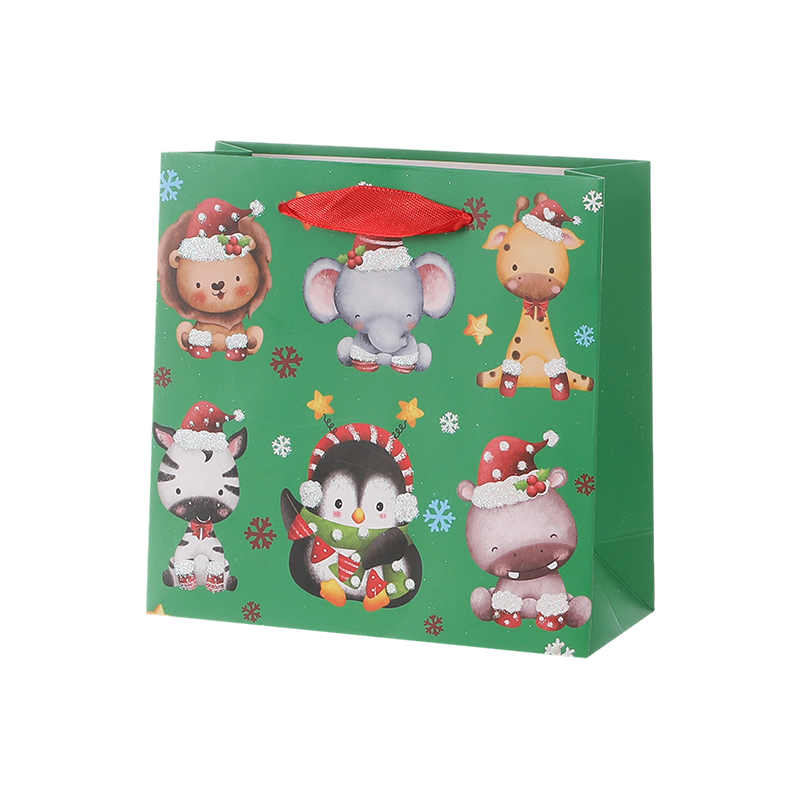
Kraft Birthday Gift Bags with Handles Party Favors
What Makes Kraft Birthday Gift Bags Useful for Modern Celebrations?
Gift packaging performs several functions at the same time. It protects the contents, makes carrying easier, supports product presentation, and communicates the mood of an event or brand. Kraft birthday gift bags are designed around these requirements. They provide a ready-to-use format for packaging party favors while also offering sufficient surface area for colorful artwork, logos, slogans, event details, or seasonal designs.
The natural kraft paper appearance gives the bags a warm and familiar character. Kraft is commonly associated with paper-based packaging, handmade products, environmentally conscious purchasing, and simple practical design. When combined with vivid birthday graphics, the material creates a contrast between a natural background and lively printed decoration. This contrast helps the bags attract attention without requiring complicated structural features.
The bags are also suitable for many different contents. Small sizes can hold candies, chocolates, cookies, stationery, stickers, small toys, and individual party favors. Medium sizes can accommodate books, clothing accessories, cosmetics, handmade products, household gifts, and retail purchases. Larger formats can be developed for gift sets, promotional kits, seasonal merchandise, and multiple-item packages.
For event organizers, the bags simplify distribution. A host can prepare one bag for each guest, fill the bags before the event, and place them on tables or hand them out at the end of the celebration. For retailers, the bags create a more polished checkout experience. For brands, the printed surface offers an additional communication area that can reinforce recognition after the customer leaves the store.
Product Structure and Core Design Features
Thick Kraft Paper Construction
The primary material is kraft paper selected for its strength, natural texture, and suitability for printing. Compared with very thin wrapping paper or low-weight disposable paper, thick kraft paper provides a firmer structure and a more substantial feel. It helps the bag remain upright and reduces the risk of tearing during normal handling.
Paper weight can be adjusted according to the intended contents and required appearance. Lightweight grades may be suitable for candy bags, small favors, and promotional handouts. Heavier grades can be selected for books, gift sets, cosmetics, or products with greater weight. This flexibility helps buyers control the balance between material consumption, carrying performance, appearance, and budget.
Kraft paper also provides a useful printing surface. Depending on the selected grade and finish, it can support colorful illustrations, repeated patterns, text, logos, promotional information, and seasonal artwork. Buyers can choose a design that uses the kraft background as part of the visual identity or select fuller coverage printing for a more colorful result.
Reinforced Bottom Design
A reinforced bottom helps the bag support its contents and maintain its shape. This feature is especially important when the bag contains multiple party favors, packaged food, toys, books, or promotional products. A weak bottom can cause the bag to sag, open, or tear, while a properly formed base gives the package greater stability during filling, storage, transportation, and carrying.
The bottom construction can be developed according to bag dimensions and expected loading requirements. A wider base may be helpful for boxed products or gift sets, while a narrower base may be adequate for flat merchandise and lightweight favors. Proper creasing and forming also help the bag open neatly and stand more consistently at retail or event locations.
Twisted Paper Handles
Strong twisted paper handles provide a comfortable grip and improve convenience compared with handle-free favor bags. They allow guests, customers, and event staff to carry the bags easily, even when the contents are distributed over several items. The handles can be coordinated with the bag color or selected to create a contrasting visual effect.
Handle length, paper construction, attachment method, and color can be adjusted for different applications. Shorter handles may create a compact gift presentation, while longer handles can provide additional carrying comfort. Handle placement must be aligned accurately with the bag structure so that the weight is distributed evenly during use.
Colorful Cartoon Patterns
The printed patterns are designed to create a cheerful and approachable appearance. Cartoon characters, balloons, birthday cakes, stars, animals, gifts, confetti, and other festive motifs can be used to match a party theme. Designs may be targeted toward children, families, schools, or general gift-giving occasions.
Colorful graphics also make it easier for distributors and retailers to organize product lines. Different patterns can be assigned to age groups, seasons, holidays, or event themes. A coordinated collection may include several bag sizes and matching paper products, allowing buyers to create a consistent party packaging display.
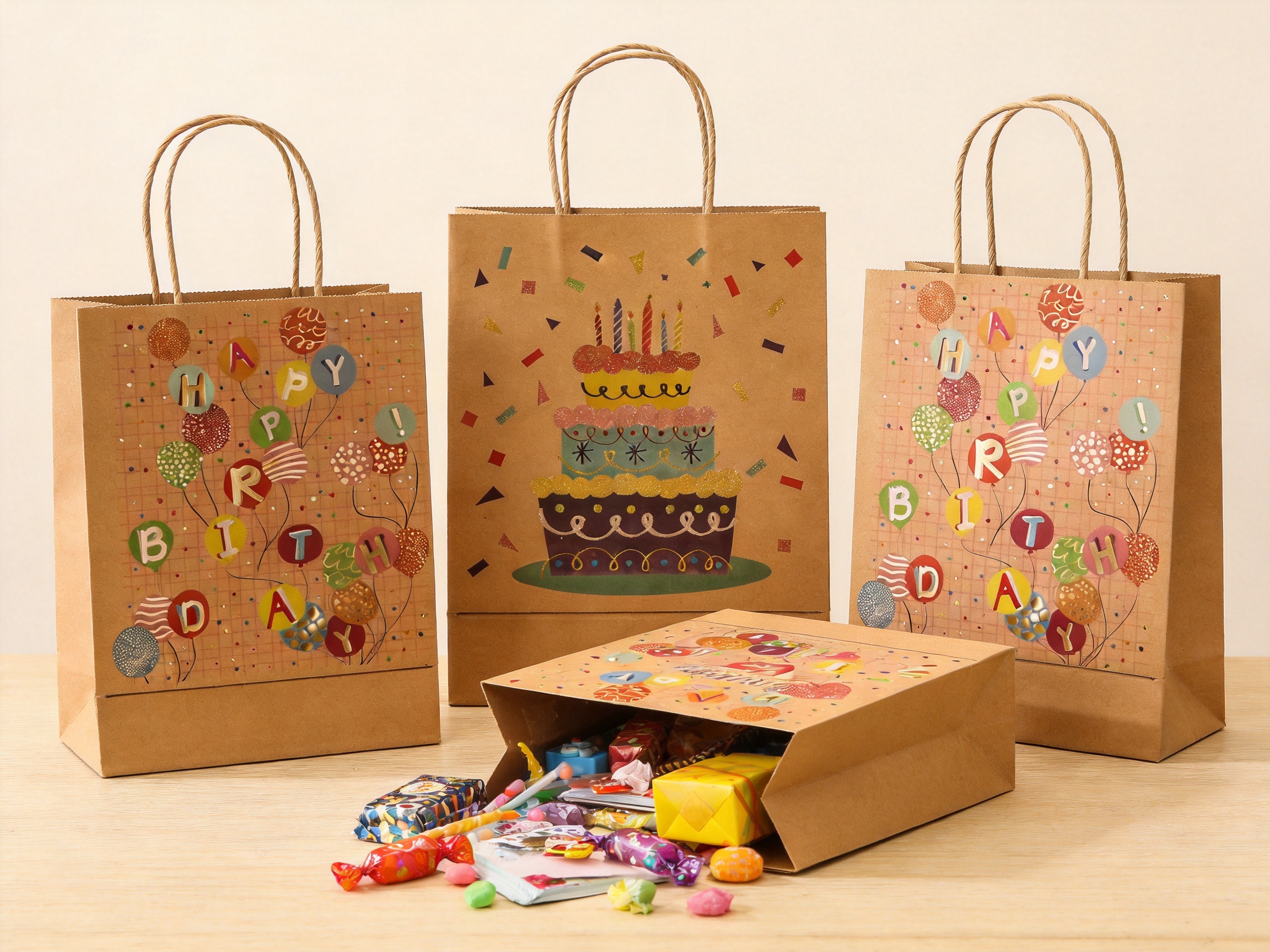
Advantages Compared with Ordinary Gift Bags
Greater Visual Appeal
Plain bags may protect a product, but they do not necessarily contribute to the customer experience. Printed kraft birthday gift bags provide immediate visual communication. Their graphics show that the packaging is intended for celebration, gift-giving, or party use before the bag is even opened.
This visual appeal is valuable in retail environments where many products compete for attention. A colorful bag can help a party supply store create an inviting display, help a supermarket promote seasonal products, or help an event organizer make a celebration feel more coordinated. Compared with generic unprinted bags, printed designs reduce the need for additional stickers, labels, or decorative wrapping.
Better Carrying Convenience
Handle-free paper bags can be difficult to carry when the contents are bulky or when guests are already holding other items. Integrated twisted paper handles improve usability and make the packaging more suitable for distribution after parties, school activities, and promotional events.
The handles also create a more finished appearance. A customer can carry the product directly from a retail counter without needing an additional shopping bag. For gift retailers, the bag becomes part of the presentation rather than an afterthought.
More Stable Shape
Low-quality favor packaging may collapse, wrinkle, or lose its form during transport. Thick kraft paper and a reinforced bottom help the bag retain a cleaner shape. This is particularly useful for wholesalers and distributors that need products to arrive in presentable condition after bulk shipment.
A stable shape also improves filling efficiency. Workers can open the bags more quickly, place products inside, and arrange them on tables or shelves. For large events, these small improvements can reduce preparation time and make packing operations more orderly.
Broader Customization Potential
Many inexpensive bags are available only in fixed sizes and preselected designs. Custom kraft gift bags can be produced with different dimensions, paper weights, colors, handles, printing layouts, and finishing requirements. This gives professional buyers more control over the final product.
Customization is especially valuable for companies that operate private-label programs. A distributor can request exclusive artwork, a retailer can use its own logo, and an event company can print a specific celebration message. Businesses can also develop limited-edition designs for birthdays, school graduations, holiday promotions, company anniversaries, or product launches.
Applications Across Different Business Sectors
Party Supply Distributors
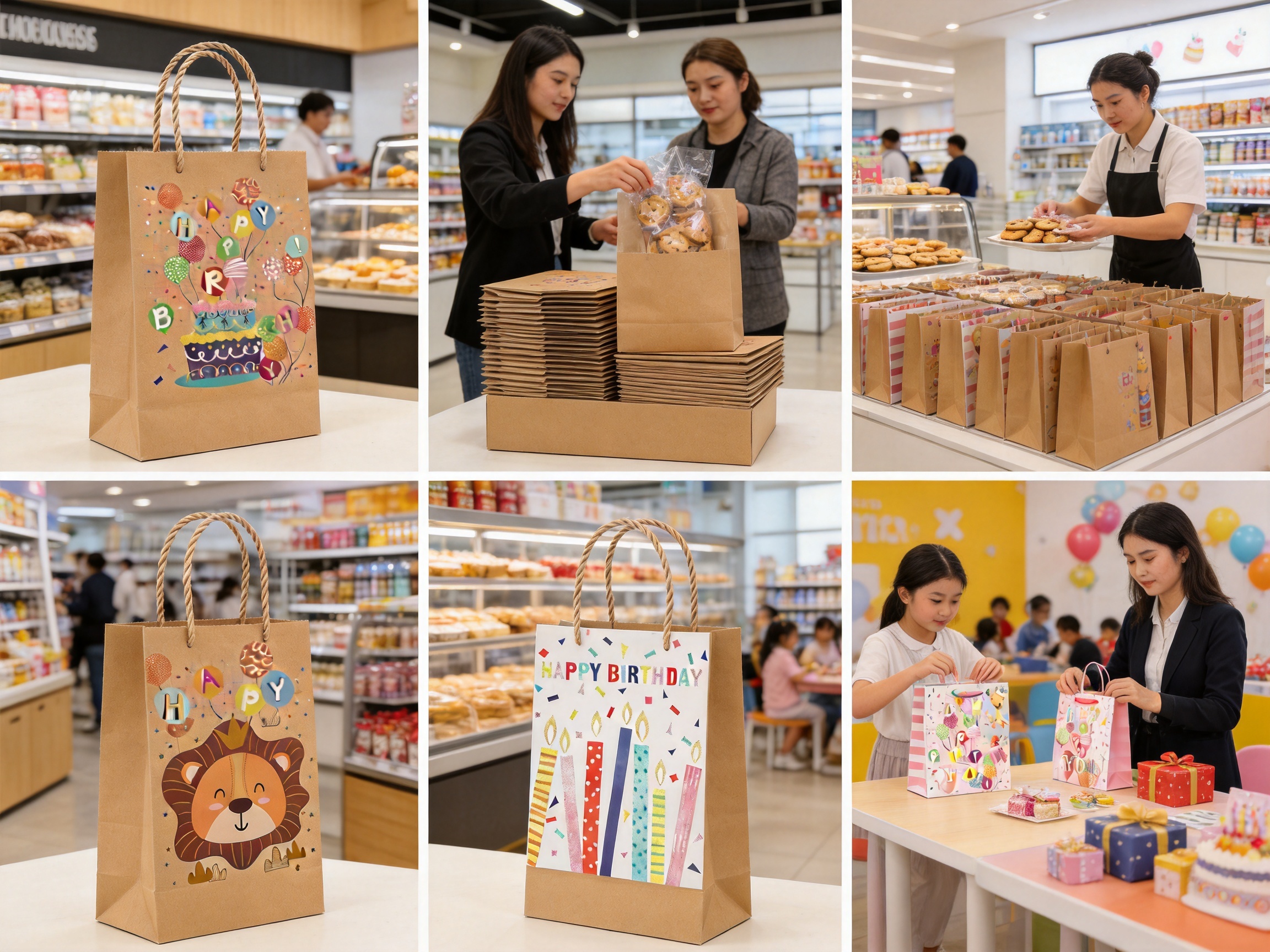
Party supply distributors need products that can serve different customer segments while remaining practical for inventory management. Kraft birthday gift bags can be supplied in assorted designs, sizes, and packaging quantities. Distributors may offer them to independent party shops, online sellers, event organizers, schools, and family entertainment centers.
Because the bags are suitable for both party favors and retail purchases, they can support several product categories at once. A distributor may sell the same style to customers purchasing candy, toys, decorations, craft products, or small gifts. This versatility can make the product easier to introduce into an existing catalog.
Supermarkets and Retail Stores
Supermarkets can use printed bags for seasonal displays, bakery products, children’s gifts, and promotional bundles. Gift stores can use them at checkout, particularly when customers purchase small presents or themed merchandise. A well-designed bag can reinforce the store’s image and make a purchase feel more complete.
Retailers can also request different sizes for different departments. Small bags may be used for accessories and confectionery, medium bags for toys and books, and larger bags for gift collections. Matching artwork across multiple sizes helps create a recognizable packaging family.
Bakeries and Confectionery Businesses
Birthday-themed kraft bags are well suited to cookies, candy, chocolates, cake accessories, and other lightweight bakery products. They can be used for party orders, children’s celebration packages, or seasonal gift promotions. The printed surface can display playful graphics that complement the bakery’s products.
When food products are placed inside, buyers should select paper and inner packaging specifications appropriate for the intended use. The bag itself may function as an outer package, while individually wrapped food products provide the direct product barrier. Production requirements should be discussed in advance to ensure the selected materials and finishes match the application.
Schools and Family Events
Schools, community organizations, and family event planners often distribute small gifts or activity materials to participants. The bags can hold stationery, badges, stickers, educational items, snacks, or commemorative products. Customized printing can include the name of an event, a school message, or a simple celebratory theme.
Using matching bags for all participants creates an organized and welcoming presentation. It can also reduce preparation work because the bags are already printed and ready to fill. For recurring events, a standard design can be maintained, while special editions can be produced for important milestones.
Brand Promotions and Product Launches
Companies can use custom gift bags as part of promotional campaigns. The bag may contain samples, brochures, coupons, small merchandise, or branded gifts. Printed logos and marketing messages extend the visibility of the campaign beyond the event itself because recipients may reuse the bags for shopping or storage.
The cheerful birthday format can also be adapted for brand anniversaries, customer appreciation activities, family-oriented marketing, and retail promotions. By changing the artwork, colors, and wording, the same basic bag structure can serve many communication objectives.
Printing and Design Options
Printing is one of the most important factors in the appearance of a gift bag. The artwork may include full-color illustrations, simple one-color logos, repeated patterns, text, product information, or a combination of these elements. Buyers should provide clear artwork files and confirm the intended color effect before production begins.
The kraft paper background may be left partially visible to emphasize a natural and handmade appearance. Alternatively, larger printed areas can be used when the buyer requires bright and highly detailed graphics. The final color effect depends on the paper tone, ink coverage, artwork, and selected production process.
Businesses can also request seasonal or occasion-specific designs. Birthday bags may feature cakes, balloons, candles, animals, stars, gifts, or confetti. Other designs can be developed for holidays, school events, baby celebrations, retail campaigns, or corporate activities. A flexible design process allows the packaging to remain relevant throughout the year.
For brands, the printing area can include logos, slogans, website names, social media identifiers, product messages, or contact information. The design should remain visually balanced so that marketing content supports the festive theme rather than making the bag look crowded. Professional prepress preparation helps verify artwork dimensions, folding positions, handle placement, and color requirements before printing.
Manufacturing Process and Quality Control
Material Selection
Manufacturing begins with the selection of paper according to the bag’s intended use. Important considerations include paper weight, color, surface texture, stiffness, printability, folding performance, and expected load. Buyers requiring a natural kraft appearance may select brown kraft paper, while other projects may use colored or specially treated paper grades.
Material selection affects every later stage of production. Paper that is too light may not provide the necessary strength. Paper that is too heavy may increase cost or make folding more difficult. The correct grade provides a suitable balance between appearance, performance, production efficiency, and shipping weight.
Artwork Preparation and Prepress
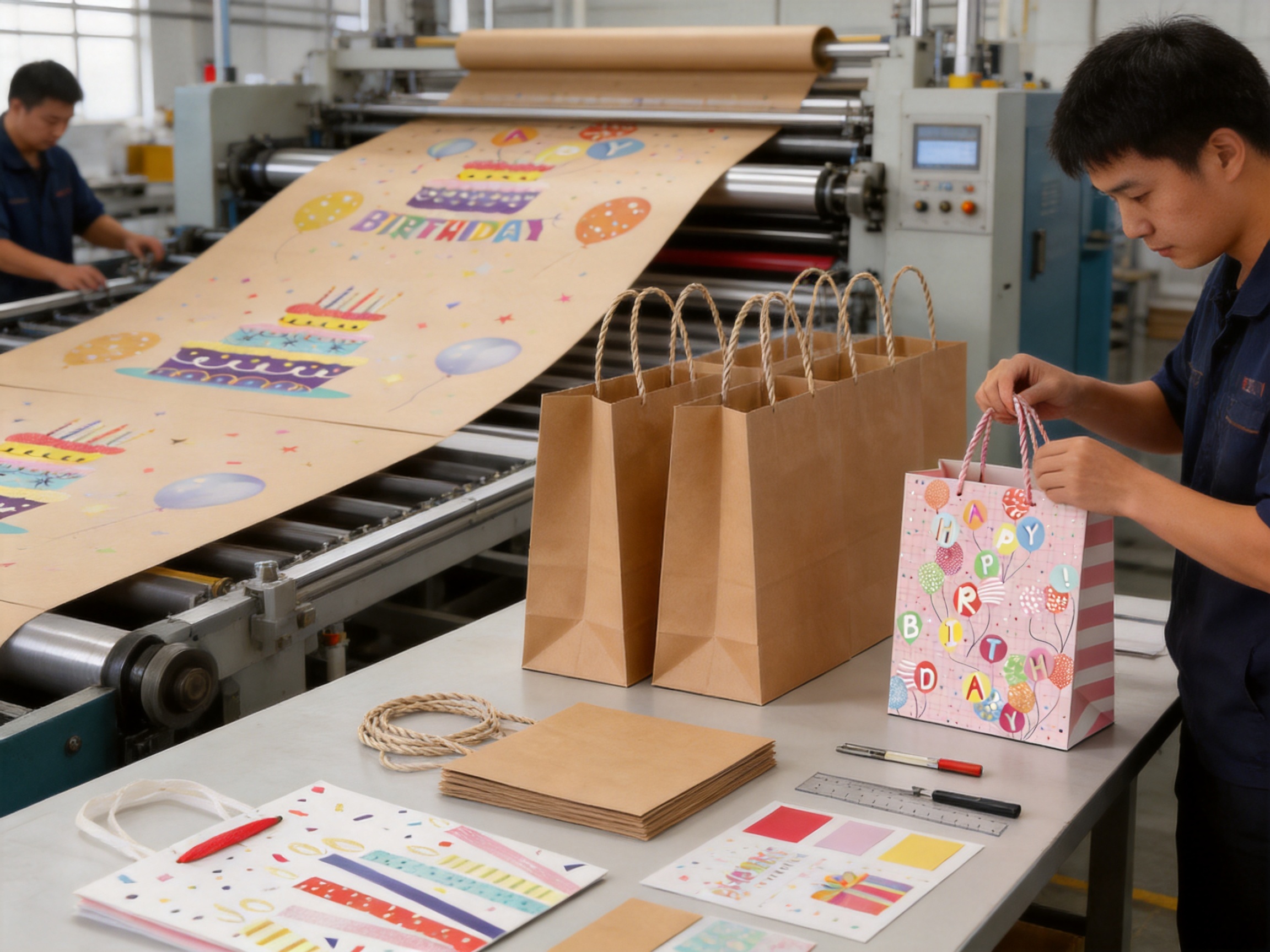
Before printing, the artwork is reviewed and prepared for the selected bag size and structure. The prepress stage checks image quality, text clarity, color separation, bleed areas, folding lines, handle positions, and other technical details. This process helps reduce production errors and ensures that the printed design appears correctly after the sheet is folded and formed.
Prepress planning is especially important for customized bags. A logo that looks centered on a flat sheet may appear incorrectly positioned after folding if structural lines are not considered. Careful layout preparation helps maintain consistent alignment across production batches.
Printing
The prepared paper is printed using a process suited to the selected design, material, and quantity. Printing may involve simple graphics, multiple colors, detailed illustrations, or branded artwork. During production, color consistency and image registration are monitored to maintain a uniform appearance from bag to bag.
Printed sheets may require appropriate drying or curing time before further processing. This helps reduce the risk of scuffing, smearing, or transfer during folding and bag making. The production team can also review samples to confirm that the printed result matches the approved artwork.
Laminating and Surface Treatment
Some projects may require a surface treatment to influence appearance, durability, or resistance to handling. Depending on the application, buyers may discuss laminating or other finishing options. A selected finish can create a different tactile effect, help protect printed graphics, or support a more premium presentation.
Not every bag requires lamination. For buyers emphasizing a natural kraft appearance or a paper-focused packaging concept, an untreated surface may be preferred. The appropriate choice depends on the intended use, desired visual effect, environmental objectives, and budget.
Creasing and Forming
Accurate creasing allows the paper to fold into a clean and consistent bag shape. Creasing lines must be coordinated with the bag dimensions, bottom construction, side folds, and handle positions. Good forming performance contributes to a more stable final product and helps prevent irregular edges or distorted panels.
The forming stage also influences how efficiently the bags can be opened and filled. Consistent folds allow workers and customers to handle the packaging more easily. For high-volume orders, reliable forming is essential for maintaining a uniform appearance throughout the shipment.
Handle Attachment and Bag Making
After the printed and creased material is prepared, the bag is assembled and the twisted paper handles are attached. Handle attachment must provide sufficient strength for the expected load while keeping the handles aligned and visually neat. The attachment area is checked because it receives concentrated stress when the bag is carried.
Bag-making equipment supports consistent production for standard formats, while manual finishing may be used for selected processes, special configurations, or detailed quality checks. The combination of machinery and skilled manual work allows the manufacturer to manage both routine wholesale orders and customized packaging programs.
Inspection and Packing
Finished bags are inspected for printing quality, structural integrity, handle attachment, bottom formation, dimensions, and general appearance. Samples can be reviewed at different stages to identify potential issues before the full order is packed.
After inspection, the bags are folded or arranged according to shipping requirements. Proper packing helps reduce crushing, moisture exposure, and unnecessary movement during transportation. Consistent packing also makes it easier for buyers to count, store, and distribute the products upon arrival.
Integrated Factory Capabilities
The manufacturer behind this product has nearly three decades of experience in paper packaging production. Established in 1996 as Fushida Plastic Factory and rebranded in 2019 as Magic Tree Paper Products Co., Ltd., the company has developed from its early manufacturing background into a supplier of paper bags, gift bags, gift boxes, greeting cards, and patterned wrapping paper.
This history provides useful manufacturing continuity for buyers seeking a long-term packaging partner. Instead of relying entirely on unrelated outside suppliers, the company manages multiple stages of production through its own factory operations. This structure supports closer coordination between design, material selection, printing, finishing, bag making, and final inspection.
The company’s capabilities include professional design and prepress, laminating, hot stamping, creasing, printing, bag making, and manual finishing. These processes cover the main steps required to develop and produce customized gift bags. Having these capabilities within one manufacturing system can simplify communication and reduce the coordination problems that sometimes occur when different suppliers handle separate stages.
Integrated production is particularly valuable for private-label projects. A buyer can discuss artwork, paper, printing, dimensions, handles, and finishing requirements with one experienced supplier. Changes can be reviewed across the full production process rather than being considered in isolation. This helps support more consistent results between the approved sample and the final bulk order.
The company serves customers in the United States, Canada, Mexico, the United Kingdom, Japan, and China. Experience with different markets can help the production team understand varying preferences in bag dimensions, color styles, packaging presentation, and order coordination. International supply also requires attention to production scheduling, packing, communication, and delivery preparation.
With an annual output value exceeding 50 million yuan, the factory has substantial production activity and the ability to support ongoing wholesale programs. Capacity is important for buyers that need repeat orders, seasonal restocking, or multiple product formats. Stable production planning can help reduce interruptions when customers require consistent designs over time.
Why Customization Matters for B2B Buyers
Customization is not limited to adding a logo. It can involve the full relationship between the bag and the buyer’s sales strategy. Dimensions can be matched to the products being sold, paper weight can be selected according to load requirements, and handle styles can be chosen to suit the desired appearance and carrying comfort.
Retailers can create packaging that matches their store colors. Event companies can develop bags for a specific celebration. Distributors can request exclusive artwork to differentiate their product range. Brand owners can integrate the bag with existing packaging systems that include boxes, cards, tissue paper, and wrapping paper.
Customized sizing may also improve material efficiency. A bag that is too large can waste paper and require additional filler, while a bag that is too small may be difficult to use or may damage the contents. Selecting an appropriate width, height, and bottom depth helps create a better fit for the intended products.
Private-label buyers may also request coordinated products. Since the manufacturer produces gift boxes, greeting cards, and patterned wrapping paper in addition to paper bags, buyers can explore matching designs across multiple packaging formats. A coordinated set can provide a stronger retail presentation and make it easier for customers to recognize a seasonal collection.
Eco-Conscious Packaging Considerations
Kraft paper is widely selected by businesses seeking paper-based packaging with a natural appearance. Compared with packaging made primarily from plastic, paper bags can communicate a different material story and may be more suitable for companies that want to reduce their reliance on conventional plastic shopping formats.
However, responsible packaging decisions require more than simply selecting a paper material. Buyers should consider paper weight, printing coverage, finishing treatments, product protection, shipping efficiency, intended reuse, and local disposal or recycling systems. Choosing the right size and avoiding unnecessary layers can help reduce material consumption.
The company positions its paper packaging solutions as eco-friendly and customizable. Specific environmental requirements should be confirmed for each project, including the selected paper grade, inks, coatings, adhesives, and any requested finishing. Buyers with special sustainability standards should communicate these requirements during the quotation and preproduction stages.
Reusable handling is another practical consideration. A sturdy gift bag may be used again for storage, shopping, school supplies, or additional gift-giving. Strong paper, reliable handles, and a stable bottom can increase the likelihood that the bag will remain useful after the original event.
Ordering Considerations for Wholesale Projects
Define the Intended Contents
Before requesting a quotation, buyers should identify the products that will be placed inside the bags. The approximate weight, dimensions, shape, and quantity of the contents influence paper selection, bag size, bottom construction, and handle requirements.
A bag for lightweight candy will have different requirements from a bag for books or boxed gifts. Providing accurate information at the beginning helps the manufacturer recommend a more suitable structure and reduces the risk of ordering a format that is inconvenient in actual use.
Confirm Dimensions
Bag dimensions should be discussed in terms of width, height, side gusset, and bottom depth where applicable. Buyers may provide a sample product, product measurements, or a preferred bag format. If the packaging must fit a particular shelf, display bin, shipping carton, or retail counter, those space limitations should also be communicated.
Prepare Artwork
Artwork should be supplied in a clear, production-ready format whenever possible. Logos, illustrations, text, colors, and placement instructions should be reviewed before mass production. Buyers should also identify whether the design is intended for a natural kraft background, a printed background, or a combination of both.
Discuss Samples and Approval
A preproduction sample can help buyers evaluate the paper feel, bag size, handle comfort, printing effect, bottom stability, and overall appearance. Sample review is especially useful for custom designs and private-label orders. Any changes should be confirmed before the production schedule is finalized.
Plan Lead Times and Seasonal Demand
Birthday and party packaging may experience seasonal demand, particularly before holidays, school events, summer celebrations, and retail promotion periods. Buyers should plan orders in advance to allow time for artwork preparation, sampling, manufacturing, inspection, packing, and transportation.
Repeat buyers can benefit from maintaining approved specifications. Keeping records of dimensions, paper weight, printing colors, handle details, and packing methods helps make future reorders more efficient and supports consistency between batches.
Quality, Service, and Long-Term Supply Strengths
For professional buyers, product quality is only one part of supplier performance. Reliable communication, clear specifications, production coordination, consistent inspection, and responsive after-sales service are also important. A supplier that understands the full packaging process can help identify potential issues before they become costly production problems.
Magic Tree’s manufacturing model combines factory production with design, prepress, printing, finishing, and manual processing capabilities. This gives buyers a single point of coordination for many project requirements. It also supports the development of packaging collections rather than isolated products.
Long-term supply relationships are particularly valuable for distributors and brand owners. A stable supplier can support repeat orders, seasonal updates, new sizes, revised artwork, and related products. This continuity helps buyers build a consistent product offering and reduces the need to repeatedly qualify new manufacturers.
Flexible OEM and ODM services further support buyers that need products developed from their own concepts. OEM programs can focus on producing an established design under a customer’s specifications, while ODM cooperation may involve adapting an existing structure or developing a more complete packaging solution. The appropriate approach depends on the buyer’s artwork, market, order volume, and product strategy.
How These Bags Compare with Other Packaging Formats
Plastic favor bags may be lightweight and inexpensive, but they offer a different appearance and may not align with businesses seeking paper-based packaging. They may also provide less structural support for certain gift sets. Kraft paper bags create a warmer presentation and can provide a more substantial retail experience.
Plain paper bags may offer basic functionality, but printed birthday designs create stronger event recognition. They reduce the need for separate decorative labels and can make a product display more coordinated. The printed surface also provides space for brand communication.
Decorative fabric bags can be reusable and premium, but they are often more expensive and may require additional production steps. Kraft gift bags provide a practical alternative for large events, promotional distribution, and wholesale retail where attractive presentation and cost control must work together.
Gift boxes can provide a rigid and high-end structure, but they may take more storage space and require more time to assemble. Kraft gift bags are easier to open, fill, carry, and distribute. Buyers can select bags when convenience and efficient handling are more important than rigid box protection.
These comparisons do not mean that one format is suitable for every application. Instead, they show why kraft birthday gift bags occupy a useful position between simple disposable packaging and more elaborate premium formats. They combine visual design, carrying convenience, flexible customization, and practical production efficiency.
Designing a Successful Birthday Gift Bag Collection
A strong collection can include several sizes, coordinated patterns, and complementary colors. Small bags may be marketed for candy and classroom favors, medium bags for toys and accessories, and larger bags for gift sets or retail purchases. Consistent artwork across the range allows customers to mix sizes while maintaining a unified theme.
Color selection should reflect the intended audience. Bright primary colors may appeal to children, while softer tones may suit family celebrations or boutique gift stores. Neutral kraft backgrounds can be combined with selected accent colors to create a more natural appearance. For brand programs, colors can be matched to an existing identity system where technically practical.
Pattern density is another design consideration. Large illustrations can create a bold visual effect, while smaller repeated motifs may make the bag feel more decorative from a distance. Text should be large enough to remain clear after folding, and important design elements should not be placed too close to creases, seams, or handle attachment points.
Packaging collections can also be updated for different seasons. Birthday graphics may be followed by holiday, graduation, baby celebration, wedding, or general gift designs. Using a consistent bag structure across several collections can simplify product development and help retailers maintain familiar packaging performance.
Frequently Asked Questions
What can be placed inside these kraft birthday gift bags?
The bags can hold candies, cookies, chocolates, small toys, books, stationery, cosmetics, handmade crafts, accessories, promotional merchandise, and other gift or giveaway items. The suitable contents depend on the selected bag size, paper weight, bottom construction, and handle configuration.
Are the bags available in different sizes?
Yes. Multiple sizes can be produced for small party favors, medium retail products, and larger gift sets. Buyers should provide the approximate dimensions and weight of the intended contents so the manufacturer can recommend an appropriate format.
Can the birthday artwork be customized?
Yes. Buyers can discuss custom cartoon patterns, logos, promotional messages, seasonal artwork, color schemes, and private-label designs. The final design should be reviewed for folding lines, handle placement, print coverage, and color expectations before production.
Can the paper weight be changed?
Paper weight can be selected according to the required strength, appearance, product weight, and budget. Lightweight paper may be suitable for small favors, while heavier paper can provide greater support for books, gift sets, or other heavier contents.
Are the handles strong enough for retail use?
The bags are designed with twisted paper handles that provide a secure grip for normal carrying. Handle strength depends on the selected paper, attachment method, bag dimensions, and contents. Buyers should communicate the expected load so the handle and bag structure can be matched to the application.
Can businesses add their own logos?
Yes. Logos, slogans, promotional messages, and other brand elements can be included in the printed artwork. The manufacturer can review the artwork during prepress to ensure that the design is suitable for the selected bag structure.
Can the bags be used by bakeries?
They can be used as outer packaging for cookies, candy, chocolates, and other bakery products when the product is appropriately wrapped or protected. Buyers should discuss food-related requirements, paper specifications, inks, coatings, and intended use before production.
Do the bags support OEM and ODM projects?
Yes. OEM and ODM services can support buyers that need customized dimensions, artwork, paper, handles, finishes, or coordinated packaging products. The exact process depends on the project scope and required specifications.
Can matching gift boxes or wrapping paper be produced?
The manufacturer also specializes in gift boxes, greeting cards, and patterned wrapping paper. Buyers can discuss coordinated designs for a more complete birthday or retail packaging collection.
What should buyers provide when requesting a quotation?
Useful information includes the intended application, bag dimensions, approximate contents and weight, quantity, paper preference, printing requirements, handle style, finishing needs, delivery destination, and artwork status. Providing complete information helps the manufacturer prepare a more accurate proposal.
How can buyers maintain consistency for repeat orders?
Buyers should keep approved samples and written specifications covering dimensions, paper weight, colors, artwork, handle details, finishing, and packing requirements. These records help the manufacturer reproduce the same product more consistently in future orders.
Conclusion
Kraft birthday gift bags with handles provide a practical combination of festive design, carrying convenience, structural stability, and customization. Their thick kraft paper construction gives them a more substantial feel than very light favor bags, while reinforced bottoms and twisted paper handles improve everyday usability. Colorful cartoon patterns make them suitable for birthdays, parties, retail displays, school events, promotional campaigns, and family celebrations.
For B2B buyers, the greatest value comes from their flexibility. Bags can be developed in different sizes, paper weights, colors, handle styles, and printed designs. Businesses can request private-label artwork, seasonal themes, promotional information, or coordinated packaging collections. This makes the product suitable for distributors, supermarkets, bakeries, gift retailers, event companies, brand owners, and packaging wholesalers.
The manufacturer’s experience, in-house design and prepress, printing, laminating, hot stamping, creasing, bag making, and manual finishing capabilities provide a strong foundation for customized packaging projects. Factory-based production supports closer control over materials and processes, while international service experience and established output capacity support ongoing wholesale supply.
When buyers define the intended contents, select suitable dimensions, confirm paper and handle requirements, review artwork carefully, and approve samples before mass production, these kraft birthday gift bags can become a dependable part of a broader packaging strategy. They offer an effective way to protect and carry gifts while adding color, personality, and brand visibility to the customer experience.
References
1. Company product information supplied for kraft birthday gift bags with handles, including product structure, applications, customization options, and manufacturing capabilities.
2. Company information supplied for the paper packaging manufacturer, including corporate history, product categories, factory operations, export markets, and production services.
3. General packaging design principles relating to paper bag dimensions, handle attachment, bottom reinforcement, printing preparation, and product presentation.
4. General considerations for paper-based packaging selection, including material weight, printing performance, finishing, product protection, storage, and end-use requirements.
5. General B2B sourcing practices for customized packaging, including artwork approval, sample review, repeat-order specifications, quality inspection, and production planning.