中文简体
 русский
 Français
 Español
 Deutsch
 عربى

Turning eighteen is a meaningful milestone. It often represents the beginning of greater independence, new responsibilities, and a new stage of personal growth. A birthday greeting card for an eighteenth birthday should therefore do more than carry a short message. It should feel intentional, attractive, easy to personalize, and memorable enough to keep after the celebration.
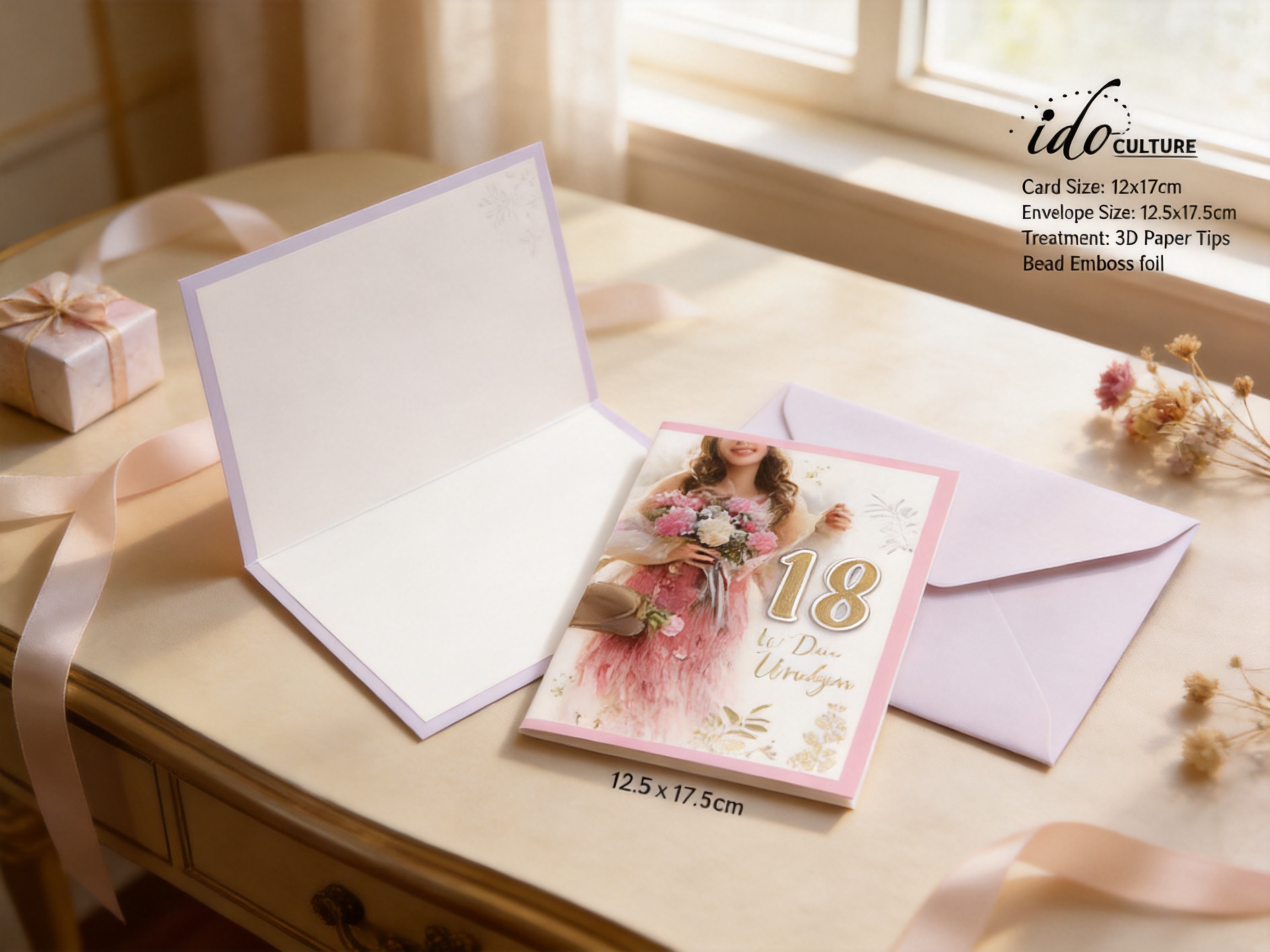
The 18th Birthday Greeting Card for a Girl is designed around these expectations. Measuring 12 x 17 cm and supplied with a matching 12.5 x 17.5 cm envelope, it provides a practical format for handwritten messages while maintaining a polished, gift-ready appearance. Its gentle textured styling, decorative treatment, and blank writing area make it suitable for family members, friends, teachers, colleagues, and retailers looking for a refined birthday card with broad appeal.
Unlike a basic folded card with a flat printed cover, this design uses a combination of 3D paper tips, bead embossing, and foil treatment. These finishing methods add visual depth and tactile interest, helping the card stand apart from ordinary mass-produced alternatives. The result is a paper product that can serve both as a greeting card and as a small keepsake connected to an important personal occasion.

18th Birthday Greeting Card for a Girl
A Greeting Card Designed for an Important Birthday
An eighteenth birthday has a distinct emotional character. It is youthful, celebratory, and optimistic, but it also carries a sense of transition. The best card designs recognize this balance by avoiding decoration that feels too childish while retaining enough warmth and charm for a birthday celebration.
This card is positioned within that middle ground. Its design is gentle and textured rather than overly formal or excessively playful. That makes it adaptable to different relationships and celebrations. A parent can use it for a heartfelt message, a sibling can add a lighthearted note, and a friend can write something personal without the card feeling too serious or too impersonal.
The 12 x 17 cm card size offers enough surface area for a cover design with visual presence while remaining compact and easy to handle. It can be placed inside a gift bag, attached to a birthday present, displayed on a table, or stored in a memory box. Its proportions are large enough to accommodate a meaningful message but not so large that it becomes difficult to carry or package.
The accompanying 12.5 x 17.5 cm envelope is an important part of the overall presentation. The slightly larger dimensions allow the card to be inserted and removed comfortably while providing a coordinated finish. A matching envelope also saves the buyer from having to source a separate mailing or presentation envelope. For retailers, this creates a more complete product that can be displayed and sold without additional accessories.
Suitable for Personal Messages
One of the strongest features of the card is the blank interior space. While pre-printed messages can be convenient, they often limit the emotional value of a greeting card. A blank writing area gives the sender room to express something specific to the recipient.
The message might be a short birthday wish, an encouraging note about the future, a humorous memory, or a longer reflection on growing up. The flexibility is especially useful for an eighteenth birthday because the occasion may be celebrated by people with very different relationships to the recipient. The same basic card can support a warm family message, a friendship-focused note, or a simple professional greeting.
The writing space also supports the card’s long-term value. After the birthday has passed, the recipient may keep the card with photographs, letters, ticket stubs, or other personal items. A message written by hand can become a reminder of the people who celebrated the occasion and the hopes they shared for the next stage of life.
Gift-Ready Without Excessive Complexity
Many greeting cards compete through large embellishments, complicated structures, or excessive decoration. Although these approaches can attract attention, they may also make the card difficult to store, write in, or combine with a gift. This design takes a more balanced approach.
The card’s visual interest comes from its textured and dimensional finishing rather than from an oversized format. It can be paired with a gift box, gift bag, or wrapping paper without creating a bulky package. It is also easy to hold, open, and place into an envelope.
For consumers, this simplicity is convenient. For stores and wholesale buyers, it can reduce display and packaging complications. The card can be stocked with other birthday stationery, grouped into seasonal collections, or sold as part of a coordinated paper-gifting range.
Material and Finishing Details
The appearance of a greeting card depends on more than its printed artwork. Paper selection, surface treatment, folding accuracy, embellishment placement, and finishing quality all contribute to the final impression. In a milestone birthday card, these details are particularly important because the product is often purchased as a reflection of the sender’s care and taste.
The listed treatment for this card includes 3D paper tips, bead embossing, and foil. Each technique contributes a different quality to the design.
Three-Dimensional Paper Tips
Three-dimensional paper elements can create a layered appearance that is not possible with flat printing alone. Carefully applied paper details give selected parts of the design additional height and definition. Depending on the artwork, these elements may emphasize decorative motifs, lettering, borders, or other focal points.
The dimensional effect adds a sense of craftsmanship. When the recipient handles the card, the design offers a tactile experience as well as a visual one. This is useful for a product intended to be remembered and kept, because the card feels more like a designed paper object than a disposable printed sheet.
Three-dimensional paper details can also help organize the visual hierarchy of the card. Raised elements draw attention to the most important areas without requiring the entire surface to be heavily decorated. This allows the design to remain gentle and refined while still offering a premium appearance.
Bead Embossing
Bead embossing introduces small raised textures that catch light and create a decorative surface effect. Unlike a completely smooth printed finish, embossed areas invite the recipient to notice the card through touch. The texture can make the paper feel more substantial and can add subtle contrast to the surrounding printed areas.
Embossing is especially suitable for birthday stationery because it communicates celebration without relying solely on bright colors or large graphics. It can make a restrained design feel more special and can support a sophisticated visual direction for teenage and young adult recipients.
From a manufacturing perspective, embossed details require accurate alignment between the artwork and the finishing process. If the raised treatment is misplaced, the design can lose balance. Consistent production therefore depends on careful preparation, suitable tooling, controlled pressure, and inspection of finished pieces.
Foil Accents
Foil treatment adds reflective highlights to selected parts of the card. These highlights can create a premium impression and help important design elements stand out under retail lighting or natural light. Foil is often associated with celebratory stationery because it adds a sense of occasion without changing the basic usability of the product.
Used in combination with a textured paper surface, foil can produce a pleasing contrast between soft matte areas and brighter reflective details. The result is more visually varied than a standard ink-only design. It can appeal to customers who want a card that feels elevated but still warm and approachable.
Good foil application requires attention to temperature, pressure, registration, and surface compatibility. Too little pressure may result in incomplete transfer, while excessive pressure can affect the paper or create unwanted marks. Consistent production controls are therefore important to achieving a clean, polished finish.
| Product Feature | Specification or Benefit |
| Card size | 12 x 17 cm; comfortable to hold and suitable for handwritten messages |
| Envelope size | 12.5 x 17.5 cm; coordinated and slightly larger for easy insertion |
| Design direction | Gentle, textured, and suitable for an eighteenth birthday celebration |
| Surface treatment | 3D paper tips, bead embossing, and foil accents |
| Interior | Blank writing area for a personal message |
| Typical uses | Birthday parties, personal gifts, retail stationery collections, and memory boxes |
Advantages Compared with Standard Greeting Cards
The greeting card market includes a wide range of products, from simple flat cards to elaborate pop-up formats. This product competes most directly with standard folded cards that provide a cover image and a basic interior message. Its advantages come from the balance between tactile finishing, practical dimensions, and flexible personalization.
A More Memorable Tactile Experience
A completely flat card may look attractive when viewed on a shelf or screen, but it offers limited sensory engagement. The combination of raised paper details, bead embossing, and foil gives this card more physical character. The recipient can see variation in the surface and feel the raised details when handling it.
This tactile quality can improve the perceived value of the product. Customers are often willing to choose a card with more refined finishing when they want the item to feel special. For retailers, a tactile product may also help create differentiation within a display where many cards use similar formats and messages.
A Practical Alternative to Oversized or Complex Cards
Some premium birthday cards use large structures or intricate moving parts. These formats can be impressive, but they may be harder to store, mail, display, or combine with a present. They can also require more space in retail fixtures and may be less suitable for a handwritten note.
The 12 x 17 cm format offers a practical alternative. It preserves a substantial writing area while remaining easy to package. The card can fit naturally into a gift bag or a standard presentation arrangement. Its attractive finish gives it a premium feel without requiring a complex mechanical structure.
More Personal Than a Fully Printed Message
Cards with pre-written interiors are convenient, but they can be less adaptable. A sender may have difficulty adding a personal message if the available space is crowded or if the printed sentiment does not match the relationship. The blank interior of this card gives the purchaser greater control over the final communication.
This flexibility is valuable in wholesale and retail settings because the card can appeal to many customer groups. It does not depend on one particular tone of voice or one narrow relationship. Buyers can make the message their own, which helps the product serve a wider range of occasions and customers.
More Collectible Than a Disposable Note
The gentle texture and decorative finishing give the card a quality that encourages keeping. A recipient may place it in a drawer, scrapbook, journal, or memory box. This potential for continued use and preservation is a competitive advantage over very basic cards that are often discarded after the birthday.
The card is not merely a container for a greeting. It can become part of the story of the recipient’s eighteenth birthday. The written message, date, signatures, and decorative surface may all contribute to its future sentimental value.
Manufacturing Strengths Behind the Product
The quality of a finished greeting card depends on the reliability of the production system behind it. Yiwu Magic Tree Gift Bag Co., Ltd. brings extensive paper-product manufacturing experience to this category. The company was founded in 1996 as Fushida Plastic Factory and rebranded in 2019 as Magic Tree Paper Products Co., Ltd. This history represents nearly three decades of experience in manufacturing packaging and paper products.
The company specializes in white cardboard, coated paper, and kraft paper products. Its product range includes paper bags, gift bags, gift boxes, greeting cards, and patterned wrapping paper. This broader manufacturing background is relevant to the birthday card because it reflects experience with several related paper structures, surface finishes, and packaging formats.
In-House Design and Prepress
Design preparation is one of the earliest stages at which product quality can be protected. A card with embossing, foil, and three-dimensional elements requires more than a basic print file. Artwork must be separated and prepared for each production process, with attention to registration, layers, clearances, and finishing tolerances.
In-house professional design and prepress capabilities allow the manufacturer to coordinate these requirements before production begins. This can help reduce avoidable errors, improve the relationship between printed artwork and decorative treatments, and support more consistent results across production runs.
Prepress planning is particularly important when a design includes small decorative details. Delicate areas must be checked for clarity, foil must be assigned to the correct locations, and embossed features must align with the visual composition. A structured prepress process helps preserve the intended appearance of the finished card.
Printing and Surface Finishing
The company’s capabilities include printing, laminating, hot stamping, creasing, bag making, and manual finishing. Not every process is required for every card, but the availability of multiple in-house operations can make production planning more coordinated.
Printing creates the foundation of the visual design. Creasing supports accurate folding and helps the card open cleanly. Hot stamping supports reflective foil details, while manual finishing can be used for selected decorative elements that require careful placement. Laminating may be appropriate for certain paper products or customized collections, depending on the required surface and structure.
When several processes are handled within one manufacturing organization, communication between stages can be more direct. Production teams can coordinate specifications, review samples, and respond to adjustments without relying entirely on multiple unrelated suppliers. This can support more consistent quality and more efficient order management.
Manual Finishing for Decorative Paper Products
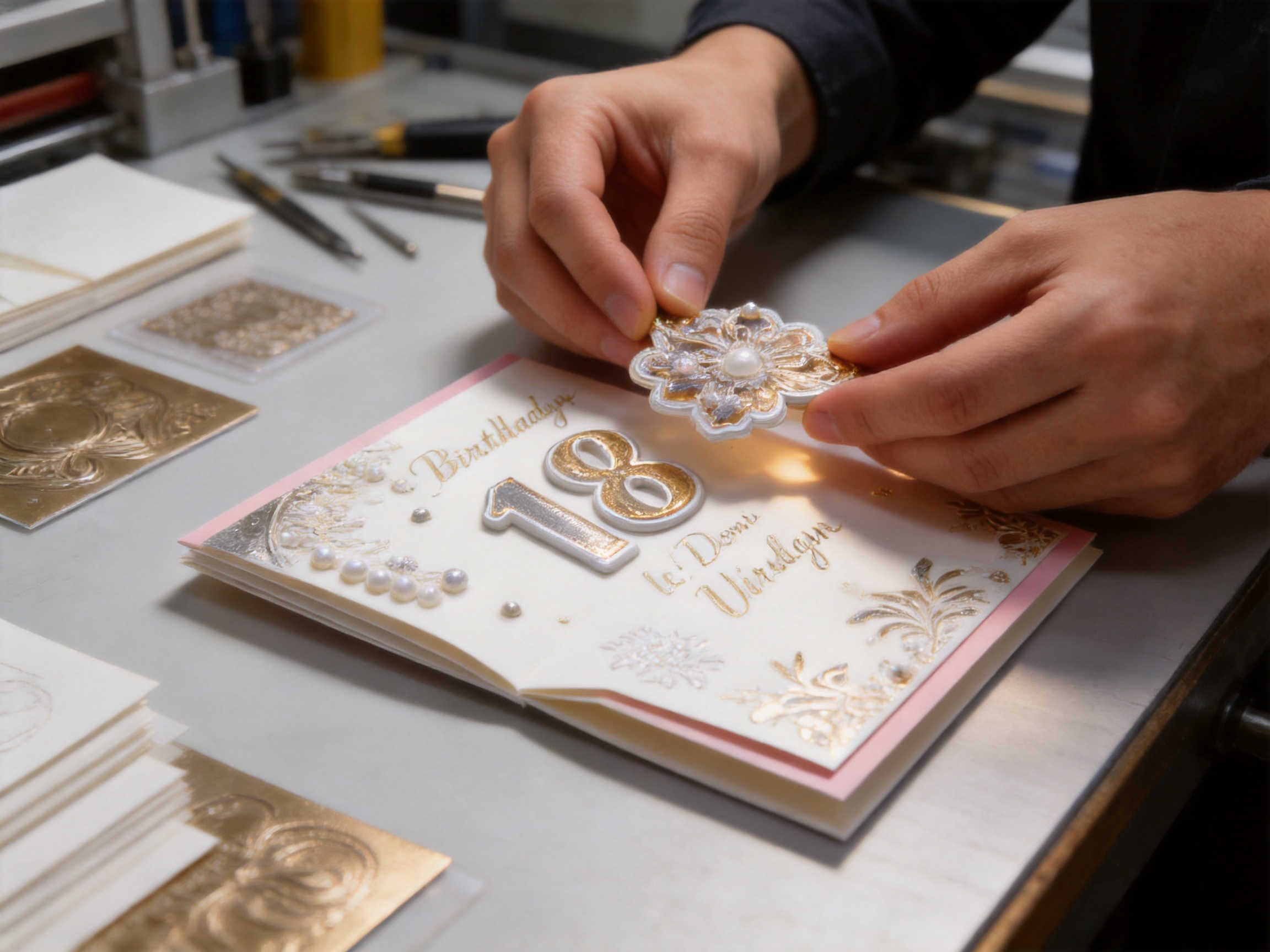
Manual finishing remains valuable in premium paper goods. Some three-dimensional details, embellishments, or specialized assembly steps require careful handling rather than purely automated production. Skilled workers can inspect placement, correct minor issues, and help preserve the visual character of a detailed design.
For a greeting card with raised paper tips and textured treatment, manual finishing may contribute to the final presentation. It allows the manufacturer to handle decorative components that might not be suited to a simple high-speed flat-printing line. The combination of industrial production and controlled hand finishing can provide both efficiency and attention to detail.
Control from Raw Materials to Finished Products
Magic Tree operates its own factory and manages the production process from raw materials to finished products. This level of control can support traceability, scheduling, and consistency. It also provides a stronger foundation for managing paper selection, printing, finishing, folding, assembly, and packing as connected stages rather than isolated services.
For wholesale buyers, this can be important. A greeting card order may need consistent dimensions, matching envelopes, reliable decorative treatment, and stable packaging. A factory that manages multiple stages internally is better positioned to coordinate these requirements and maintain a consistent production standard.
The company reports an annual output value exceeding 50 million yuan. While production scale alone does not determine quality, an established manufacturing base can support organized workflows, equipment investment, experienced personnel, and the ability to serve larger or repeated orders.
Quality Considerations for Wholesale Buyers
Retailers and distributors evaluating a birthday greeting card generally look beyond the artwork. They also consider consistency, packaging, lead times, product flexibility, and the manufacturer’s ability to support ongoing supply. These considerations are especially relevant for seasonal and milestone birthday products.
Consistent Dimensions
Accurate dimensions help the card and envelope work together properly. A 12 x 17 cm card should fit the 12.5 x 17.5 cm envelope without excessive looseness or difficult insertion. Consistency also helps retailers organize shelves, display trays, gift sets, and mailing arrangements.
Dimensional control depends on accurate cutting, creasing, folding, and inspection. It is particularly important when paper treatments or layered elements are included, because added thickness can affect how the card fits into the envelope.
Reliable Decorative Application
Foil and embossing should be applied cleanly and consistently. Buyers may look for sharp edges, even coverage, accurate positioning, and a well-controlled relationship between the decorative elements and the printed design. Raised paper details should be securely attached and should not create unnecessary loose edges.
These factors influence both appearance and durability. A greeting card may pass through several hands before reaching the recipient, including warehouse staff, retail employees, gift wrappers, and customers. Robust finishing helps the product maintain its presentation throughout that journey.
Suitable Packing and Protection
Paper products need protection from bending, moisture, surface abrasion, and compression during storage and transport. A card with dimensional features and foil accents should be packed in a way that minimizes pressure on the finished surface.
Appropriate packing also supports efficient retail handling. Cards and envelopes should be grouped in a way that keeps them clean, organized, and easy to count. For larger orders, protective cartons and sensible inner packaging can help reduce damage during shipment.
Production Communication
Clear communication is essential when ordering paper products with multiple finishing processes. Buyers may need to confirm artwork, paper type, card dimensions, envelope specifications, decoration, packaging, and inspection requirements.
A manufacturer with design, prepress, printing, finishing, and factory management capabilities can provide a more coordinated communication process. This is useful for buyers developing a new greeting card collection or expanding an existing range with milestone birthday products.
Applications Across Retail and Gifting Channels
The card is suitable for more than one sales environment. Its format and design can support independent gift shops, stationery stores, department stores, online retailers, party-supply businesses, and curated gift-box providers.
Gift and Stationery Shops
In a traditional gift shop, the card can be displayed with birthday gifts for teenage and young adult customers. Its textured surface may attract shoppers who are comparing several cards with similar messages. It can be stocked alongside gift bags, wrapping paper, small accessories, and keepsake products.
The card’s neutral but celebratory direction allows it to fit different store identities. It can sit within a colorful birthday display, a more sophisticated stationery collection, or a selection of paper products centered on meaningful life events.
Online Retail
Online buyers often rely on product descriptions to understand why one card is different from another. Important selling points include the card size, matching envelope, blank writing area, tactile treatments, and suitability for an eighteenth birthday.
Product photography can show the card’s scale, surface detail, envelope pairing, and decorative finish. Detailed descriptions should explain that the card is easy to hold, suitable for handwritten messages, and appropriate for personal gifts or memory keeping. These details help shoppers make a confident purchase decision without physically handling the card before buying.
Gift Sets and Bundled Products
The card can be combined with a gift bag, gift box, or patterned wrapping paper to create a coordinated birthday presentation. Because the card has a practical size, it can be placed inside a larger gift package or attached to the outside with ribbon, adhesive tabs, or a small clip.
Bundling can increase convenience for customers and create additional merchandising opportunities for retailers. A coordinated set may appeal to shoppers who want the entire gift presentation to feel considered, from the outer wrapping to the written message.
Party and Event Retail
Businesses serving birthday parties and milestone celebrations can include the card in seasonal displays or event-specific collections. An eighteenth birthday is often planned with increased attention because it marks a significant age. Families and friends may be willing to select a card with a more distinctive finish for the occasion.
The card may also be suitable for group signing. Its blank interior gives several people the opportunity to add short messages, making it useful for classmates, coworkers, teammates, or family groups who want to contribute to one shared card.
Eco-Conscious Paper Packaging Considerations
Paper products are increasingly evaluated not only for appearance and function but also for material responsibility. Buyers may consider the paper grade, amount of material used, decorative components, packaging efficiency, and the manufacturer’s broader approach to eco-friendly production.
Magic Tree describes its product range as including eco-friendly and customized paper packaging solutions. The company works with white cardboard, coated paper, and kraft paper products, giving buyers options for different visual and structural requirements.
For this greeting card, responsible purchasing decisions should include asking about the specific paper composition, applicable certifications, ink systems, foil requirements, and packaging materials for a particular order. Sustainability claims are strongest when they are connected to clearly defined material and production specifications.
The card’s compact format can also support efficient storage and transport compared with oversized greeting products. Its matching envelope provides a complete presentation without requiring a separate package. When responsibly sourced paper and suitable protective packing are selected, the product can combine celebratory design with practical material use.
Balancing Decoration and Material Use
Decorative finishing adds value, but it should be applied with purpose. The use of foil, embossing, and dimensional paper elements creates a more engaging product while allowing the overall card to remain relatively compact. This can be more efficient than relying on a large structure or extensive plastic components to create visual impact.
For brands and retailers developing eco-conscious stationery collections, the key is to evaluate the full product system. Paper choice, decorative treatments, packaging, shipping, and end-of-life considerations all contribute to the environmental profile. A paper-based card can be part of a responsible range when its materials and production methods are selected carefully.
Why Manufacturing Experience Matters in Greeting Cards
Greeting cards may appear simple, but premium results require coordination across several technical steps. The product must be printed clearly, cut accurately, folded neatly, finished attractively, and packed without damage. When a card includes multiple decorative techniques, the need for process control increases.
Magic Tree’s history in paper packaging provides experience relevant to these requirements. Paper bags, gift boxes, wrapping paper, and greeting cards share several manufacturing foundations, including paper handling, printing, surface finishing, cutting, creasing, assembly, and quality inspection.
Experience across related product categories can also support practical design decisions. A manufacturer familiar with gift packaging can help consider how a card will be displayed, inserted into an envelope, combined with a gift bag, or included in a larger product collection.
The company serves clients in the United States, Canada, Mexico, the United Kingdom, Japan, and China. This international customer base indicates experience working with buyers from different markets and product expectations. For wholesale customers, an established export orientation may support clearer order coordination and more familiar shipping processes.
Manufacturing capability is especially valuable for buyers who want to develop coordinated collections. A greeting card can be designed to complement gift bags, gift boxes, and patterned wrapping paper. When one supplier can produce several related paper products, buyers may be able to create stronger visual consistency across a complete gifting range.
Design Flexibility and Custom Product Development
The featured card is presented as an 18th birthday greeting card for a girl, but the manufacturing platform can also support broader paper-product development. Buyers may explore related designs for different ages, relationships, seasons, colors, messages, and retail audiences.
Customization can involve artwork, paper stock, size, envelope format, decorative treatments, packaging, and product combinations. A buyer may wish to create a collection of milestone birthday cards using the same general dimensions and production quality while changing the visual themes for different ages.
It is important to separate design flexibility from uncontrolled variation. A professional production process should preserve the technical requirements that make the card reliable while allowing creative changes in artwork and finishing. Prepress review, sampling, and production approval help maintain this balance.
Consistent Collection Architecture
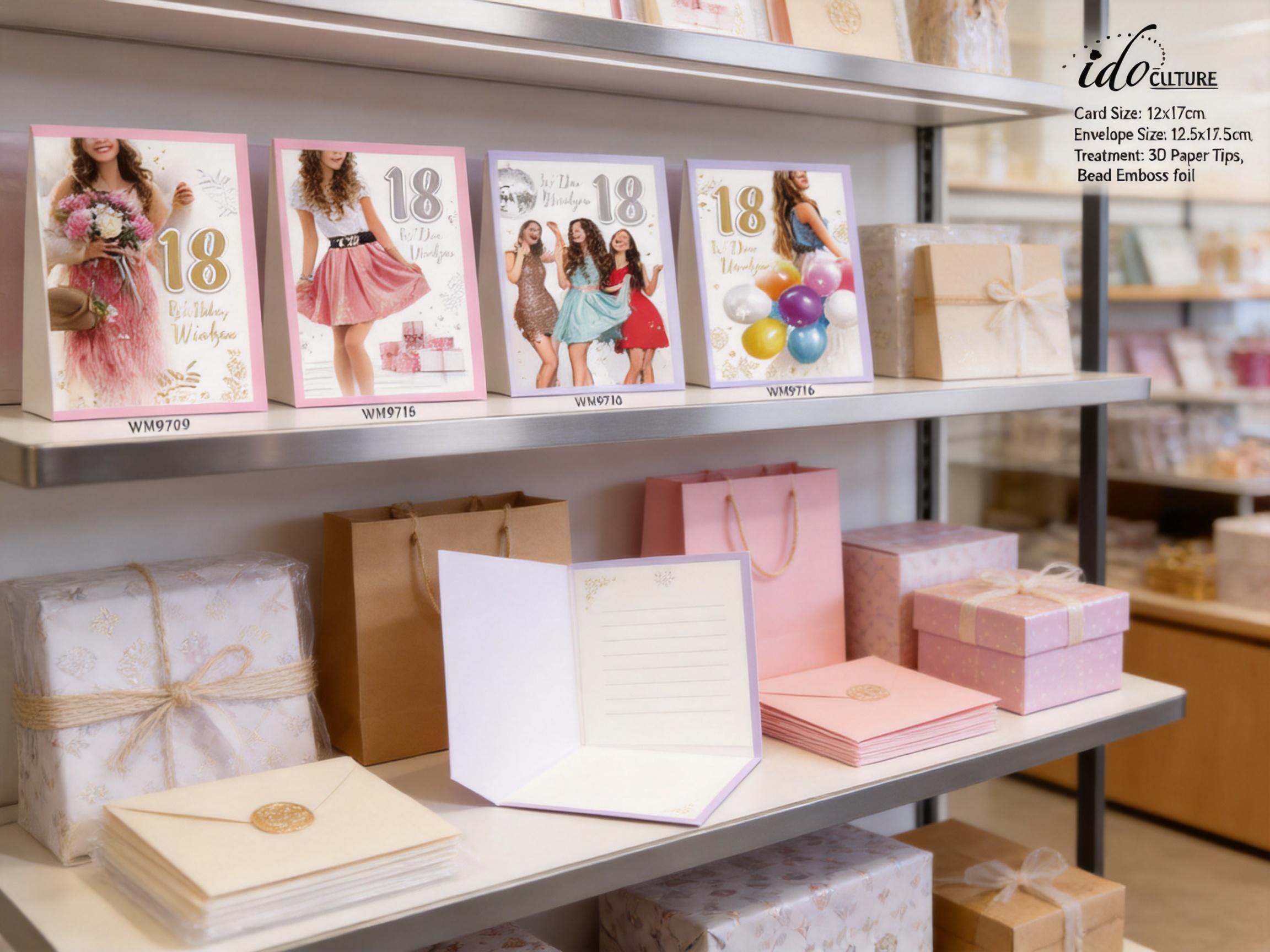
Retailers often benefit from collections that look related when displayed together. Matching dimensions, envelope proportions, paper quality, and finishing standards can give a range a unified appearance. Different birthday ages or recipient groups can then be distinguished through artwork and color while retaining a recognizable product structure.
The 12 x 17 cm card format is suitable as a foundation for such a collection. It offers a practical writing area and can be paired with a consistent envelope format. Foil, embossing, or raised paper details can be adapted to different designs without changing the fundamental usability of the product.
Brand and Store Exclusivity
Retailers and brands may also use customized greeting cards to create a more distinctive product selection. A unique design or coordinated collection can help reduce direct comparison with generic cards sold by many competitors.
Because Magic Tree provides design and prepress capabilities in addition to manufacturing, the production process can support the development of tailored products. Buyers should confirm artwork ownership, sampling procedures, minimum order requirements, packaging details, and quality standards before placing a customized order.
How to Present the Card to Customers
Product presentation should communicate both the emotional purpose and the physical quality of the card. A clear retail message can mention the milestone occasion, the blank interior, the matching envelope, and the textured decorative treatment.
For physical stores, the card can be displayed at eye level or grouped with other eighteenth birthday products. Placing it near gift bags, small gifts, jewelry, personal accessories, or keepsake items can encourage customers to complete their purchase with a card.
For online listings, images should show the front design, the opened interior, the envelope, and close details of the finish. The product copy can explain the 12 x 17 cm card size and 12.5 x 17.5 cm envelope size. It should also make clear that the interior provides space for a personal handwritten message.
Packaging should protect the decorative face while allowing customers to understand the product. If the card is sold in a protective sleeve or retail pack, the packaging should not obscure important features or create excessive glare that makes the foil difficult to appreciate.
Suggested Customer Positioning
The card can be positioned as a thoughtful milestone birthday card, a premium textured greeting card, or a keepsake-style paper gift. Each position emphasizes a different benefit:
A milestone birthday card highlights the significance of turning eighteen and the suitability of the design for the occasion.
A premium textured greeting card emphasizes the 3D paper tips, bead embossing, foil, and tactile surface.
A keepsake-style paper gift focuses on the blank message area and the possibility of preserving the card in a memory box or personal collection.
These descriptions can be used separately or together depending on the retailer’s audience. The most persuasive presentation will connect the physical features to the emotional purpose of the product.
Care, Storage, and Handling
Greeting cards with dimensional and reflective finishes should be stored in a clean, dry environment away from excessive pressure. Stacking should be managed so that raised details are not compressed for long periods. During retail handling, cards should be kept upright or placed in protective compartments where possible.
The envelope should be stored with the corresponding card to prevent mismatching or loss. If cards are sold individually, clear organization can help staff and customers identify the correct envelope quickly.
For shipment, protective inner packaging can reduce bending and surface abrasion. Cartons should not be overloaded, and heavier products should not be placed directly on top of delicate finished cards. These practices are straightforward but important for preserving the presentation that makes the product more distinctive than a basic flat card.
Q&A: Common Questions About the 18th Birthday Greeting Card
What are the dimensions of the card?
The card measures 12 x 17 cm. This format is large enough for a meaningful handwritten message while remaining easy to hold, store, display, and include with a gift.
What size is the matching envelope?
The matching envelope measures 12.5 x 17.5 cm. Its slightly larger dimensions allow the card to be inserted and removed comfortably while maintaining a coordinated presentation.
Is the inside of the card blank?
Yes. The interior provides blank space for a personal note. The sender can write a short birthday wish, a longer message, a joke, a memory, or an encouraging note about the recipient’s future.
What decorative treatments does the card use?
The listed treatments are 3D paper tips, bead embossing, and foil. Together, these techniques create raised texture, visual depth, and reflective accents that distinguish the card from a standard flat printed design.
Who is this card intended for?
The product is designed for an eighteenth birthday celebration for a girl. Its gentle and textured style can suit messages from parents, relatives, friends, classmates, colleagues, or other people who want to recognize this important milestone.
Can the card be used with a gift?
Yes. Its practical size makes it suitable for use with a gift bag, gift box, wrapped present, or small personal gift. It can also be placed into a memory box after the birthday.
How is this card different from a basic greeting card?
The main differences are its tactile finishing, dimensional paper details, bead embossing, foil accents, matching envelope, and keepsake potential. It offers more sensory and visual interest than a simple flat card while remaining easier to handle than many oversized or mechanically complex designs.
Can retailers include it in a broader stationery collection?
Yes. The format can be displayed with birthday cards, gift bags, gift boxes, wrapping paper, and other paper-gifting products. The manufacturer’s broader capabilities may also support related or customized paper products for coordinated collections.
What manufacturing capabilities support this product?
The company provides in-house design and prepress, printing, laminating, hot stamping, creasing, bag making, and manual finishing. It operates its own factory and manages production from raw materials through finished products.
Does the manufacturer provide customized paper products?
Magic Tree specializes in customized paper packaging solutions and manufactures products including paper bags, gift bags, gift boxes, greeting cards, and patterned wrapping paper. Buyers interested in customized versions should confirm artwork, materials, finishing, packaging, order quantities, and production requirements with the manufacturer.
What should buyers check before ordering?
Buyers should confirm the paper specification, card and envelope dimensions, decorative treatments, artwork requirements, sampling process, packaging, quality inspection, order quantity, production schedule, and shipping arrangements. For eco-conscious ranges, they should also request clear information about materials and applicable environmental standards.
Conclusion
The 18th Birthday Greeting Card for a Girl combines a practical format with decorative finishing suited to a significant personal occasion. Its 12 x 17 cm size provides a comfortable writing area, while the 12.5 x 17.5 cm matching envelope completes the presentation. The blank interior gives the sender freedom to create a message that is specific to the recipient and the relationship.
Its strongest competitive advantage is the balance between tactile quality and everyday usability. Three-dimensional paper tips, bead embossing, and foil accents create a more memorable surface than a basic flat card, yet the product remains compact, easy to package, and simple to include with a present. The gentle textured direction also allows the card to appeal to a broad range of customers without appearing overly childish or excessively formal.
Behind the product is a manufacturer with nearly thirty years of paper-product experience, in-house design and prepress capabilities, multiple printing and finishing processes, manual finishing expertise, and factory control from raw materials to completed goods. These strengths are relevant to retailers, wholesalers, and brands that value consistent production and the possibility of building coordinated paper-gifting collections.
For a milestone birthday, the card offers more than a place to write a greeting. It provides a carefully finished paper object that can be displayed, included with a gift, and preserved as a personal reminder. For the trade, it offers a practical and differentiated product suited to modern gift, stationery, and paper packaging ranges.
References
1. Product specification sheet for the 18th Birthday Greeting Card for a Girl, including card dimensions, envelope dimensions, and listed finishing treatments.
2. Company information supplied by Yiwu Magic Tree Gift Bag Co., Ltd., including company history, product categories, manufacturing capabilities, and international service markets.
3. General principles of greeting card design, paper handling, folding, embossing, foil application, and printed product finishing.
4. General retail merchandising practices for greeting cards, gift packaging, stationery collections, and milestone celebration products.
5. General considerations for paper-product quality control, protective packaging, material selection, and eco-conscious product development.