中文简体
 русский
 Français
 Español
 Deutsch
 عربى

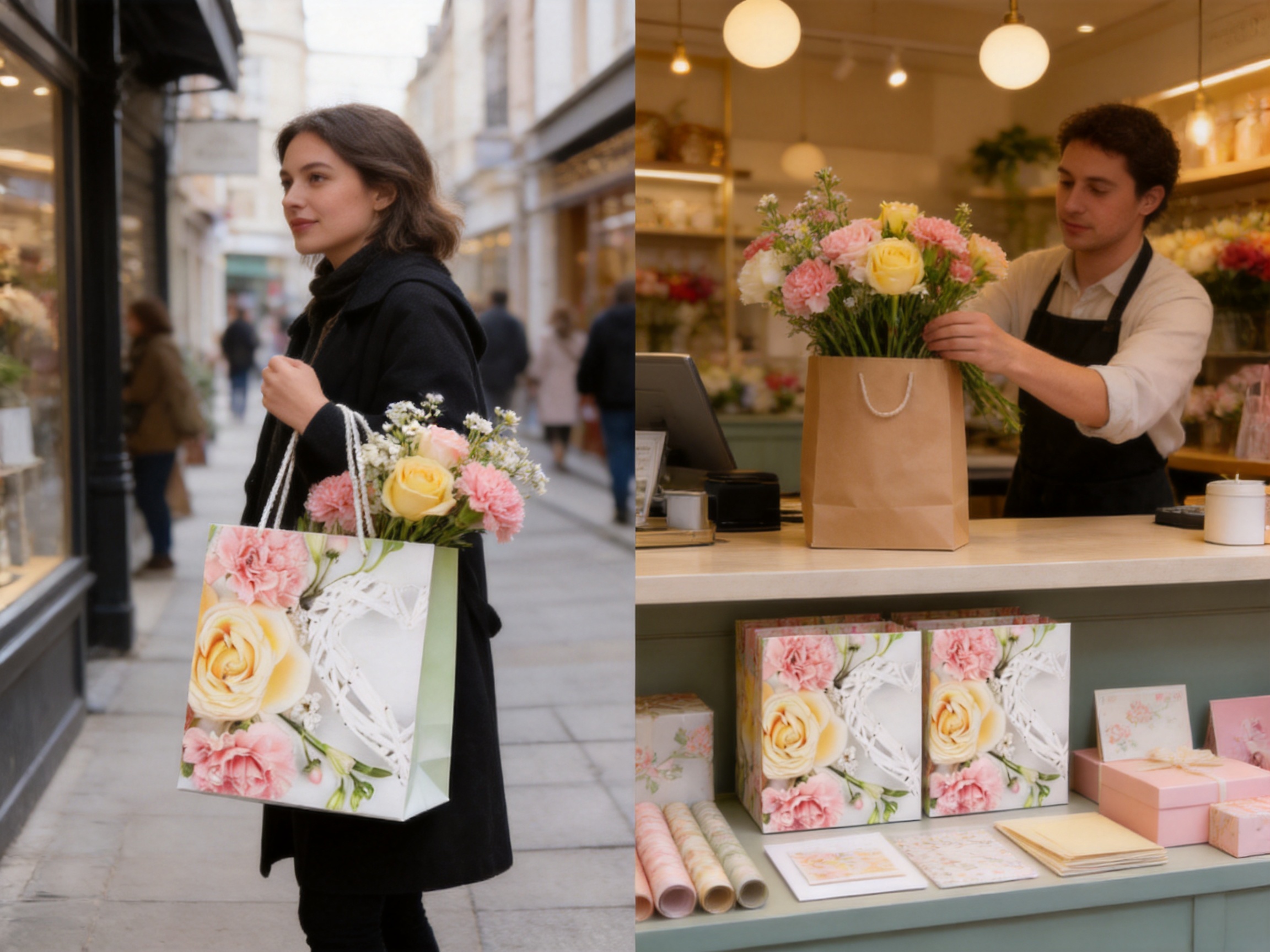
Custom paper gift bags occupy an important place between practical packaging and brand presentation. They protect products during short-distance carrying, provide a convenient way to present gifts, and create an immediate visual impression before the package is opened. When a bag combines a carefully selected paper grade, a suitable handle, a well-planned floral pattern, and an exclusive logo, it becomes more than a simple carrier. It becomes part of the customer experience.
Paper gift bags are used by retailers, boutiques, florists, beauty brands, fashion stores, food businesses, event organizers, hotels, corporate gift suppliers, and many other industries. Their appeal comes from their flexibility. A small bag can hold a lightweight accessory or greeting card, while a larger and more structurally reinforced version can carry a heavier boxed product. The outer design can remain understated with a single logo, or it can use a full floral layout that covers most of the visible surface.
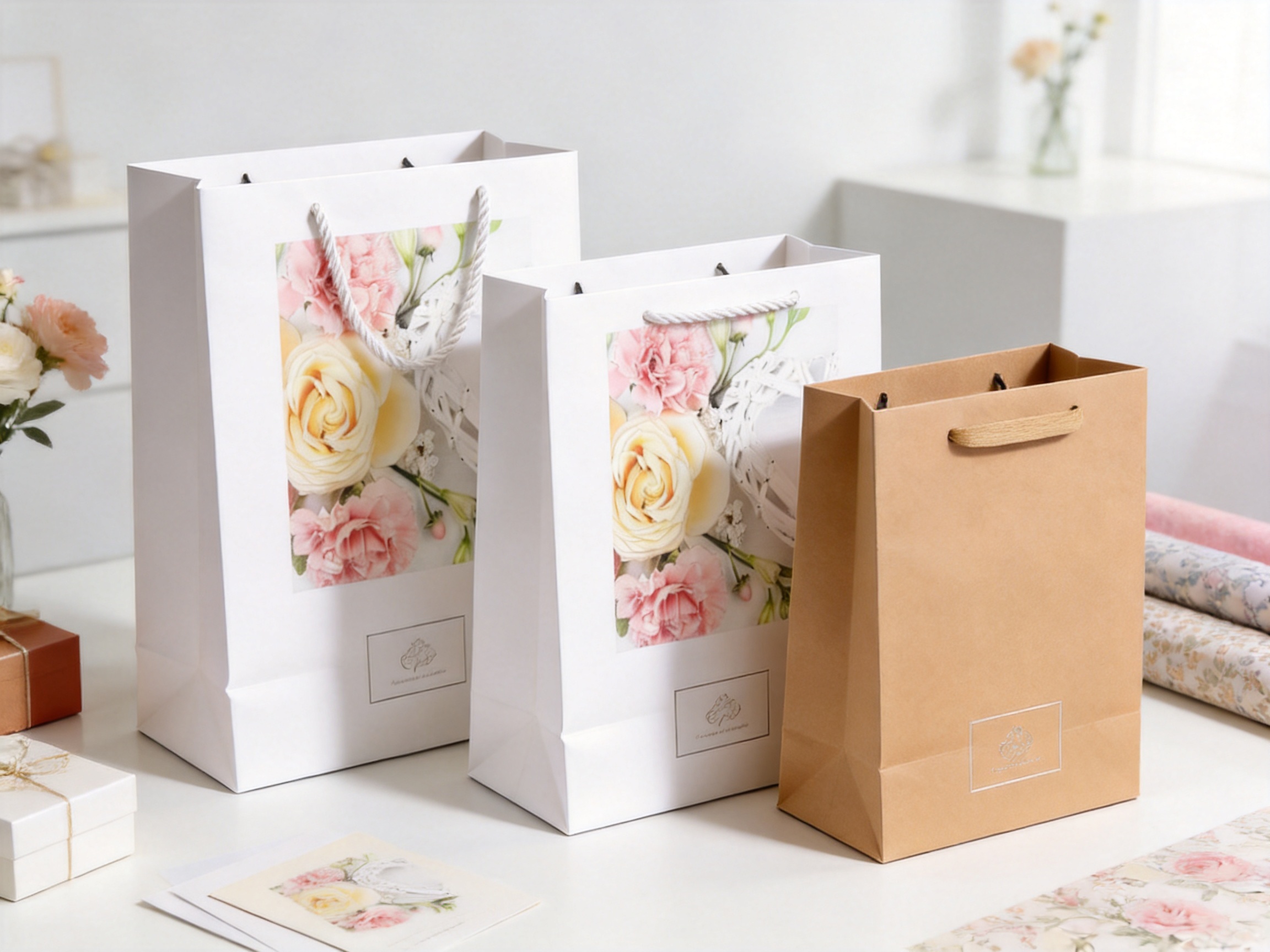
This product is designed for buyers who need packaging that balances appearance, usability, customization, and production reliability. The structure can be adjusted according to the contents. Thicker paper is appropriate for heavier items and applications that require a stronger body, while lighter paper may be suitable for lightweight products and short-distance carrying. Twisted paper handles offer a familiar retail appearance, while flat handles provide another practical carrying option.
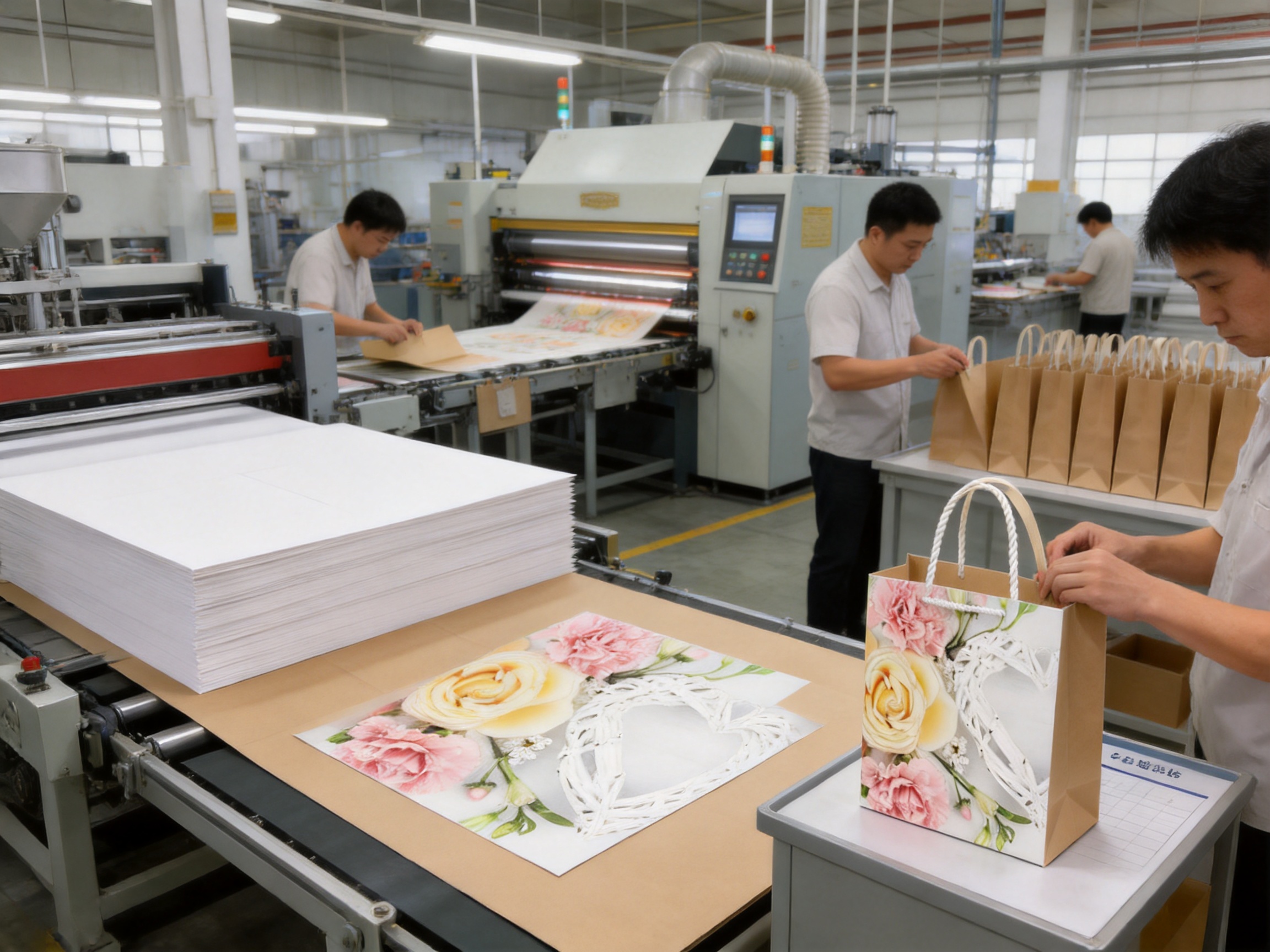
Behind the finished bag is a coordinated manufacturing process. Paper selection, artwork preparation, printing, surface treatment, creasing, folding, bag making, handle installation, and manual finishing all influence the quality of the final product. A capable manufacturer must control these stages as one connected workflow rather than treating them as separate tasks.
Why Custom Paper Gift Bags Continue to Matter
Packaging is often the first physical contact a customer has with a product after purchase. A carefully designed paper bag can communicate the character of a business before the product itself is viewed. Floral artwork may suggest elegance, freshness, celebration, or natural inspiration. A clean logo may emphasize simplicity and brand recognition. A more detailed pattern can turn the packaging into a memorable visual element that customers are willing to carry in public.
Unlike anonymous stock packaging, custom gift bags allow a business to control the relationship between packaging and brand identity. The logo, color palette, artwork, paper finish, handle style, and overall proportions can be considered together. This creates a more consistent presentation across stores, promotional events, seasonal campaigns, and gift-giving occasions.
Paper also provides a flexible surface for printing and finishing. White cardboard can support bright colors and clean graphic details. Coated paper can create a smooth, polished appearance. Kraft paper can provide a more natural visual direction and may support packaging programs that emphasize an eco-conscious image, depending on the actual paper grade, coatings, inks, and disposal conditions selected for the project.
For buyers, the value of a custom bag is not limited to decoration. The bag must also be practical. It needs to stand or hold its shape appropriately, support the intended product weight, remain comfortable to carry, and arrive with consistent folding and printing. A visually attractive bag that tears easily or has poorly attached handles does not provide a satisfactory customer experience. The best results come from treating appearance and performance as equally important.
Product Overview
Custom paper gift bags with floral patterns and exclusive logo printing are made for businesses that want branded packaging with a decorative appearance. The design can be developed around a company logo, a seasonal campaign, a product collection, or a broader visual identity. Floral patterns may be used as a subtle border, a repeated background, a centered illustration, or a full-surface composition.
The product can be adjusted in several ways to suit different applications. The paper weight and structure can be selected according to the expected contents. The printed area can be limited to the logo or expanded across the front, back, gusset, and other visible panels. Handle construction can be selected according to the desired appearance and carrying requirements. The finishing approach can also be coordinated with the artwork and paper surface.
Because different industries have different packaging needs, there is no single design that is ideal for every buyer. A florist may want soft floral artwork and a refined finish. A clothing boutique may prefer a structured bag with a high-contrast logo. A gift shop may use colorful patterns for seasonal collections. A corporate buyer may choose a restrained layout with a small logo and a professional color scheme. Custom production allows these directions to be developed within one product category.
Paper Selection
Paper is one of the most important decisions in the development of a gift bag. It affects stiffness, appearance, folding behavior, print quality, carrying performance, and the overall impression of the package.
White cardboard is suitable for designs that require a clean background and clear color reproduction. Its surface can help logos, illustrations, and floral graphics appear crisp and defined. It is often considered when a brand wants a bright, organized, and contemporary appearance.
Coated paper provides a smoother surface that can support a polished visual effect. It may be appropriate for detailed patterns, refined retail packaging, and designs where image clarity is a priority. The final appearance still depends on the chosen coating, printing method, ink, and artwork, so the material should be evaluated as part of the entire specification rather than in isolation.
Kraft paper offers a different visual direction. Its natural tone can support simple artwork, botanical concepts, handmade products, and packaging programs that seek a less formal appearance. Kraft paper can also be combined with selected printing treatments to create contrast between the natural base and the custom logo or floral design.
Thicker paper is generally more suitable when the bag must carry heavier products or maintain a more substantial structure. Lighter paper may be suitable for lightweight products, event distribution, or short-distance carrying where a lower material weight is appropriate. The correct selection should be based on the actual contents, expected handling, bag dimensions, handle construction, and desired appearance.
Floral Pattern Design
Floral patterns are versatile because they can communicate several different moods. Fine botanical lines may create a delicate and premium appearance. Large flowers in bold colors can make the bag more noticeable in a retail environment. Repeated small motifs can provide a balanced background that does not overwhelm the logo. A single floral illustration can function as a focal point for a limited-edition or seasonal package.
Pattern placement should be planned around the shape of the bag. The front panel usually provides the clearest area for a central logo or primary graphic. Side gussets can extend the visual system, but artwork must be prepared with folds and creases in mind. A pattern that crosses a fold may need careful alignment to avoid an unintended interruption. Important logo elements should be kept away from areas that may be covered, folded, or affected by handle installation.
Color selection is equally important. A floral design should support the logo rather than compete with it. A quiet pattern may be used behind a strong logo, while a more expressive pattern may work best with a smaller and simpler mark. A manufacturer with in-house design and prepress capability can help prepare artwork for the physical structure, including safe areas, bleed requirements, panel alignment, and print suitability.
Exclusive Logo Printing
A logo gives the bag a clear point of brand ownership. It can be printed alone for a clean and flexible design, or integrated into a larger floral composition. Logo size, placement, color contrast, and repetition should be considered carefully. The goal is not always to make the logo as large as possible. In many cases, a well-positioned mark with sufficient visual space appears more professional and is easier to recognize.
For businesses with multiple product lines, the bag can serve as a consistent packaging platform. The base structure may remain similar while the floral pattern, accent color, or product-specific mark changes. This approach can help a company maintain brand consistency while creating visual variety for different seasons or collections.
Printing performance depends on the paper surface, artwork resolution, color requirements, and selected production process. Prepress preparation is therefore essential. Files should be reviewed for image quality, color mode, text outlines, panel positioning, and the relationship between printed artwork and physical creases. Proper preparation reduces the likelihood of blurred details, shifted graphics, or unexpected positioning on the finished bag.

Custom Paper Gift Bags with Floral Patterns and Your Exclusive Logo
Advantages Compared with Generic and Competing Packaging Options
Custom paper gift bags compete with several alternatives, including plain stock bags, plastic carrier bags, unprinted paper bags, and packaging produced without coordinated structural and printing control. Each option may be suitable in a particular situation, but a custom paper gift bag offers several advantages for brands that care about presentation and consistency.
Stronger Brand Visibility
A plain bag may perform the basic function of carrying an item, but it does not provide the same opportunity for brand communication. A custom logo and floral design can make the package identifiable in a store, at an event, or while being carried away by a customer. This additional visibility can help a business create a more complete experience around the sale.
Printed bags may also support repeated exposure. Customers can reuse a durable bag for shopping, storage, or gift-giving. When the design is attractive and the structure remains useful, the packaging may continue to display the logo after the original purchase. The practical value of reuse depends on the paper grade, construction, handling conditions, and customer behavior, but a well-designed bag has more potential for a second life than disposable anonymous packaging.
More Flexible Design Than Standard Stock Bags
Stock bags are usually available in a limited range of colors, sizes, and handle options. Custom production provides more room to coordinate the bag with a brand identity. A business can select a floral pattern that reflects its market position, choose a paper appearance that matches its products, and place its logo where it will be most visible.
This flexibility is particularly useful for seasonal campaigns. Spring collections may use fresh botanical artwork, wedding-related products may use refined floral details, and holiday gift programs may combine flowers with seasonal colors. The packaging can be updated without changing the company’s entire visual identity.
Better Alignment Between Structure and Contents
A generic bag may be too light for a heavier product or unnecessarily rigid for a small and lightweight item. Custom development allows the structure to be considered in relation to the contents. Paper thickness, bag proportions, bottom construction, handle style, and reinforcement requirements can be discussed before production.
This does not mean that every custom bag is automatically stronger than every stock bag. Performance depends on the selected specification and manufacturing quality. The advantage is that the buyer has a greater opportunity to choose a specification that matches actual use rather than accepting a one-size-fits-all option.
More Consistent Retail Presentation
For businesses operating several stores or selling through multiple channels, consistent packaging can support a unified presentation. A centralized manufacturing process helps ensure that bags produced for different orders follow the same approved artwork and construction requirements. This is especially valuable when the package is part of a larger branded environment involving boxes, greeting cards, wrapping paper, labels, and other printed materials.
Paper-Based Presentation for Eco-Conscious Programs
Paper packaging is often selected by businesses seeking an alternative to plastic-based carrier bags or a more natural visual direction. White cardboard, coated paper, and kraft paper each offer different design and performance characteristics. Some paper grades may be available with eco-friendly considerations, but buyers should confirm the exact material composition, coatings, inks, certifications, and end-of-life requirements before making specific environmental claims.
A responsible packaging decision considers the complete product life cycle. Material sourcing, production efficiency, shipping volume, durability, reuse potential, and local recycling systems all influence the environmental profile. Choosing paper does not eliminate the need for careful evaluation, but it gives brands a flexible platform for developing packaging that aligns with many sustainability-focused communication strategies.
Manufacturing Process and Quality Control
The quality of a paper gift bag is created through multiple connected stages. A professional factory must manage both the visual and mechanical aspects of production. Printing alone cannot compensate for inaccurate creasing, weak handle attachment, or poor folding. Similarly, a strong structure cannot deliver a premium result if the logo is misaligned or the floral pattern is inconsistent.
1. Requirement Review and Product Planning
Production begins with understanding the intended use. The manufacturer reviews the bag category, approximate dimensions, paper preference, expected contents, carrying distance, handle style, artwork requirements, finishing options, order quantity, and delivery expectations. This stage helps identify potential conflicts before materials are purchased or machines are prepared.
The contents are especially important. A lightweight scarf, a boxed cosmetic product, a book, and a collection of small gifts place different demands on the bag. The manufacturer can use this information to recommend a suitable paper grade and construction direction. Buyers should provide as much practical information as possible, including the approximate weight and shape of the items to be packed.
2. Design and Prepress Preparation
Professional design and prepress work converts a brand idea into a production-ready file. The artwork is checked for correct dimensions, panel placement, color settings, resolution, typography, and bleed. Floral elements are positioned so that they work with the physical folds of the bag. The logo is checked for clarity and appropriate scale.
Prepress is also the stage where design limitations can be addressed. Very fine lines may not reproduce effectively at a small size. Low-resolution images may appear soft. Colors may behave differently on white, coated, or kraft paper. A skilled prepress team can identify these issues and propose adjustments before mass production.
When a buyer has a finished design, the manufacturer can prepare it for the bag format. When the buyer needs design assistance, the in-house design capability can support the development of floral layouts, logo placement, and print-ready artwork. This integrated approach can reduce communication gaps between an external designer and the production floor.
3. Material Preparation
Paper is prepared according to the approved specification. The selected grade, thickness, surface, and sheet format need to be compatible with the required printing and bag-making processes. Material consistency is important because changes in paper surface or stiffness can affect color appearance, creasing, folding, and handle attachment.
Material planning also influences production efficiency. Correct sheet preparation helps reduce unnecessary waste and supports stable machine operation. A factory that manages its own production process can coordinate material usage with printing and converting requirements instead of relying entirely on disconnected suppliers.
4. Printing
The printed design is transferred to the prepared paper according to the approved artwork. The logo and floral pattern should maintain consistent positioning and appearance across the production run. Printing control includes checking registration, color consistency, coverage, smudging, and the relationship between the artwork and the later folding lines.
Simple logo printing and full-surface floral printing have different production considerations. A small logo may require precise placement and strong contrast. A full floral layout requires attention to repeat alignment, panel transitions, and the continuity of the visual pattern. Both approaches benefit from an approved sample or proof before larger-scale production.
5. Surface Treatment and Finishing
Depending on the required appearance, the paper may receive laminating, hot stamping, or another finishing treatment. Lamination can influence surface feel, visual depth, and resistance to light handling. Hot stamping can create a distinctive accent for logos or selected decorative elements. The appropriate treatment depends on the paper, design, use case, and budget.
Finishing should be selected carefully rather than added simply because it is available. A natural kraft design may work best with limited treatment, while a luxury floral bag may benefit from a more polished surface or metallic logo accent. The manufacturer can help determine whether the finish supports the intended visual message and remains compatible with later folding and bag making.
6. Creasing
Creasing creates controlled fold lines that help the paper form the intended bag structure. Accurate creasing supports cleaner corners, better panel alignment, and more consistent dimensions. If crease positions are inaccurate, the bag may appear uneven or the printed artwork may not align correctly across adjacent panels.
The paper grade and thickness influence how it responds to creasing. A heavier material may require a different setting from a lighter sheet. Proper production control helps reduce cracking, excessive deformation, and inconsistent folds, although the final result also depends on the paper surface and finish selected.
7. Bag Making
After printing, finishing, and creasing, the paper is converted into the bag form. Panels are folded and joined, the base is formed, and the structure is prepared for handle installation and final inspection. Production accuracy at this stage determines whether the bag opens properly, stands as intended, and maintains a consistent appearance from one unit to the next.
Automation can support speed and repeatability, while manual operations may be used for selected finishing steps or designs that require additional attention. The balance between machine processing and manual finishing depends on the product specification and order requirements.
8. Handle Installation
Handles are a functional and visual component. Twisted handles provide a familiar paper-bag appearance and can complement retail and gift packaging. Flat handles offer another style and may be selected for their appearance, feel, or compatibility with the overall design.
Handle attachment requires attention to position, strength, spacing, and alignment. A handle that is installed unevenly can affect the way the bag hangs and may reduce the perceived quality. The attachment area should be appropriate for the intended carrying load, and the selected paper structure should support the handle design.
9. Manual Finishing and Inspection
Manual finishing can address details that require visual judgment or careful handling. Workers may inspect folds, remove minor production debris, check handle attachment, organize units, and prepare the bags for packing. This stage is especially useful for customized products that include multiple materials, special finishes, or detailed visual requirements.
Quality inspection should cover both appearance and function. Typical checks include paper condition, print clarity, logo placement, floral pattern alignment, surface finish, crease accuracy, bag shape, handle position, and general cleanliness. Samples from the production run can be compared with the approved reference to maintain consistency.
10. Packing and Delivery Preparation
Finished bags must be packed in a way that protects them during storage and transport. Folding or stacking methods should help prevent unnecessary crushing, surface marks, moisture exposure, and handle deformation. The shipping arrangement should also consider the volume of the finished bags and the buyer’s receiving process.
Efficient delivery is supported when the factory coordinates production planning, quality inspection, and packing as one workflow. Clear order records and approved specifications help reduce the risk of shipping the wrong design, paper grade, or handle style.
Manufacturing Strengths Behind the Product
The manufacturer described in the supplied company information has a long operating history in paper packaging. The business was founded in 1996 as Fushida Plastic Factory and was rebranded in 2019 as Magic Tree Paper Products Co., Ltd. This history represents nearly three decades of experience in manufacturing and developing packaging products.
The company specializes in white cardboard, coated paper, and kraft paper products. Its product range includes paper bags, gift bags, gift boxes, greeting cards, and patterned wrapping paper. This broader product capability is relevant to buyers who want multiple paper packaging items to share related artwork, colors, and finishing treatments.
In-house capabilities include professional design and prepress, laminating, hot stamping, creasing, printing, bag making, and manual finishing. Keeping these operations within the company can simplify coordination between design and manufacturing. It also allows production teams to consider the effect of one stage on the next. For example, the selected paper and finish can be reviewed in relation to creasing and folding, while the artwork can be prepared with the final bag structure in mind.
The company operates its own factory and manages the production process from raw materials to finished products. This type of control can support more consistent communication, production scheduling, and quality management. It also gives wholesale buyers a single manufacturing partner for discussions involving paper selection, artwork, sampling, finishing, and order delivery.
The stated annual output value exceeds 50 million yuan, indicating substantial production activity and experience serving commercial orders. The company serves clients in the United States, Canada, Mexico, the United Kingdom, Japan, and China. Experience with customers in different markets can be useful when projects involve varied design preferences, packaging expectations, and communication requirements.
These strengths do not remove the need for project-specific approval. Every order should still be confirmed through an agreed specification and, where appropriate, a sample or proof. However, an established factory with integrated capabilities provides a stronger foundation for managing customized packaging than a supplier that only resells standard bags or outsources every production stage.
Application Areas
Retail Stores and Boutiques
Fashion boutiques, accessory shops, gift stores, and lifestyle retailers can use floral paper bags to create a recognizable presentation at checkout. A custom logo allows the bag to function as a visible extension of the store, while the floral design can be adjusted to match the season, product category, or store atmosphere.
Florists and Plant-Related Businesses
Floral artwork is a natural fit for flower shops, plant stores, garden-related businesses, and event florists. The design can use botanical details without copying the actual products inside the bag. A soft, elegant pattern may complement bouquets and small gifts, while a bold illustrated design can provide a more contemporary identity.
Beauty and Personal Care Brands
Cosmetics, skincare, fragrance, and personal care products are often purchased as gifts. A well-printed bag can support a premium unboxing experience and give the buyer a suitable way to present the product. Paper thickness and handle selection should be matched with the weight of boxes, bottles, and product sets.
Corporate and Event Gifting
Companies may use custom bags for conferences, employee gifts, promotional programs, product launches, or customer appreciation events. A restrained logo and coordinated floral pattern can provide a professional appearance without making the packaging feel overly commercial. For event use, the bag size and paper grade should be selected according to the materials being distributed.
Seasonal and Holiday Collections
Floral patterns can be adapted for spring promotions, weddings, birthdays, Mother’s Day campaigns, hospitality programs, and other occasions. A reusable base structure can support several artwork variations, helping a business maintain manufacturing familiarity while refreshing its visual presentation.
Gift Shops and Hospitality Businesses
Hotels, resorts, museums, specialty food stores, and destination gift shops can use custom paper bags to create a more memorable purchase experience. A logo combined with a locally appropriate or nature-inspired floral pattern can connect the packaging with the character of the business and its surroundings.
Specification Planning Guide
Before requesting production, buyers should prepare information about the intended application. Clear requirements make it easier for the manufacturer to recommend materials and provide an accurate quotation.
| Specification Area | Key Consideration | Why It Matters |
|---|---|---|
| Product contents | Weight, shape, size, and quantity of items per bag | Helps determine paper grade, structure, and handle requirements |
| Paper type | White cardboard, coated paper, kraft paper, or another approved grade | Influences appearance, stiffness, print result, and finishing compatibility |
| Artwork | Logo, floral pattern, colors, images, and panel layout | Supports accurate prepress preparation and visual consistency |
| Handle style | Twisted handle or flat handle | Affects carrying feel, appearance, and attachment requirements |
| Surface treatment | Uncoated presentation, lamination, hot stamping, or other finish | Changes the surface effect, tactile impression, and production process |
| Order quantity | Expected initial order and possible repeat volume | Supports production planning and cost evaluation |
| Delivery requirements | Destination, schedule, packing, and receiving conditions | Helps coordinate manufacturing and logistics preparation |
Buyers should also explain how the bag will be carried. Short-distance use inside a shopping center may require a different specification from bags that customers will carry outdoors or transport between locations. The more accurately the use conditions are described, the more appropriately the manufacturer can advise on paper and construction.
How to Develop a Successful Custom Order
Start with the Product Weight
The contents should be considered before the artwork. A beautiful bag is not successful if its paper and handle construction are unsuitable for the items inside. Provide the approximate total weight and identify whether the contents have sharp corners, irregular shapes, moisture, or rigid packaging that may place additional stress on the bag.
Choose the Visual Direction
Decide whether the bag should appear natural, elegant, colorful, modern, traditional, playful, or understated. Floral artwork can support many directions, but the pattern must be consistent with the product and target customer. A beauty brand may choose fine line art, while a children’s gift business may prefer brighter and more expressive flowers.
Prepare a Clear Logo
Vector artwork is generally preferable for logos because it can be scaled while maintaining clean edges. Buyers should provide the approved logo file, preferred colors, and any rules governing spacing or placement. If the logo must appear on multiple panels, the manufacturer should receive clear instructions about size and alignment.
Consider the Bag as a Three-Dimensional Object
Artwork that looks correct on a flat screen may behave differently after folding. The design should be reviewed across the front, back, side gussets, top edge, base, and handle area. Floral elements may need to be adjusted so that important details do not disappear into a fold or become hidden during carrying.
Review a Sample or Proof
A sample or proof provides an opportunity to confirm the paper appearance, color direction, logo scale, floral pattern, handle style, and general structure. It is much easier to correct a design decision before mass production than after the entire order has been completed. The approved reference should be retained for future repeat orders.
Plan for Repeat Production
If the bag will be reordered, retain the final artwork, approved paper specification, handle details, finishing requirements, and packaging instructions. A documented specification can make later orders more efficient and help maintain consistency across production periods.
Paper Packaging and Responsible Material Choices
Many buyers are interested in eco-friendly paper packaging bags because paper can provide a more natural alternative to certain plastic packaging formats. However, environmental performance should be discussed with precision. The actual result depends on the paper source, recycled content, coatings, inks, adhesives, production efficiency, shipping distance, durability, reuse, and local recycling infrastructure.
White cardboard, coated paper, and kraft paper may support different environmental and visual objectives. A buyer seeking a natural appearance may prefer kraft paper, while a buyer prioritizing bright color reproduction may choose white cardboard. Coatings and laminations can affect the way a bag is handled at end of life, so these details should be confirmed before making a recyclability statement.
Durability can also contribute to responsible use. A bag that is appropriate for its intended contents may be reused more effectively than a bag that fails after one carrying event. Correct sizing can reduce unnecessary material use, while efficient production planning may help limit waste. Responsible packaging design is therefore a balance among material choice, performance, production, transportation, and disposal.
Manufacturers and buyers should communicate environmental claims carefully and use specific evidence where claims are required. Terms such as “eco-friendly,” “recyclable,” or “sustainable” can mean different things in different markets. Confirming the exact specification helps businesses communicate more accurately to customers.
Comparison of Common Packaging Choices
Every packaging format has advantages and limitations. The following comparison explains where a custom paper gift bag may provide a particularly strong solution.
| Packaging Choice | Typical Strength | Common Limitation | Where Custom Paper Gift Bags Can Differ |
|---|---|---|---|
| Plain stock paper bag | Quick availability and simple use | Limited branding and design flexibility | Offers exclusive logo printing, floral artwork, and coordinated specifications |
| Plastic carrier bag | Light weight and resistance to some handling conditions | May not match a paper-focused brand image or premium gift presentation | Provides a paper-based visual direction with more decorative print potential |
| Unprinted paper bag | Basic paper packaging function | Little communication value for the brand | Uses the bag as a visible marketing and customer-experience element |
| Rigid gift box | Strong structure and premium presentation | May require more storage space and higher material use | Provides a lighter carrying format for many retail and gift applications |
| Generic printed bag | Some visual appeal | May not be unique to one retailer or campaign | Allows exclusive artwork, logo placement, and brand-specific floral design |
This comparison does not suggest that paper gift bags replace every other packaging format. Gift boxes remain valuable for rigid protection and luxury presentation. Plastic formats may be selected for specific moisture or handling needs. Stock bags may be appropriate for urgent or small-scale purchases. The advantage of custom paper gift bags is their balance of brand communication, flexible structure, decorative potential, and practical carrying use.
Ordering from an Experienced Factory
Working directly with an experienced manufacturer can simplify the path from concept to finished product. Instead of coordinating separate design, printing, converting, and finishing suppliers, buyers can discuss the project with a factory that manages several of these capabilities internally.
For wholesale buyers, this integrated approach may provide better visibility into the production process. The buyer can ask questions about paper selection, printing suitability, finishing, bag structure, handle options, sampling, inspection, and packing in one communication process. It also creates a clearer route for solving problems if artwork or construction needs to be adjusted.
Magic Tree’s stated capabilities cover design and prepress, laminating, hot stamping, creasing, printing, bag making, and manual finishing. Its own factory manages production from raw materials through finished products. This combination is particularly relevant for customized paper packaging because the quality of the finished bag depends on coordination across all of these steps.
The company’s product range also extends beyond gift bags to gift boxes, greeting cards, and patterned wrapping paper. Buyers developing a complete gift packaging program may benefit from discussing related products with the same manufacturer. Coordinated materials and artwork can help create a consistent presentation across the full packaging set.
International service experience is another consideration for wholesale customers. The company reports serving customers in the United States, Canada, Mexico, the United Kingdom, Japan, and China. Buyers should still confirm current export arrangements, production schedules, documentation, and delivery terms for each project, but an established international customer base indicates familiarity with serving varied markets.
Quality Expectations for Wholesale Buyers
Wholesale buyers should establish quality expectations before production begins. The approved specification should identify the paper type, artwork, print colors, bag dimensions, handle style, finishing, packaging method, and acceptable tolerances. A reference sample can provide a useful visual and structural standard.
Inspection should not focus only on printing. A complete review includes the physical shape of the bag, the accuracy of folds, the condition of the paper, the consistency of the floral pattern, logo placement, handle attachment, surface finish, and cleanliness. If the bag is intended for a heavier product, practical carrying tests may also be appropriate.
Repeat orders should be compared with the approved version. Paper batches and production conditions can create minor visual variation, so buyers should communicate which features are critical and which variations are acceptable. Clear documentation helps the manufacturer maintain consistency and helps the buyer evaluate the shipment objectively.
Frequently Asked Questions
What makes these bags different from standard paper gift bags?
They are developed around the buyer’s selected paper, artwork, logo, floral pattern, handle style, and intended use. Rather than accepting a standard design, the buyer can coordinate the bag’s visual appearance and structure with the brand and the products being carried.
Can the bag carry heavy products?
The structure can be adjusted for heavier products by considering paper thickness, bag dimensions, base construction, handle selection, and attachment details. The manufacturer should receive information about the approximate contents and total carrying weight before recommending the final specification.
Can I use only my logo without a floral pattern?
Yes. Printing can remain simple with only an exclusive logo, or it can expand into a floral layout covering more of the surface. The choice depends on the desired brand image, campaign design, and budget.
What handle styles are available?
The supplied product information identifies twisted handles and flat handles as available options. The best choice depends on the bag’s appearance, the expected carrying use, and compatibility with the selected structure.
Which paper is best for a premium appearance?
There is no single answer for every project. White cardboard can provide a clean and bright base, coated paper can support a smooth and polished appearance, and selected kraft papers can create a natural and distinctive look. The final decision should consider artwork, product weight, finishing, and brand direction.
Can the floral design cover the entire bag?
Yes. Floral artwork can be limited to one panel, used as a repeated pattern, or extended across most of the visible surface. The design should be prepared with folds, gussets, creases, and handle placement in mind.
Can the packaging be described as eco-friendly?
Paper packaging may support an eco-conscious packaging strategy, but the exact claim depends on the selected paper, coatings, inks, adhesives, production process, and disposal conditions. Buyers should confirm the detailed material specification before using environmental claims in marketing.
Does the factory provide design assistance?
The company information states that in-house professional design and prepress capabilities are available. Buyers can provide existing artwork for production preparation or discuss design development for logos, floral patterns, and panel layouts.
What finishing options can be considered?
The stated in-house capabilities include laminating and hot stamping, along with printing, creasing, bag making, and manual finishing. The appropriate finish depends on the paper, artwork, desired surface effect, and use conditions.
Can matching gift boxes or cards be produced?
The company specializes in paper bags, gift bags, gift boxes, greeting cards, and patterned wrapping paper. Buyers seeking a coordinated packaging collection can discuss whether related products can use matching artwork, colors, and finishing treatments.
What should be supplied when requesting a quotation?
Useful information includes the intended contents, approximate weight, bag size, paper preference, logo file, floral artwork or design direction, handle style, finishing requirements, order quantity, destination, and requested delivery schedule. Clear information helps the factory evaluate the project more accurately.
Why is a sample important?
A sample helps confirm the paper appearance, bag structure, artwork placement, color direction, handle style, and finishing before mass production. It also gives the buyer and manufacturer a shared reference for quality inspection.
Conclusion
Custom paper gift bags with floral patterns and exclusive logo printing provide a practical way to combine carrying function with brand presentation. Their main advantage is flexibility. The paper can be selected according to the contents and desired appearance. The artwork can range from a simple logo to a full floral composition. Handles can be chosen for different visual and carrying preferences. The bag can be developed for retail sales, gifts, events, hospitality, seasonal promotions, and many other applications.
Compared with plain or generic packaging, a custom bag creates more opportunities for recognition, visual consistency, and customer engagement. Compared with rigid gift packaging, it can offer a lighter and more convenient format for many everyday retail situations. Its performance depends on correct specification, so paper weight, structure, handle attachment, and expected use must be considered together.
The manufacturing partner is equally important. An experienced factory with in-house design, prepress, printing, laminating, hot stamping, creasing, bag making, and manual finishing can coordinate the stages that determine the final result. Magic Tree has operated in the paper packaging field for nearly three decades, maintains its own factory, serves customers in several international markets, and produces related paper products including gift boxes, greeting cards, and patterned wrapping paper.
For wholesale buyers, the most reliable approach is to begin with a clear product brief, review the paper and structure, approve the artwork and sample, and document the final specification for production and repeat orders. When these steps are managed carefully, a floral paper gift bag can become a useful packaging product, a recognizable brand carrier, and a polished part of the customer’s gift-giving experience.
References
1. Company-provided product information for custom paper gift bags with floral patterns and exclusive logo printing.
2. Company-provided manufacturing profile describing paper materials, in-house processes, product categories, factory operations, and international markets served.
3. General packaging design principles concerning paper selection, structural suitability, printing preparation, creasing, handle attachment, and quality inspection.
4. General responsible packaging principles concerning material selection, durability, reuse potential, recycling conditions, and accurate environmental communication.
5. General retail packaging practices concerning brand presentation, seasonal artwork, customer carrying experience, and coordinated paper packaging systems.