中文简体
 русский
 Français
 Español
 Deutsch
 عربى


Introduction
Packaging plays an important role in how a product is carried, presented, protected, and remembered. For retailers, event organizers, gift suppliers, food shops, boutiques, and promotional businesses, a paper bag is often more than a simple container. It can provide convenient carrying performance, communicate a brand message, support a seasonal campaign, and contribute to a more responsible packaging strategy. Custom kraft paper gift bags with handles meet these needs through a combination of practical construction, printable surfaces, flexible customization, and efficient production.
Cheap kraft paper bags are widely used in daily commercial packaging because they offer a straightforward balance between cost and function. They are suitable for businesses that need dependable packaging in regular quantities without selecting overly complex materials or decorative structures. The natural appearance of kraft paper also gives the bag a familiar, approachable character. Depending on the required design, the surface can display a logo, product information, a short greeting, seasonal artwork, or other printed content.
The addition of handles improves the user experience. A handled bag can be picked up quickly, carried through shopping areas, transported from a retail counter to a vehicle, or used to present a gift. When the bag is correctly designed and manufactured, its size, paper weight, handle attachment, folding structure, and bottom construction work together to support everyday use.
Custom printed kraft paper bags manufactured by Yiwu Magic Tree Gift Bag Co., Ltd. are positioned for wholesale buyers and businesses that need practical paper packaging with design flexibility. The company produces paper bags, gift bags, gift boxes, greeting cards, and patterned wrapping paper. Its capabilities include design and prepress, printing, laminating, hot stamping, creasing, bag making, and manual finishing. This combination allows customers to coordinate several packaging elements through one experienced paper-products manufacturer.
This article examines the construction, applications, customization options, production process, quality considerations, and competitive advantages of printed kraft paper gift bags with handles. It also explains how a factory-managed supply chain can support wholesale customers seeking consistent output, flexible order sizes, and dependable service.

Cheap Kraft Paper Bags Carrying Gift Bag Print with Handles China
What Are Kraft Paper Gift Bags with Handles?
Kraft paper gift bags are paper carriers made from kraft stock selected for its useful combination of strength, printability, recognizable texture, and economical pricing. The term “kraft” generally refers to paper produced through a process that preserves strong cellulose fibers. The resulting paper may be brown and natural in appearance or processed into a lighter, brighter grade depending on the desired visual effect and performance requirements.
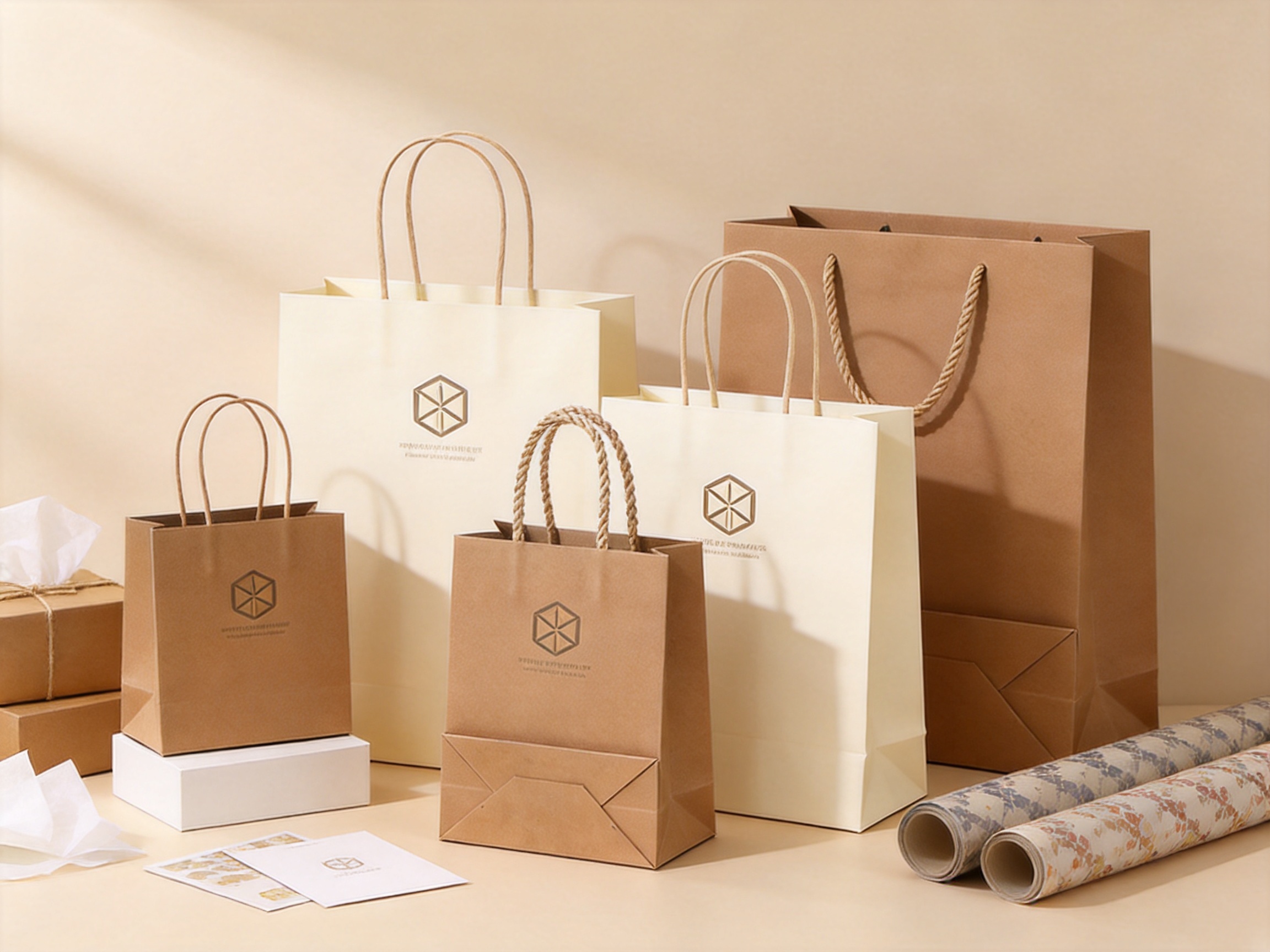
A typical handled gift bag includes a front panel, back panel, side gussets, a top opening, a folded bottom, and two handles. The handles may be made from twisted paper cord, flat paper, cotton-style rope, ribbon, or another suitable material. The selection depends on the bag’s size, intended load, appearance, budget, and retail environment. A simple paper handle may be appropriate for everyday shopping, while a decorative cord or ribbon handle can create a more elevated presentation for gift packaging.
Unlike an ordinary shipping carton, a gift bag is intended to be visible during use. Its exterior surface therefore has both a functional and communication role. A plain kraft bag can reinforce a natural or handmade design language. A printed bag can support a retail identity or promotional campaign. A bag with color printing and finishing effects can be coordinated with gift boxes, greeting cards, wrapping paper, labels, and other products.
The product can be manufactured in different proportions. Small bags may hold jewelry, cosmetics, candles, accessories, or small promotional items. Medium sizes are suitable for clothing, books, packaged foods, personal-care products, and general retail purchases. Larger formats may be used for apparel, multiple gift items, event materials, or product bundles. The correct dimensions should be selected according to the product’s width, height, depth, weight, and the amount of space needed for easy insertion and removal.
Why Kraft Paper Is a Practical Packaging Material
Natural appearance and broad market appeal
Kraft paper has a familiar visual identity that works across many product categories. Its natural brown appearance can suggest simplicity, craft, freshness, or environmental awareness. This makes it especially useful for independent shops, cafés, bakeries, handmade-product businesses, clothing retailers, gift stores, and lifestyle brands. The material does not require an elaborate graphic treatment to look presentable, which can help businesses create an attractive package with a relatively simple design.
White kraft and other light-colored paper grades offer a cleaner base for bright graphics and detailed images. Brown kraft, on the other hand, can provide a warm background for dark ink, one-color logos, line illustrations, or minimalist typography. The choice between natural and lighter paper depends on the visual identity of the product and the printing result required.
Useful strength for daily retail handling
Kraft paper is commonly selected for bags because it can provide suitable resistance to ordinary carrying and handling when the paper weight and construction are correctly matched to the product. Performance depends on multiple factors, including paper grade, thickness, bag dimensions, gusset width, bottom design, handle material, handle reinforcement, and adhesive quality. A responsible specification considers the complete bag rather than relying on paper weight alone.
For most retail applications, the bag does not need to function as a heavy-duty industrial container. It needs to carry the intended product from a store, counter, event, or delivery point to the customer’s next destination. This makes kraft paper an efficient choice for everyday packaging where practical performance and presentable appearance are both important.
Recyclability and material perception
Many buyers choose paper packaging because paper is widely recognized as a recyclable material when it is clean and accepted by local recycling systems. Kraft paper can also be reused by customers for light carrying, storage, or gift presentation. The exact environmental performance of a finished bag depends on the paper source, inks, coatings, laminations, adhesives, finishing treatments, local collection systems, and the way the consumer disposes of the product.
For this reason, businesses should avoid making broad environmental claims without confirming the specifications. A bag described as recyclable should be evaluated as a complete product, including any film lamination, foil treatment, metallic decoration, or mixed-material handle. Clear material communication helps buyers make appropriate claims and supports more responsible packaging decisions.
Product Advantages Compared with Basic Competitor Bags
More adaptable than unprinted commodity bags
Unprinted commodity bags may be inexpensive, but they provide little opportunity for communication or brand recognition. A custom printed kraft bag allows a business to place its identity directly in the customer’s hands. The printed surface can include a company name, logo, slogan, website text, product category, event message, seasonal greeting, or illustration. Even a small design element can make a basic package feel more intentional and professional.
Compared with generic bags purchased from an unrelated stock assortment, a custom product can be developed around the actual requirements of the buyer. Dimensions, paper color, handle style, printing coverage, and finishing can be coordinated instead of selected independently. This is particularly valuable for brands that want packaging to look consistent across stores, product lines, or marketing campaigns.
More presentable than thin single-use carriers
Very thin plastic or low-grade paper carriers may perform adequately for a single short trip, but they can appear less suitable for gift presentation and may offer limited opportunities for premium design. A kraft paper gift bag creates a more structured and visible package. Its side gussets and folded base can give the bag a defined shape, while the handles make it easier to carry and display.
The bag can also become part of the gift experience. Customers may reuse it for another gift, carry personal items in it, or keep it for storage. A well-designed printed surface can extend the practical and promotional life of the packaging beyond the original purchase.
More cost-conscious than complex rigid packaging
Rigid gift boxes can provide an upscale appearance, but they may require more material, occupy more storage space, and involve higher production and shipping costs. A handled kraft paper bag can provide a polished presentation with a simpler structure. For businesses that need large quantities or frequent seasonal replenishment, this may create a useful balance between appearance, usability, and budget.
Paper bags are also often easier to store flat before assembly or use. This can support more efficient warehouse management compared with fully formed rigid packaging. The final logistics benefit depends on the bag design, carton packing method, order volume, and shipping conditions, but flat or semi-flat packaging is generally practical for wholesale supply.
More flexible than one-format packaging
Custom kraft bags can be developed in multiple sizes and styles for different products. A supplier with broader paper-converting capabilities can also help customers coordinate bags with gift boxes, greeting cards, and wrapping paper. This makes it easier to build a complete packaging family rather than relying on unrelated products from multiple sources.
One manufacturer can manage shared colors, matching artwork, consistent paper selections, and related finishing requirements across several product types. This can reduce communication complexity and help maintain a unified appearance throughout a retail or gift-presentation program.
Key Construction Features
Paper selection
Paper selection should begin with the intended use. Lightweight paper may be suitable for small items, event handouts, or low-load applications. Medium-weight paper can serve general retail and gift packaging. Heavier paper may be selected when the bag must support larger or denser products, although a heavier grade alone does not guarantee better performance.
The paper’s surface, color, grain direction, folding behavior, printability, and compatibility with adhesives should also be considered. Natural kraft paper can create an organic appearance, while coated or smoother stock may support sharper graphics. The most appropriate grade is determined by the complete combination of design, product weight, appearance, and production method.
Handle design
Handles influence both carrying comfort and visual style. Twisted paper handles are widely used because they can coordinate naturally with kraft paper. Flat paper handles may offer a clean and economical appearance. Rope, ribbon, or decorative cord handles can create a more gift-oriented presentation. The handle should be proportionate to the bag and attached with sufficient reinforcement for the intended load.
Handle color can match the printed design, contrast with the bag, or remain close to the natural kraft tone. Businesses may select a neutral handle for broad use or a distinctive color for seasonal and promotional packaging. Handle length should allow comfortable carrying without causing the bag to fold awkwardly or strike the user’s hand against the product inside.
Bottom and gusset construction
The bottom of the bag distributes the weight of the contents. A properly folded and glued bottom supports stability and helps the bag stand when placed on a counter or floor. Side gussets expand the internal volume and allow the bag to accommodate products with different widths. Narrow gussets can create a slim appearance, while wider gussets increase capacity.
The relationship between the bag’s height, width, and gusset depth affects both appearance and performance. A bag that is too tall and narrow may be difficult to load. A bag that is too wide for its height may lose shape. Experienced production planning considers these proportions before the sample stage.
Reinforcement options
Depending on the product and expected load, reinforcement may be added around the handle area, top fold, or bottom. Reinforcement helps distribute stress and reduce the risk of tearing during ordinary use. The appropriate solution may involve an additional paper layer, a folded top edge, stronger adhesive, a larger attachment patch, or a change to the handle construction.
Reinforcement should be specified according to the real application rather than added without purpose. For a lightweight promotional bag, excessive reinforcement may increase cost unnecessarily. For a larger retail bag, insufficient reinforcement may reduce user confidence. A balanced design uses the right amount of material and processing for the expected conditions.
Printing and Customization Possibilities
Logo and identity printing
The most common customization is the addition of a logo or wordmark. A logo can be printed on one side, both sides, the gussets, or a selected area. Simple one-color printing is often effective for natural kraft paper and can support a clean, economical look. More complex designs may use multiple colors, gradients, illustrations, photographic images, or full-surface graphics.
Artwork should be prepared with the bag’s folding and gluing areas in mind. Important text and logos should remain clear after the bag is formed. Bleed, trimming, registration, and panel alignment should be reviewed during prepress. A production-ready design is not simply a flat image; it must account for the final three-dimensional structure of the bag.
Seasonal and promotional graphics
Retailers can use custom kraft bags for holidays, anniversaries, product launches, store openings, exhibitions, and limited-time campaigns. Seasonal printing can turn a standard bag format into a campaign-specific item without changing the fundamental structure. Short messages such as “Thank You,” “Happy Birthday,” or “Made for Giving” can make the package suitable for gift-oriented transactions.
Businesses with recurring campaigns may also maintain a standard bag design and change only a selected panel or printed message. This approach can help preserve recognition while allowing the packaging to remain current. For large wholesale programs, artwork version control is important because different languages, markets, and seasonal editions may require separate approvals.
Finishing effects
Laminating, hot stamping, and other finishing processes can change the visual and tactile character of paper packaging. Lamination may add a smoother surface or provide a specific appearance, but its effect on recyclability should be evaluated. Hot stamping can create a metallic or reflective detail for logos, borders, or selected typography. Creasing helps define accurate folds and can improve the final shape of the bag.
Finishing should support the purpose of the packaging rather than obscure the natural qualities of kraft paper. A restrained design may use a small hot-stamped logo on a brown background. A fashion or gift brand may use a more decorative combination of print, lamination, and special handle materials. The factory’s role is to ensure that the selected treatments are compatible with the paper and the bag-making process.
Manufacturing Process and Factory Capabilities
1. Design consultation and specification review
Production begins with a clear understanding of the buyer’s requirements. The factory may review the desired bag dimensions, paper type, handle construction, printing area, order quantity, application, delivery schedule, and budget. Product samples, reference images, technical drawings, or packaging prototypes can help clarify the expected result.
At this stage, it is useful to identify the product weight and how the bag will be handled. A bag for lightweight clothing does not have the same requirements as a bag for glassware, books, cosmetics, or multiple packaged items. The specification review helps prevent an attractive design from being paired with an unsuitable structure.
2. Professional design and prepress
Magic Tree maintains in-house professional design and prepress capabilities. These functions help convert customer artwork into production-ready files and provide a practical review of dimensions, panel placement, colors, and finishing. Prepress is especially important for bags because the artwork must be positioned across folds, gussets, seams, and bottom panels.
Color preparation may involve the selection of appropriate color values, proof review, and consideration of how the chosen ink will appear on natural or light-colored paper. Brown kraft paper can influence the appearance of printed colors, so customers should approve samples or proofs when color accuracy is important. Clear prepress communication reduces the risk of errors during mass production.
3. Material preparation
Once the specification is approved, suitable paper and accessory materials are prepared. Paper rolls or sheets must be stored and handled in a way that supports stable production. Moisture, temperature, paper direction, and surface condition can affect folding, printing, and gluing. Handle materials, reinforcement pieces, adhesives, and other components should also correspond to the approved sample.
A factory that manages its own production process can coordinate material preparation with the final bag structure. This provides greater control than purchasing an unverified finished product from a trading channel where the source and process may change from order to order.
4. Printing
Printing applies the approved artwork to the selected paper. The process may vary according to the paper surface, artwork complexity, order quantity, and required color effect. Production control should monitor registration, ink coverage, surface cleanliness, print sharpness, and consistency between batches.
Printed paper should be checked before further converting. Problems such as incorrect artwork, uneven color, smearing, misregistration, or incomplete coverage are easier to identify before the material has been folded and glued. Inspection at this stage supports efficient correction and helps reduce waste.
5. Laminating and special treatments
When required, printed paper may receive laminating or another surface treatment. The factory’s experience with laminating helps coordinate the treatment with subsequent creasing and bag making. The selected finish should not interfere with folding, adhesive bonding, handle attachment, or the intended recycling communication.
Hot stamping may be added to create a focused decorative effect. It requires appropriate control of pressure, temperature, positioning, and foil selection. Because special effects are usually applied to selected areas, accurate alignment is essential. The result should be assessed both as a flat printed sheet and as a completed bag.
6. Creasing and folding preparation
Creasing creates controlled fold lines in the paper. Accurate creasing helps the front panel, back panel, gussets, top fold, and bottom structure form correctly. If the crease is too weak, the bag may not fold neatly. If it is too deep or poorly positioned, the paper may crack or distort, especially after printing or laminating.
Proper folding preparation contributes to a cleaner final shape and more consistent dimensions. It also helps ensure that printed graphics align with the intended panels. This is one reason why bag production requires more than simply printing a logo on a sheet of paper.
7. Bag making and handle attachment
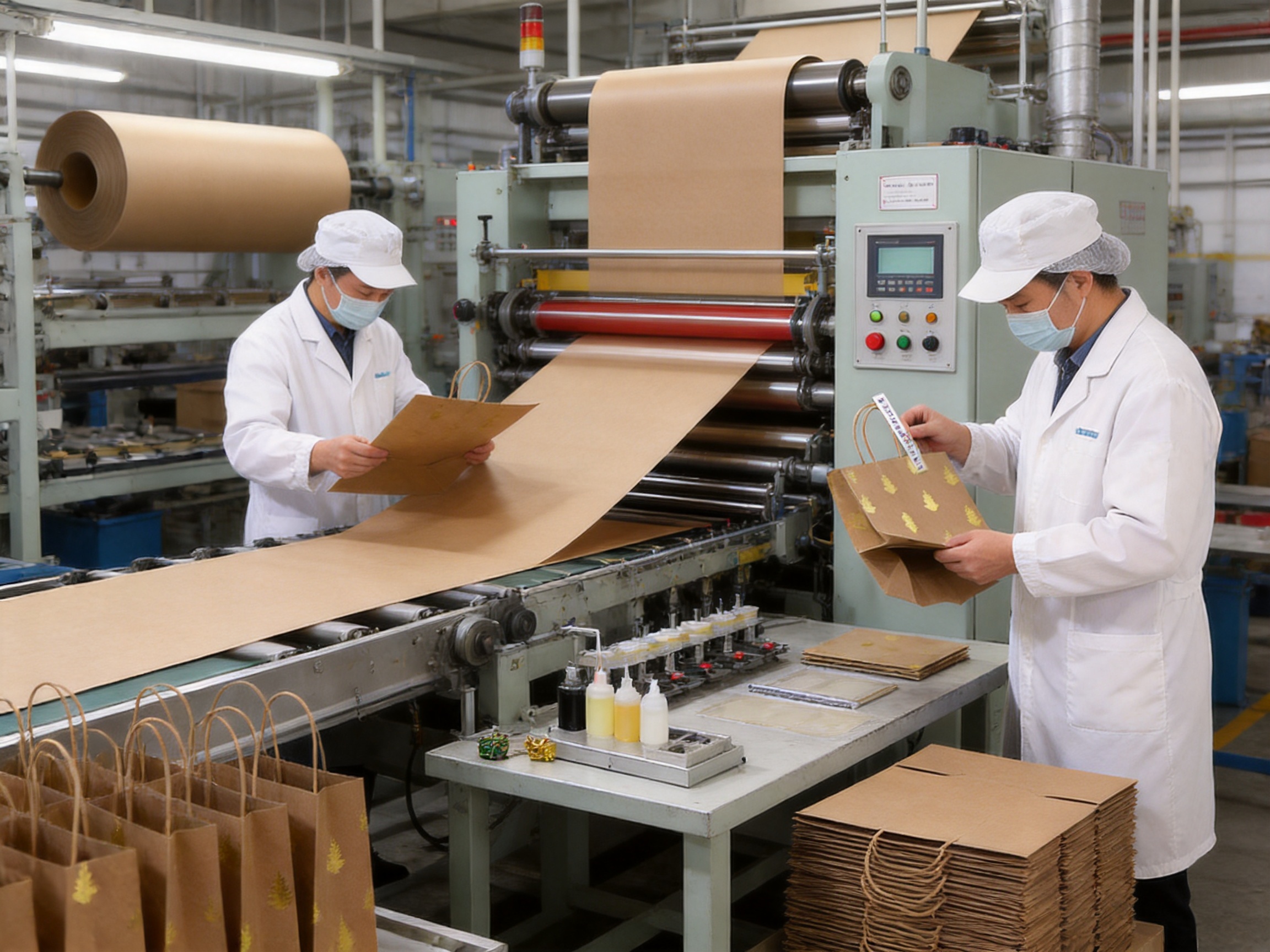
During bag making, the printed and creased paper is formed into a tubular structure, side seams are bonded, gussets are shaped, and the bottom is folded and secured. Handles are attached according to the approved construction. The attachment method should provide a reliable connection while maintaining the desired appearance.
Manual finishing may be used for selected steps, detailed assembly, special handles, decorative components, or smaller customized runs. Skilled manual work can be valuable when the design contains features that are not efficiently handled by a standard automated line. The most appropriate production method depends on order volume, bag construction, finishing requirements, and quality expectations.
8. Inspection, packing, and delivery preparation
Finished bags should be inspected for dimensions, print quality, folding accuracy, adhesive bonding, handle attachment, surface marks, and overall appearance. Sampling plans may be used for larger orders, while special or complex products may require more detailed inspection. Approved bags are then counted, packed, and prepared for shipment in a way that protects them from crushing, moisture, and contamination.
Factory control from raw materials through finished products helps support consistent quality and efficient delivery. It also gives wholesale buyers a central point of communication when they need revisions, repeat orders, or coordination with related paper products.
Manufacturing Strengths of the Supplier
Long-term paper-product experience
Magic Tree traces its manufacturing history to the establishment of Fushida Plastic Factory in 1996 and its later rebranding as Magic Tree Paper Products Co., Ltd. in 2019. This history represents nearly three decades of experience in manufacturing packaging and paper products. Long-term production experience can support more practical recommendations because the factory has encountered a broad range of materials, structures, printing requirements, and finishing challenges.
Experience is especially valuable when a customer’s desired result must be balanced against cost, lead time, and manufacturing feasibility. A supplier that understands the relationship between design and production can help identify potential problems before they become expensive corrections.
Integrated production capabilities
The company’s in-house capabilities include design, prepress, laminating, hot stamping, creasing, printing, bag making, and manual finishing. This integrated structure can reduce the number of separate suppliers involved in a project. It also allows the production team to coordinate the sequence of processes more effectively.
For buyers, integrated production may simplify sample approvals, artwork revisions, quality discussions, and repeat ordering. When the same organization manages multiple stages, it can maintain better visibility of the approved specification. This is useful for packaging programs that include both simple kraft bags and more decorative gift products.
Own-factory management
The company operates its own factory and manages the production process from raw materials to finished products. Factory ownership or direct factory management can offer greater transparency regarding production scheduling, process control, and quality responsibility. It may also improve communication when customers need adjustments to materials, quantities, finishing, or delivery arrangements.
Direct production management does not remove the need for clear specifications and inspection. However, it can create a stronger foundation for consistent manufacturing than an arrangement in which a supplier outsources every major process without close control.
International customer experience
Magic Tree serves customers in the United States, Canada, Mexico, the United Kingdom, Japan, and China. Experience across different markets can help the company understand varied packaging expectations, design preferences, communication styles, and commercial requirements. Export-oriented production also requires attention to packaging protection, documentation, scheduling, and coordination with international buyers.
Customers should still confirm all destination-specific requirements, including labeling, material claims, customs documentation, safety expectations, and recycling communication. International experience is a useful advantage, but the final responsibility for market compliance should be addressed during project planning.
Production scale and service capacity
The company reports an annual output value exceeding 50 million yuan. This indicates substantial production activity and provides a basis for serving wholesale customers that need repeat supply or coordinated product programs. Scale can support material purchasing, equipment utilization, production scheduling, and the ability to manage several packaging categories.
At the same time, a good supplier should match production scale with the needs of each project. Some buyers need large standardized orders, while others require smaller customized runs, seasonal editions, or mixed packaging products. Flexible communication about order size and production planning helps determine the most efficient approach.
Applications Across Retail and Gifting
Retail stores and boutiques
Clothing stores, shoe shops, accessory retailers, cosmetics stores, bookstores, and lifestyle boutiques can use handled kraft bags for customer purchases. The bag’s printed surface reinforces store recognition while providing a convenient way to transport the product. A consistent bag design can help create a unified retail experience across physical stores, pop-up locations, and events.
Gift shops and seasonal businesses
Gift shops often require several bag sizes because their merchandise ranges from small souvenirs to larger gift sets. Kraft paper bags can support everyday purchases and seasonal campaigns. Businesses may print a permanent logo on one side and use a changeable seasonal design on the other, or create separate editions for holidays and special occasions.
Food and specialty products
Bakeries, cafés, confectionery stores, tea retailers, and specialty-food businesses may use paper bags for boxed or wrapped items. The appropriate paper and construction should be selected according to the product, moisture exposure, temperature, and food-contact requirements. The bag itself should not be treated as automatically suitable for direct food contact unless the complete specification has been evaluated.
Corporate events and promotional programs
Handled paper bags can carry brochures, samples, notebooks, apparel, and promotional gifts at conferences, exhibitions, company celebrations, and product launches. They provide visible branding while helping attendees transport event materials. Event-specific printing can include dates, locations, campaign messages, and partner logos.
Online order collection and local delivery
Retailers offering local pickup or short-distance delivery can use printed kraft bags to maintain a professional presentation when the customer receives an online purchase. The bag may also serve as a useful secondary marketing tool when carried in public or reused after the order is complete.
Specification Guide for Wholesale Buyers
The following table summarizes common specification areas that should be discussed before production. The final selection depends on the product, brand identity, handling conditions, quantity, and budget.
| Specification area | Common choices | Why it matters |
|---|---|---|
| Paper appearance | Natural brown kraft, white or light-colored paper, printed surface | Determines the visual character and influences color reproduction. |
| Bag size | Small, medium, large, or custom dimensions | Must accommodate product dimensions and carrying requirements. |
| Gusset depth | Narrow, medium, or wide side gussets | Controls internal capacity and affects the bag’s proportions. |
| Handle type | Twisted paper, flat paper, rope, ribbon, or decorative cord | Affects comfort, style, load performance, and cost. |
| Printing | One-color, multi-color, partial coverage, or full coverage | Supports branding, product information, and campaign graphics. |
| Finishing | None, laminating, hot stamping, special decoration | Adds surface effects but may influence cost and material claims. |
| Reinforcement | Standard construction or reinforced handle and bottom areas | Helps match the bag to the expected product weight and handling. |
| Order planning | Initial run, seasonal order, repeat production, or mixed program | Influences material planning, production scheduling, and inventory. |
Quality Control Considerations
Appearance inspection
Appearance inspection should check the overall shape, color consistency, print sharpness, fold alignment, handle position, and cleanliness. A bag may meet its basic dimensions but still appear unsuitable if the logo is poorly positioned or the printed colors vary noticeably between panels. Visual consistency is important when bags are displayed together in a store or distributed at a public event.
Structural inspection
Structural checks may include measuring the bag, opening and closing the gussets, reviewing the bottom construction, and examining the handle attachment. Where appropriate, samples can be tested with a representative load. The test load should reflect the actual application rather than an unrealistic maximum.
Adhesive and finishing inspection
Side seams and bottom folds should remain bonded during ordinary handling. If laminating or hot stamping is used, the finish should be checked for lifting, cracking, incomplete coverage, or misalignment. Manual finishing components should be securely attached and consistently positioned.
Packaging for shipment
Finished paper bags can be vulnerable to moisture, crushing, and surface abrasion during transportation. Appropriate inner packing and outer cartons help protect the products before they reach the buyer. Wholesale customers should discuss carton quantities, palletization, storage conditions, and shipping marks when planning large orders.
How to Select the Right Bag for a Product
Start by measuring the product in its final packaged form. Include any box, tissue, insert, protective wrap, or secondary container that will be placed inside the bag. The bag should provide enough clearance for easy loading without excessive empty space. Overly tight dimensions can damage the product or make the bag difficult to use, while excessive space can make the package look unstable.
Next, estimate the filled weight. Consider whether customers will carry one item or several items together. If the product is dense, fragile, or irregularly shaped, discuss reinforcement and handle options with the manufacturer. A heavier paper grade may be useful, but the bottom and handle structure must also be designed for the load.
Then determine the desired visual language. Natural kraft can support an understated, handmade, or environmentally conscious appearance. White or coated paper may better suit detailed color graphics. Special finishing can create a more luxurious look, but it should be balanced against the budget and the desired material profile.
Finally, decide whether the packaging will be a permanent stock item or a campaign-specific product. Permanent bags should use artwork that remains relevant over time. Seasonal bags may use more expressive graphics but require better inventory planning. A manufacturer with printing, bag making, and related paper-product capabilities can help coordinate these decisions.
Ordering and Communication Process
Prepare a complete project brief
A useful project brief should state the bag category, approximate size, paper preference, handle style, printing requirements, finishing, estimated quantity, destination market, and expected delivery timing. Reference images can communicate style, but technical details are still necessary for an accurate quotation and sample.
Approve artwork and samples carefully
Artwork approval should cover every printed panel, color, logo position, text element, and finishing detail. A physical sample or production proof can reveal differences that are difficult to see on a screen. Buyers should inspect the sample when the bag is opened, filled, carried, and displayed, not only when it is lying flat.
Confirm tolerances and inspection expectations
Custom paper products naturally involve manufacturing tolerances. Customers should discuss acceptable variation in dimensions, color, handle position, and print registration before mass production. Clear inspection criteria make it easier for both parties to evaluate the finished order objectively.
Plan repeat orders in advance
Repeat orders may require the same paper, ink colors, handle materials, and finishing conditions as the original production. Keeping an approved sample and accurate artwork record can support consistency. Seasonal customers should allow enough time for design approval, material preparation, production, inspection, and international delivery.
Q&A
What are cheap kraft paper gift bags with handles used for?
They are used for everyday retail purchases, gift presentation, events, promotional distribution, local pickup, boutiques, specialty stores, and seasonal packaging. Their main benefits are convenient carrying, recognizable paper appearance, customizable printing, and practical cost control.
Can the bags be printed with a company logo?
Yes. A logo can generally be printed on one or more panels, together with a slogan, message, illustration, or other artwork. The final printing method and color result depend on the selected paper, artwork, quantity, and desired coverage.
Are kraft paper bags recyclable?
Paper is widely recognized as a recyclable material, but the recyclability of a finished bag depends on its complete construction. Laminations, metallic treatments, mixed-material handles, adhesives, inks, and local recycling rules should be considered before making a specific claim.
Can the bag size be customized?
Yes. Custom width, height, and gusset dimensions can be developed for different products. Buyers should provide the product’s final packaged dimensions and approximate weight so that the bag structure can be matched to the intended use.
Which handle type is best?
There is no single best handle for every application. Twisted paper handles are practical and coordinate well with kraft paper. Flat paper handles may provide a simple appearance. Rope, ribbon, or decorative cord handles can create a more gift-oriented style. The choice should reflect load, comfort, appearance, and budget.
Can these bags include hot stamping or laminating?
Yes, special finishing such as laminating and hot stamping can be considered when compatible with the paper and structure. These treatments should be reviewed for appearance, cost, folding performance, adhesive bonding, and environmental communication.
What is the advantage of purchasing from a factory with in-house production?
An integrated factory can coordinate design, prepress, printing, finishing, bag making, and manual assembly. This may simplify communication, improve production visibility, support more consistent quality, and make it easier to coordinate related products such as gift boxes, greeting cards, and patterned wrapping paper.
Are kraft paper bags suitable for heavy products?
They can be suitable for selected heavier products when the paper grade, dimensions, bottom construction, handle attachment, and reinforcement are properly designed. Buyers should not assume that every kraft bag can carry heavy loads. Product weight and handling conditions should be reviewed before production.
Can the same supplier produce matching gift packaging?
Magic Tree manufactures paper bags, gift bags, gift boxes, greeting cards, and patterned wrapping paper. This allows buyers to discuss coordinated packaging programs that use related artwork, colors, materials, and finishing effects across multiple products.
What information should be included in an inquiry?
An inquiry should include the desired bag size, paper preference, handle type, artwork status, printing coverage, finishing requirements, estimated quantity, product weight, destination, and target delivery date. Photos or samples of similar packaging can also help communicate the expected style.
Conclusion
Custom kraft paper bags with handles offer a practical packaging solution for businesses that need useful carrying performance, visible branding, and controlled cost. Their natural paper appearance works across retail, gifting, events, specialty products, and promotional applications. Printing allows a basic carrier to become a communication tool, while size, handle, gusset, reinforcement, and finishing options provide flexibility for different products and market positions.
Compared with generic unprinted carriers, custom kraft bags provide stronger identity and presentation. Compared with complex rigid packaging, they can offer a more economical and storage-friendly format. Their suitability for recycling or reuse can also support packaging strategies that prioritize paper materials, provided the complete finished construction and local disposal conditions are considered accurately.
The manufacturing process is central to the final result. Design and prepress determine whether the artwork works on the three-dimensional bag. Printing, laminating, hot stamping, creasing, bag making, handle attachment, and manual finishing must be coordinated carefully. Inspection and shipment preparation then protect the product’s appearance and structure before delivery.
Yiwu Magic Tree Gift Bag Co., Ltd. combines long-term paper-product experience with in-house design, prepress, printing, finishing, converting, and manual assembly capabilities. Its own-factory production model and experience serving customers in several international markets provide a practical foundation for wholesale buyers. Businesses seeking custom paper packaging can use this type of integrated supplier to develop handled kraft bags and coordinate them with gift boxes, greeting cards, and patterned wrapping paper.
For the best result, buyers should provide complete specifications, approve artwork and samples carefully, confirm load requirements, review environmental claims accurately, and plan production schedules in advance. When these steps are followed, printed kraft paper gift bags can deliver an effective combination of function, presentation, customization, and commercial value.
References
1. Company-provided product information for custom kraft paper bags with handles, including product category, construction concept, printing applications, and image references.
2. Company-provided information regarding Yiwu Magic Tree Gift Bag Co., Ltd., its manufacturing history, product categories, factory capabilities, and international customer base.
3. General packaging design principles concerning paper-bag dimensions, gusset construction, handle attachment, bottom strength, printing preparation, and quality inspection.
4. General paper-packaging guidance concerning kraft paper characteristics, recycling considerations, mixed-material finishing, and responsible environmental communication.
5. General commercial printing and converting practices concerning prepress, color preparation, creasing, laminating, hot stamping, bag making, and manual finishing.