中文简体
 русский
 Français
 Español
 Deutsch
 عربى

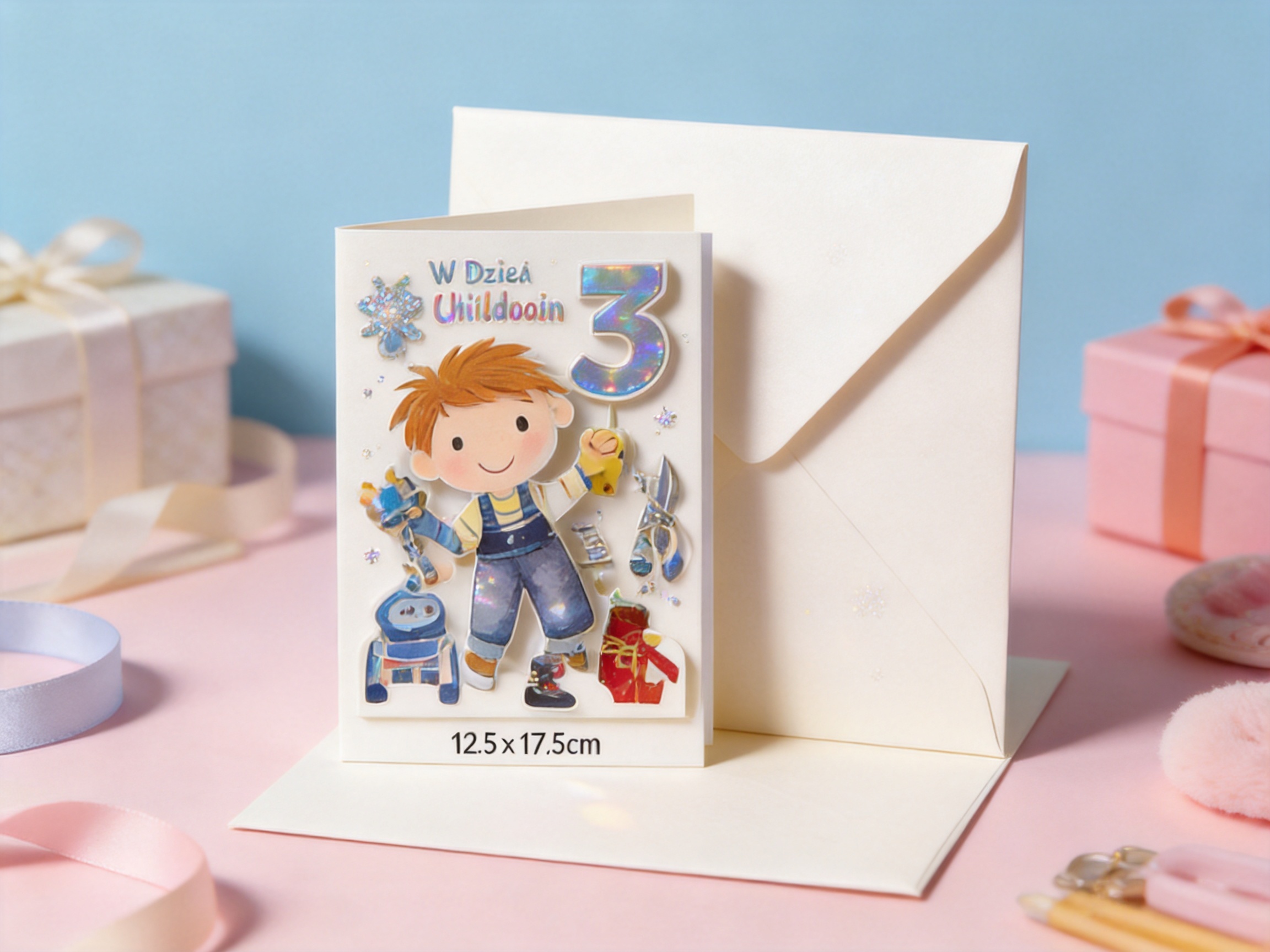
A greeting card can be a small product, but it often carries a large emotional purpose. It helps people express appreciation, celebrate a birthday, remember a shared experience, or add a personal message to a gift. The Happy Childhood Different Boy Gift Greeting Card is designed for exactly these moments. Its playful subject, dimensional paper details, decorative surface treatments, and practical card-and-envelope format make it more distinctive than a basic flat-printed greeting card.
At first glance, the card presents a cheerful childhood-inspired design featuring a different boy character. Its appeal comes from more than the printed illustration. The card uses 3D paper tips, holographic foil, and glitter to create additional visual and tactile interest. These details help the image stand out under changing light and give the recipient something to look at and feel, rather than offering only a flat printed surface.
The product is suitable for birthdays, children’s celebrations, family occasions, personal notes, gift bundles, and memory-themed stationery collections. It can be used by retailers, gift shops, stationery stores, department stores, online sellers, and brands looking for a greeting card with a more crafted appearance. It is also a suitable choice for buyers who want a modestly sized card that still feels special and carefully finished.
Product Overview
The Happy Childhood Different Boy Gift Greeting Card combines a practical writing format with decorative paper craftsmanship. The card measures 12 by 17 centimeters, providing a comfortable area for a handwritten message while remaining easy to store, display, package, and mail. The matching envelope measures 12.5 by 17.5 centimeters, giving the card enough clearance for smooth insertion without unnecessary pressure on the edges.
The design is based on a playful childhood theme. This makes the product especially appropriate for children’s birthdays, family celebrations, school-related occasions, friendship messages, and gift presentations. However, the design does not have to be limited to children. Adults who appreciate nostalgic artwork, cheerful stationery, or memory-inspired gifts may also find the card appealing.
The card includes three notable treatments: 3D paper tips, holographic foil, and glitter. These treatments work together to create contrast. Raised paper components introduce physical depth, holographic foil produces changing reflective highlights, and glitter adds a bright decorative accent. Used together, they give the card a more layered appearance than ordinary single-process printing.
| Product Name | Happy Childhood Different Boy Gift Greeting Card |
| Product Category | Greeting Card |
| Card Size | 12 x 17 cm |
| Envelope Size | 12.5 x 17.5 cm |
| Surface Treatments | 3D paper tips, holographic foil, glitter |
| Primary Theme | Childhood, playful memories, gifts, and celebrations |
| Recommended Uses | Birthdays, gift bundles, personal notes, children’s occasions, and retail stationery |
Why the Product Stands Out
Many greeting cards rely entirely on printed color to create visual appeal. Printing remains important, but a card with added material treatments can offer a more engaging experience. When customers pick up this card, they can notice the raised paper details and see how the reflective and glittered areas respond to light. That physical interaction helps distinguish it from inexpensive cards that look similar from a distance and offer little texture when handled.
The product’s first advantage is its layered presentation. The 3D paper tips create a raised effect that gives selected parts of the image additional prominence. Instead of appearing as one uninterrupted printed plane, the design has visible layers. This can make the illustration feel more animated and help guide attention toward important character or decorative elements.
The second advantage is its combination of visual treatments. Holographic foil and glitter create different kinds of brightness. Holographic foil can produce shifting highlights as the card moves, while glitter offers a concentrated sparkle. The two treatments can make the card appear lively on a retail display, under store lighting, or when opened by the recipient.
The third advantage is emotional flexibility. The childhood theme is cheerful without being restricted to one exact event. A buyer can use the card for a child’s birthday, a family member’s celebration, a school achievement, or a small gift accompanying a personal message. This broader use can make the product more practical for retailers that want stationery with multiple selling occasions.
The fourth advantage is its balanced size. A 12 by 17 centimeter card is large enough for a meaningful message but not so large that it becomes inconvenient to package. The envelope is proportioned to the card, helping protect it during handling and making the complete product look orderly when placed in a gift set or on a display shelf.
The fifth advantage is its keepsake quality. Cards with dimensional and decorative finishes are more likely to be saved as reminders of an event. A recipient may place the card on a desk, shelf, noticeboard, or memory box because the surface details give it value beyond the written message. For retailers, this quality can support a stronger emotional position than a disposable note card.

Happy Childhood Different Boy Gift Greeting Card
Design and Tactile Experience
The physical experience of a greeting card begins before the recipient reads the message. It starts when the card is lifted from a display, removed from its envelope, or passed from one person to another. Surface treatment influences that first impression. The raised components on this product provide a noticeable difference in texture and help communicate that the card has received additional finishing work.
Three-dimensional paper tips are especially useful for designs based on characters, clothing, accessories, decorative shapes, or playful scenes. The raised pieces can create separation between foreground and background elements. That separation gives the design a sense of depth and makes it easier for viewers to recognize the central subject.
The tactile effect is also valuable for gift-giving. A person who receives a card with textured details may spend more time examining it. The act of touching the raised areas can make the card feel more personal and crafted. This is particularly appropriate for childhood-themed products, where layered paper and bright details support a sense of play and discovery.
Holographic foil adds another visual dimension. Its reflective quality changes according to the viewing angle and available light. A card can look different when viewed straight on, tilted slightly, or displayed under bright retail lighting. This movement helps attract attention without requiring an oversized format.
Glitter contributes a familiar celebratory effect. It can emphasize stars, accents, borders, clothing details, or other decorative parts of the illustration. When carefully applied, glitter adds sparkle while allowing the central image and message area to remain clear. The result is decorative but still functional as a greeting card.
The combination of raised paper, foil, and glitter must be handled with care during production. Each treatment has its own application requirements, and the alignment between printed artwork and finishing elements affects the final appearance. A controlled manufacturing process is therefore important to ensure that the decorative treatments support the design rather than overwhelm it.
Practical Format for Messages and Gifts
A greeting card must do more than look attractive. It also needs to provide enough space for the sender to write naturally. The 12 by 17 centimeter format offers room for a short greeting, a personal memory, a birthday wish, or a longer note. It avoids the cramped feeling associated with very small cards while remaining compact enough for everyday gifting.
The card size can support several writing styles. A buyer may write only a few lines and leave the rest of the interior open, or use more of the available space for a detailed message. Parents, relatives, friends, teachers, and gift-givers can all adapt the card to their own communication style.
The 12.5 by 17.5 centimeter envelope is slightly larger than the card. This proportion is important because it allows the card to slide inside without excessive bending, rubbing, or pressure. The extra space also helps preserve the finished surface, especially when the card includes raised components, foil, or glitter.
For retailers, the coordinated envelope makes the item easier to merchandise as a complete product. The card does not require a separate envelope purchase, and the set can be placed directly in a display rack, gift section, or stationery assortment. For consumers, the matched format simplifies preparation for a birthday or other occasion.
The product can also be included in small gift bundles. It may accompany toys, books, children’s accessories, craft products, party items, or family gifts. Its moderate size allows it to fit into many presentation formats without taking up excessive space. The card can therefore function as both a standalone stationery product and an accessory that increases the emotional value of another purchase.
Suitable Occasions and Target Customers
Children’s Birthdays
The playful childhood theme makes the card an obvious choice for children’s birthdays. Parents and relatives can use it with wrapped gifts, party packages, or birthday money. The bright finishing details help it look festive, while the writing area allows the sender to include a personal message that a child can keep and revisit.
Family Celebrations
The design can also be used for family occasions where the message is more important than the formal event. A grandparent may send the card to a child, or a family member may include it with a small surprise gift. The childhood imagery can reinforce feelings of affection, happiness, and shared memories.
Friendship Messages
Not every greeting card needs to mark a major event. Friends can use this product to send encouragement, congratulations, thanks, or a simple message of appreciation. The cheerful design gives the sender a friendly presentation without making the message feel overly formal.
Gift Bundles and Retail Sets
Gift shops and online sellers can include the card in themed bundles. It can be paired with wrapping paper, a gift bag, a small toy, or another paper product. Because the card already contains multiple decorative finishes, it can add a premium touch to a modest gift set.
Memory and Nostalgia Collections
Retailers that sell nostalgic stationery may find the childhood theme useful for collections focused on memories, family, school days, or playful illustrations. The tactile finish supports this positioning because the card feels more like a small decorative object than a purely functional piece of paper.
Advantages Compared with Standard Greeting Cards
Standard flat-printed greeting cards can be economical and effective, but they often compete mainly through artwork, color, and price. A card with layered paper and special finishing has additional points of difference. These features can help retailers create a more varied product range and provide consumers with a reason to select one design over another.
One advantage is stronger shelf presence. Reflective foil and glitter can catch the eye when several cards are displayed together. The raised paper details may also be visible from the front of a rack or counter. This can help the card stand out in a crowded stationery section.
Another advantage is perceived craftsmanship. Consumers often associate multiple finishing techniques with greater attention to detail. While production quality remains essential, the presence of layered and reflective elements can make the card feel more considered and gift-worthy.
A third advantage is the tactile memory created by the product. A flat design is viewed, read, and put away. A card with texture can also be touched and explored. That extra sense may increase the recipient’s emotional connection to the item, particularly when the card is saved after the occasion.
A fourth advantage is merchandising flexibility. The product can be positioned in children’s stationery, birthday accessories, family gifts, decorative paper goods, or premium greeting card sections. It does not depend on only one retail category. This flexibility can help buyers build collections that serve different customer groups and seasonal occasions.
A fifth advantage is the relationship between design and format. The card is large enough to provide a useful writing area, but it remains easy to envelope and package. This balance makes it practical for both personal users and commercial sellers.
| Feature | Value to the Recipient | Value to the Retailer |
| 3D paper tips | Creates a raised, touchable design | Provides a visible point of difference |
| Holographic foil | Adds changing reflective highlights | Improves attention on displays |
| Glitter | Creates a festive and playful sparkle | Supports birthday and celebration merchandising |
| 12 x 17 cm card | Provides practical writing space | Fits common gift and stationery formats |
| 12.5 x 17.5 cm envelope | Allows easier insertion and protection | Creates a complete ready-to-sell set |
| Childhood theme | Encourages emotional and nostalgic use | Supports several customer and occasion categories |
Manufacturing Expertise Behind the Product
The appearance of a finished greeting card is closely connected to the manufacturing system behind it. Paper selection, printing accuracy, finishing control, folding, inspection, and packing all influence the final customer experience. A supplier with broad in-house capabilities can coordinate these stages more effectively than a fragmented production arrangement.
Magic Tree Gift Bag Co., Ltd. has experience in paper packaging and paper gift products dating back to 1996, when the business operated as Fushida Plastic Factory. The company was rebranded in 2019 as Magic Tree Paper Products Co., Ltd. This history represents nearly three decades of manufacturing experience across paper-based products and related packaging processes.
The company specializes in white cardboard, coated paper, and kraft paper products. Its product range includes paper bags, gift bags, gift boxes, greeting cards, and patterned wrapping paper. This broad category knowledge is relevant to greeting card production because it connects the card with the wider gift presentation system in which it is commonly used.
Manufacturing paper products requires careful control of material behavior. Different paper grades respond differently to ink, pressure, folding, adhesive, foil, and glitter. Experience with multiple paper categories helps a manufacturer select and process materials according to the intended appearance and use.
Design and Prepress
Professional design and prepress are important at the beginning of production. Artwork must be prepared for the selected paper, printing method, and special treatments. Areas intended for foil, glitter, or raised paper components must be clearly separated and aligned with the printed image.
Accurate prepress preparation helps reduce registration errors. It also helps ensure that the decorative elements appear in the correct positions and that the writing area remains usable. For a character-based design, small alignment differences can affect facial features, clothing details, accessories, or the overall balance of the illustration.
In-house design and prepress capabilities allow production teams to communicate more directly. Changes can be reviewed with manufacturing requirements in mind, rather than being passed between unrelated suppliers. This can support smoother development and more consistent results between approved artwork and finished cards.
Printing
Printing establishes the color foundation of the greeting card. It defines the background, character, decorative shapes, and visual contrast needed for the finishing treatments. A well-controlled printing stage helps ensure that the card remains readable and attractive before the additional processes are applied.
Printing quality also affects how foil and glitter are perceived. If the underlying colors are inconsistent, the reflective and sparkling treatments may not appear balanced. Stable color production therefore contributes to both the basic image and the premium appearance of the completed product.
Laminating
Laminating can contribute to surface protection and presentation, depending on the selected material and structure. It may help support a smooth surface, enhance visual depth, or improve resistance to ordinary handling. The precise application must be coordinated with subsequent finishing steps so that the card retains the desired texture and appearance.
Hot Stamping and Foil Application
Hot stamping is a specialized process associated with metallic and holographic effects. It requires controlled heat, pressure, timing, and positioning. When correctly applied, foil can create crisp reflective details that add energy to the card design.
Holographic foil is particularly sensitive to viewing angle. The manufacturing process must place it accurately so that the intended areas catch light without interfering with text or important illustration details. This is another reason that prepress preparation and production inspection are important.
Creasing and Folding
Creasing prepares paper for clean folding. A suitable crease helps the card open smoothly and reduces the likelihood of uneven edges or unwanted cracking. It also contributes to a professional appearance when the card is placed inside the envelope.
Because this product includes decorative surface treatments, folding must be managed carefully. Excessive pressure or incorrect crease placement could affect raised elements, foil areas, or glittered sections. A coordinated process helps preserve the decorative work while delivering a card that functions properly.
Bag Making and Manual Finishing
The company also has capabilities in bag making and manual finishing. Although the featured product is a greeting card, experience with gift bags and other paper packaging is valuable because many greeting cards are sold as part of wider gift presentations.
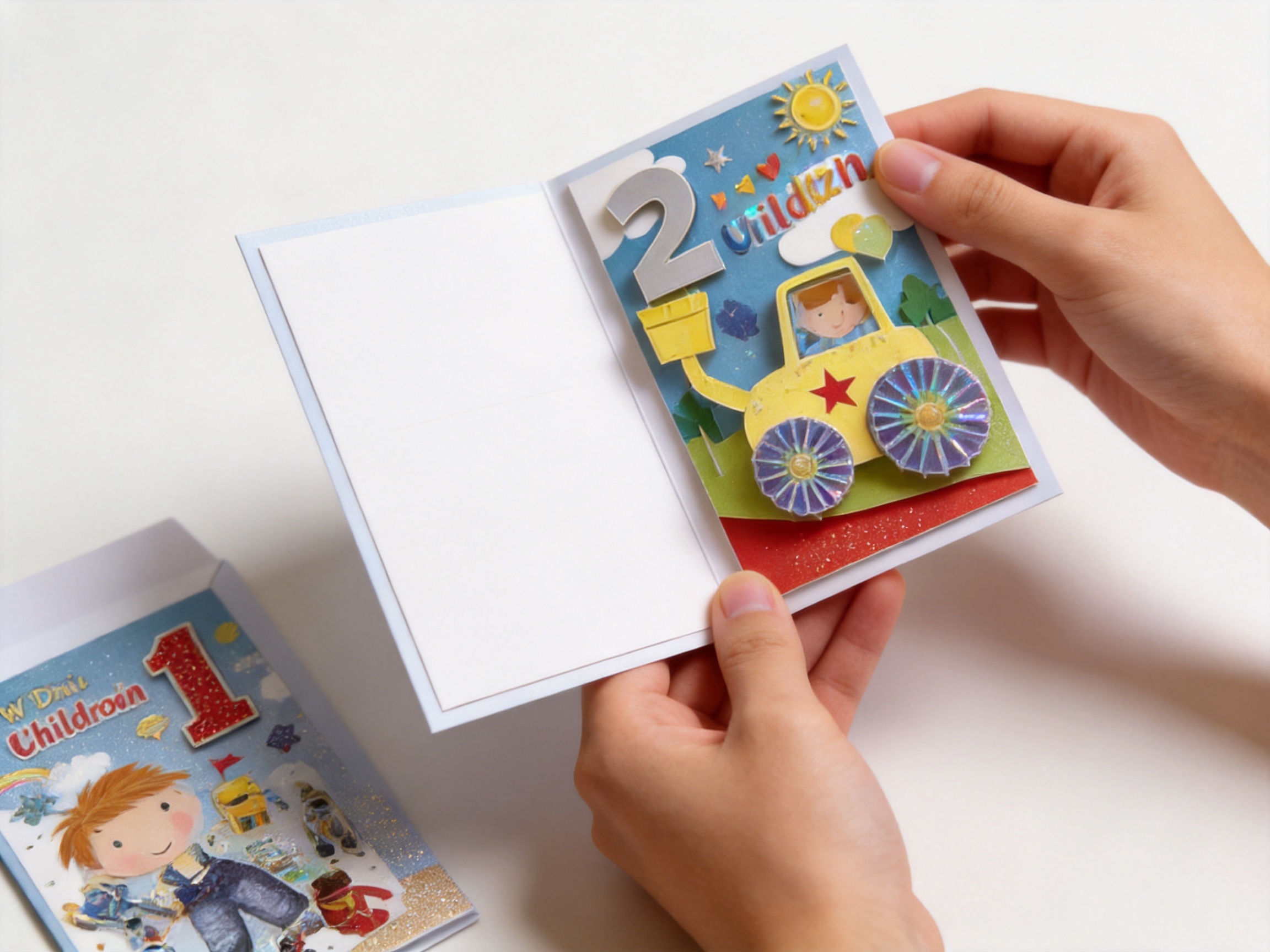
Manual finishing can be useful for products with layered or decorative details that require close visual attention. Workers can check the placement of components, remove obvious production irregularities, and prepare the card and envelope as a complete set. Manual work is especially relevant when the design contains three-dimensional paper tips or multiple surface treatments.
Integrated Production and Quality Control
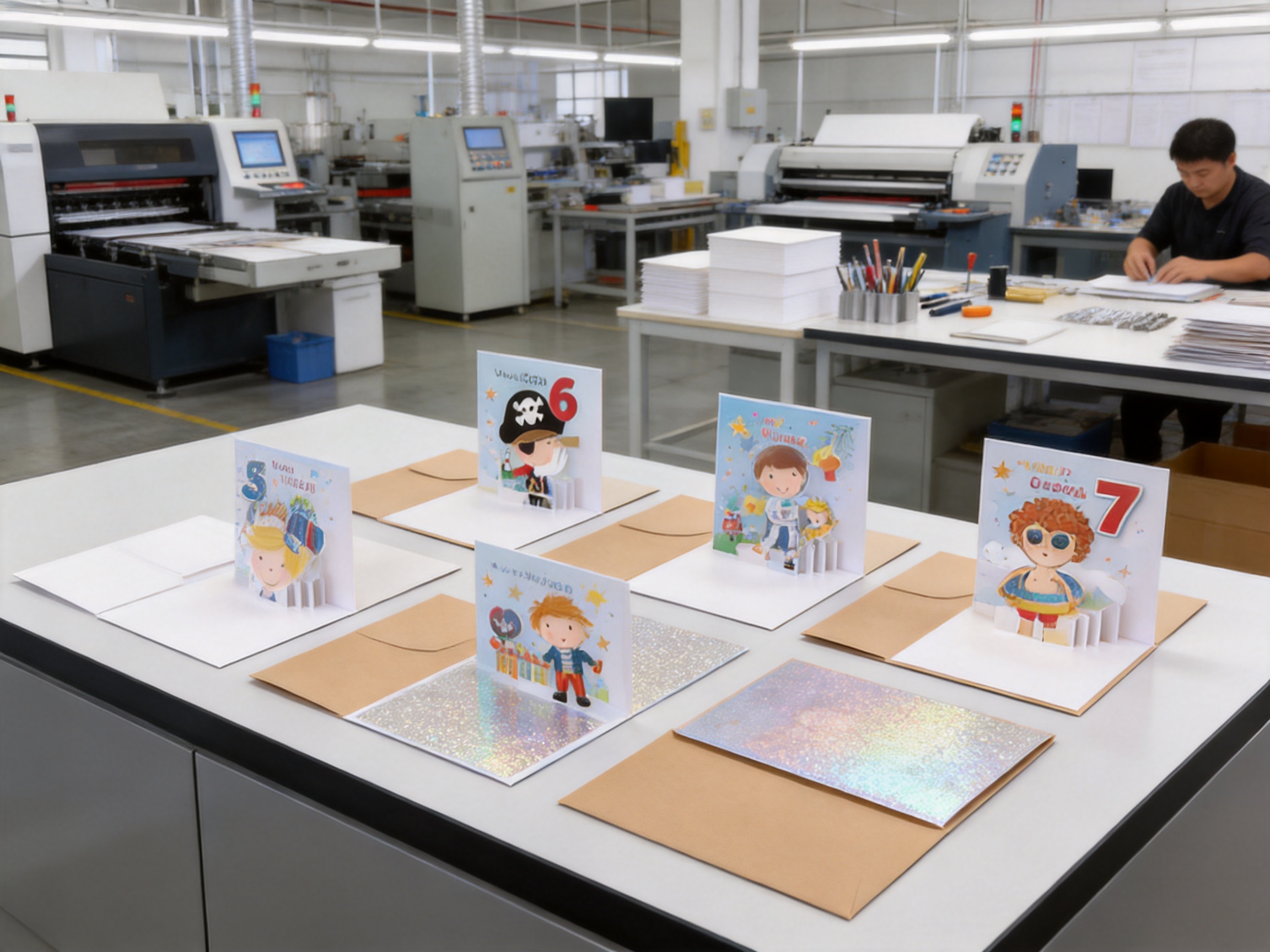
Magic Tree operates its own factory and manages production from raw materials to finished products. An integrated factory structure can provide several advantages. It allows production planning, material handling, printing, finishing, assembly, and packing to be coordinated within one manufacturing system.
For buyers, this may simplify communication. Instead of coordinating separate printing, finishing, assembly, and packaging suppliers, a customer can work with one experienced paper product manufacturer. This can make it easier to discuss specifications, approve samples, manage revisions, and organize delivery schedules.
In-house control can also support consistency. The same production team can observe how materials perform across multiple stages and identify issues earlier. If a paper surface reacts differently to a treatment than expected, the relevant departments can collaborate on an adjustment rather than waiting for information to move between unrelated companies.
Quality control for this greeting card should consider several areas. The card dimensions should remain within the agreed specification. The envelope should be correctly sized and suitable for the card. The printed artwork should be clear and appropriately aligned. The 3D paper tips should be securely placed. Holographic foil should appear in the intended locations, and glitter should be applied consistently to the designated areas.
Folding and edges also deserve attention. The card should open smoothly, and the finished edges should look clean. The envelope should not be excessively tight or loose. Packaging should protect the decorative surface during handling, storage, and transportation.
These checks are important because a greeting card is often purchased as a gift accessory. Customers expect it to arrive in presentable condition. A small issue on the front surface can be noticeable because the product is compact and decorative. Careful inspection therefore supports both customer satisfaction and retailer reputation.
Material and Sustainability Considerations
Paper products are increasingly evaluated not only for appearance and price but also for material responsibility. The company’s product range includes white cardboard, coated paper, and kraft paper, giving buyers options for different visual and packaging objectives. Material selection should be made according to the required strength, surface quality, print performance, finishing compatibility, and environmental goals.
The card format is paper-based and can be positioned within a broader paper stationery collection. Buyers seeking more environmentally considerate product lines should discuss paper grades, coatings, inks, adhesives, foil application, glitter composition, and packaging requirements during product development. Sustainability performance depends on the complete construction rather than on the word “paper” alone.
Eco-friendly product planning may include reducing unnecessary packaging, selecting suitable paper sources, optimizing the card size, and avoiding excess material. A compact card and envelope format can help keep the product practical and efficient. Retailers can also merchandise the card alongside reusable gift bags or recyclable paper packaging to create a more consistent product story.
Special effects require particular attention in sustainability discussions. Foil, glitter, laminates, adhesives, and layered paper components can affect recycling considerations depending on their quantity and construction. Buyers should request material details and production recommendations when environmental claims are important to their market. Clear communication helps ensure that product descriptions remain accurate and responsible.
Commercial Applications for Wholesale Buyers
Wholesale buyers can use this greeting card in several ways. A stationery distributor may include it in a children’s birthday assortment. A gift shop may place it near toys, wrapping paper, or small gifts. An online retailer may sell it individually or as part of a themed bundle. A department store may use it in a seasonal display focused on family celebrations.
The design’s broad emotional appeal can support different price positions. It can be presented as an accessible decorative card for everyday gifting or as a more finished item within a premium stationery range. The final position depends on packaging, retail presentation, order quantity, market expectations, and the broader assortment.
The card may also support cross-selling. A customer purchasing a gift bag can be offered a coordinating greeting card. A customer buying wrapping paper may be encouraged to add a card. A gift bundle can include the card as the personal communication element that completes the presentation.
For online sellers, photographs should show the front design, the surface depth, the foil effect, the glitter, the card size, and the envelope. Since tactile qualities are difficult to communicate digitally, product descriptions should explain the raised paper details and reflective finishes clearly. Accurate presentation helps customers understand why the card differs from a basic printed option.
For physical retailers, the card can be displayed under lighting that allows the holographic foil and glitter to catch attention. It may be arranged with other childhood, birthday, or gift-related products. A small sign describing the dimensional finish can help customers recognize the added value immediately.
Packaging and Presentation Benefits
A greeting card is often part of a larger presentation. The card may be placed inside a gift bag, attached to a package, or handed over with a present. Its design should therefore complement rather than compete with the gift itself. The childhood theme and decorative treatments make it suitable for cheerful and colorful presentations.
The matching envelope provides a clean outer layer. It protects the card during storage and gives the sender a simple way to prepare it for delivery. The slightly larger envelope also reduces the need to force the card into place, which can help preserve the front surface.
Retailers can use the card as an add-on product near checkout areas, gift-wrapping counters, children’s departments, or stationery shelves. Its relatively compact format makes it suitable for racks and tabletop displays. Because it serves both emotional and practical purposes, it can encourage impulse purchases when positioned near related gift products.
For brands and organizations, the card may also be considered as part of a broader paper goods collection. The company’s experience with gift bags, gift boxes, and patterned wrapping paper provides a foundation for coordinated product programs. A collection that uses related colors, themes, or finishing details can create a more unified retail appearance.
Ordering and Product Development Considerations
Wholesale buyers should define their requirements clearly before production. Important points may include the intended market, order quantity, card and envelope specifications, paper type, printing requirements, finishing treatments, packaging method, and delivery schedule.
It is useful to confirm whether the buyer wants the existing design or a customized version. Customization may involve artwork, colors, wording, dimensions, paper grades, packaging, or finishing combinations. Any change to the design should be evaluated for production suitability, particularly when it affects 3D paper tips, holographic foil, glitter, folding, or envelope fit.
Sample approval is an important stage. A physical sample allows buyers to evaluate color, texture, raised components, reflective details, glitter coverage, folding, and overall presentation. It also provides an opportunity to confirm that the card fits correctly inside the envelope.
Buyers should also consider how the product will be transported and stored. Decorative surfaces may need suitable protective packaging to reduce rubbing or pressure. Carton dimensions, inner packing, and stacking arrangements can influence the condition of the product when it reaches the warehouse or store.
Clear production documentation can help prevent misunderstandings. Specifications should identify the card size, envelope size, treatment areas, material requirements, packing method, and quality expectations. When the product is intended for several markets, labeling and packaging details should be reviewed for local requirements.
Why Manufacturing Experience Matters
Nearly thirty years of experience in paper product manufacturing can be valuable when a product combines printing, paper construction, and decorative finishing. Experience helps teams understand how different materials behave and how production stages affect one another.
A company with capabilities covering design, prepress, laminating, hot stamping, creasing, printing, bag making, and manual finishing can approach the product as a complete paper item. This is useful for buyers who need more than a single printed sheet. The manufacturer can consider the card’s appearance, handling, envelope fit, packaging, and relationship to other gift products.
The company serves clients in the United States, Canada, Mexico, the United Kingdom, Japan, and China. Experience with customers across several markets can support awareness of different retail expectations, packaging styles, communication requirements, and product presentation preferences.
The company reports an annual output value exceeding 50 million yuan and emphasizes high-quality, eco-friendly, and customized paper packaging solutions. For wholesale customers, production scale can be relevant because it may support larger programs, repeat orders, and coordinated product collections. The appropriate supplier choice should still be based on confirmed specifications, samples, quality standards, capacity, and delivery requirements.
Recommended Product Positioning
The Happy Childhood Different Boy Gift Greeting Card can be positioned as a decorative and tactile alternative to ordinary flat greeting cards. Its main selling message should focus on the combination of a playful childhood design, useful writing space, matching envelope, raised paper details, holographic foil, and glitter.
For children’s retail, the card can be positioned as a bright birthday accessory. For gift shops, it can be presented as a thoughtful addition to small presents. For stationery collections, it can represent a more dimensional and decorative style. For nostalgic ranges, it can emphasize memory, childhood, and keepsake value.
Product descriptions should remain specific. Rather than making broad claims about quality, sellers can explain what the customer can actually see and feel: the card measures 12 by 17 centimeters, the envelope measures 12.5 by 17.5 centimeters, and the front includes 3D paper tips, holographic foil, and glitter. Clear descriptions build confidence and help distinguish the item from standard printed cards.
Frequently Asked Questions
What is the main theme of the greeting card?
The card features a happy childhood-inspired design centered on a different boy character. Its playful appearance makes it suitable for birthdays, children’s celebrations, family messages, friendship notes, and gift presentations.
What are the dimensions of the card?
The card measures 12 by 17 centimeters. This gives the sender enough room for a personal message while keeping the product compact for storage, display, and gift packaging.
What size is the envelope?
The envelope measures 12.5 by 17.5 centimeters. It is slightly larger than the card so that the card can be inserted more easily and with less risk of bending the edges.
What finishing treatments are used?
The product uses 3D paper tips, holographic foil, and glitter. These treatments create raised texture, reflective highlights, and sparkling decorative accents.
Is the card suitable only for children?
No. Although the childhood theme is especially appropriate for children’s birthdays and family occasions, adults may also use it for nostalgic messages, friendship notes, gift bundles, and cheerful personal communication.
How does it differ from a standard flat-printed card?
The card offers a more layered and tactile presentation. Raised paper details can be felt, while holographic foil and glitter add changing reflective and sparkling effects that are not usually available on a basic flat-printed design.
Can it be included in a gift bundle?
Yes. Its compact format makes it suitable for bundles with toys, books, gift bags, wrapping paper, small accessories, or other children’s and family-oriented products.
What manufacturing capabilities support this product?
The manufacturer’s capabilities include design and prepress, laminating, hot stamping, creasing, printing, bag making, and manual finishing. These processes support the production of printed and specially finished paper products.
Does the company manufacture other paper products?
Yes. The company manufactures paper bags, gift bags, gift boxes, greeting cards, and patterned wrapping paper using materials such as white cardboard, coated paper, and kraft paper.
Why is an integrated factory useful for buyers?
An integrated factory can coordinate materials, printing, finishing, assembly, inspection, and packing within one production system. This may simplify communication and support more consistent results across the finished product.
Can buyers request customization?
The company specializes in customized paper packaging solutions. Buyers should discuss artwork, dimensions, paper type, treatments, packaging, quantities, and delivery requirements before production. A physical sample is recommended for approval when decorative finishing is involved.
What should buyers check before placing an order?
Buyers should confirm card and envelope dimensions, paper specifications, artwork, finishing treatments, color expectations, sample approval, packing method, order quantity, production schedule, and delivery arrangements.
Conclusion
The Happy Childhood Different Boy Gift Greeting Card is designed to make a small written message feel more memorable. Its 12 by 17 centimeter format provides useful writing space, while the 12.5 by 17.5 centimeter envelope supports easy insertion and presentation. The childhood-inspired design gives the card a cheerful emotional character, and the combination of 3D paper tips, holographic foil, and glitter creates a more engaging surface than ordinary flat printing.
For consumers, the card offers a thoughtful way to celebrate birthdays, share family affection, encourage a friend, or complete a small gift. For retailers and wholesale buyers, it offers several merchandising possibilities across children’s stationery, gift accessories, birthday products, nostalgic collections, and decorative paper goods.
The product is supported by a manufacturer with nearly three decades of paper product experience and capabilities covering design, prepress, printing, laminating, hot stamping, creasing, bag making, and manual finishing. Its own factory and integrated production system provide a practical foundation for coordinating materials, decorative treatments, quality control, and packaging.
By combining playful design, tactile detail, reflective finishing, practical dimensions, and experienced paper manufacturing, this greeting card occupies a useful position between everyday stationery and a small keepsake. It is an approachable product with enough visual and physical character to make the act of giving and receiving a card feel more personal.
References
1. Product specification sheet for the Happy Childhood Different Boy Gift Greeting Card, including card size, envelope size, and surface treatments.
2. Company manufacturing profile for Magic Tree Gift Bag Co., Ltd., including product categories, production capabilities, and factory operations.
3. General paper product manufacturing principles concerning printing, creasing, laminating, hot stamping, manual finishing, and quality inspection.
4. Retail stationery and gift presentation practices concerning greeting cards, gift bundles, seasonal merchandising, and point-of-sale display.
5. Sustainable paper packaging considerations concerning paper selection, coatings, adhesives, decorative treatments, packaging reduction, and responsible product communication.